Table of Contents
Building an online store is no longer about simply listing products and accepting payments. Customers arrive with higher expectations than ever before, they compare multiple stores in minutes, and they leave without a second thought if something feels off. For business owners planning a new store or improving an existing one, knowing which eCommerce features to prioritize is the difference between a store that converts and one that collects traffic without revenue.
This blog covers the key eCommerce features your online business needs in 2026, explaining what each one does, why it matters, and how it affects your bottom line.
Quick Answer
The most important eCommerce features include a fast and secure checkout, mobile-optimized design, multiple payment options, product search and filtering, user reviews, real-time order tracking, and scalable infrastructure. Together, these features reduce drop-off, build trust, and give customers a reason to return. Missing even one of these can cost you sales.
Why Do User Reviews Matter More Than You Think?
Shoppers trust other shoppers. Before making a purchase, a large majority of online buyers read reviews, and stores with a rating below 4 stars lose a significant share of potential customers. User-generated reviews prove that real people bought the product and had an experience worth sharing.
# What Good Review Integration Includes
A well-built review system does more than collect star ratings. It should show verified buyer badges, allow photos and video submissions, surface the most recent reviews prominently, and respond to negative feedback publicly. This signals to new visitors that your store is active and that you care about customer experience.
Negative reviews handled well actually build trust. A store with only perfect scores looks suspicious. Authentic feedback, paired with a professional response, shows that your business is real and accountable.
# Platforms and Tools to Consider
Review integrations like Judge.me, Stamped.io, or platform-native review systems work well for most eCommerce stores. The key is choosing one that displays well on mobile, supports rich snippets for SEO, and sends automated review request emails after order fulfillment.
How Do Special Offers and Promotions Affect Conversions?

Discounts and promotional mechanics are a direct conversion tool, not just a way to clear inventory. When a shopper sees a time-limited offer or a first-order discount code, it creates a decision point that moves them closer to checkout. Without this trigger, many visitors browse and leave without acting.
# Types of Promotional Features to Build In
eCommerce solutions should support discount codes,%age-off deals, buy-one-get-one offers, bundle pricing, and free shipping thresholds. Each of these targets a different stage of the purchase decision. Free shipping at a certain cart value, for example, pushes customers to add one more item to qualify.
Header banners and sticky bars that promote active deals keep the offer visible throughout the browsing session. Pair this with an email capture pop-up offering a welcome discount, and you build a list while also recovering customers who might otherwise leave.
What Makes a Shopping Cart Work for Both Guests and Registered Users?
The shopping cart is where purchase decisions happen or fall apart. A cart that loses items on session expiry, forces account creation before checkout, or fails to show shipping costs upfront will push customers away at the worst possible moment.
# Guest Checkout is Non-Negotiable
Requiring account registration before checkout is one of the most common reasons for cart abandonment. Guest checkout removes that barrier entirely. Customers can complete their purchase in minutes, and you can invite them to create an account after the order is confirmed. This maintains a low-friction path to conversion without sacrificing your ability to build a customer list.
# Cart Persistence and Recovery
A well-built cart saves items across sessions. If a customer adds products on their phone and returns on a desktop later, the items should still be there. Paired with an abandoned cart email sequence, cart persistence gives you a second chance with shoppers who left before completing their order. This alone can recover 5% to 15% of abandoned sessions.
How Does Order Management Help You Fulfill Orders at Scale?
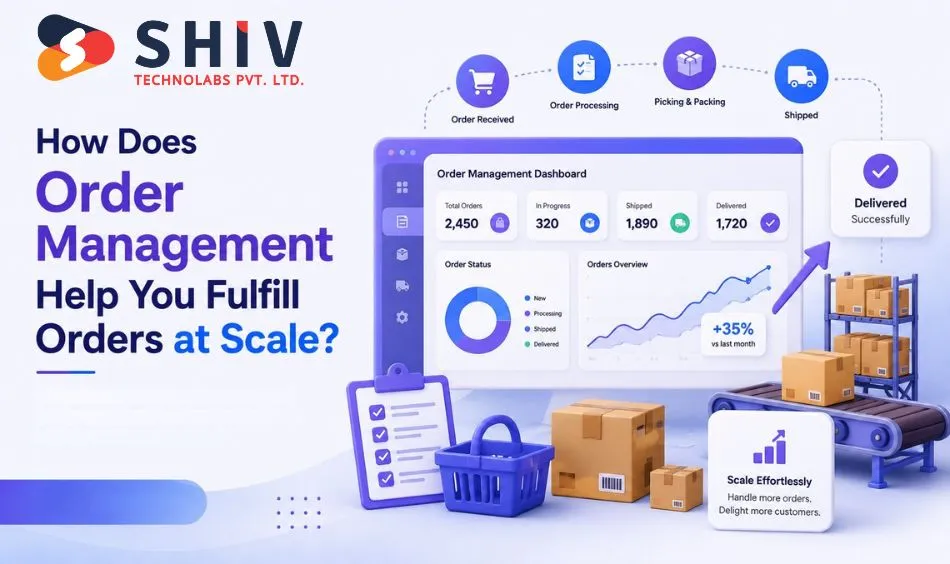
As your store grows, manually tracking orders across channels becomes unmanageable. A proper order management system gives you a centralized dashboard where every order is visible, and every action from confirmation to dispatch to refund is logged and traceable.
# What a Strong Order Panel Should Handle
Your order management system should process COD verification, handle return and refund requests, flag high-risk orders for review, and sync inventory in real time. When an item goes out of stock during a flash sale, the system should automatically prevent overselling rather than leaving you to deal with the fallout manually.
For businesses shipping across multiple regions, order management should also integrate with third-party logistics providers and generate shipping labels directly, reducing manual steps and the chance of errors at dispatch.
Which Payment Options Do Online Shoppers Expect?
Payment friction is one of the leading causes of checkout abandonment. Shoppers who reach the payment screen but cannot find their preferred method will leave without completing the order. Offering the right mix of payment options removes that final barrier.
# Standard Gateways and Local Options
For stores selling internationally, the standard set includes credit and debit cards through Stripe or Braintree, PayPal, and Apple Pay or Google Pay for mobile shoppers. For markets like India, UPI integration and net banking options matter. For the UAE and the Middle East, local card networks and digital wallets are expected. Build your payment gateway list based on where your customers are, not just what is easy to integrate.
# Buy Now, Pay Later is Growing Fast
BNPL options like Klarna, Afterpay, and Sezzle have shifted from a nice-to-have to a competitive necessity in many product categories. Shoppers who cannot afford the full amount upfront are more likely to convert when a BNPL option is available at checkout. This is especially true for higher-priced items like electronics, furniture, and fashion.
Why Is eCommerce Security a Feature, Not Just a Requirement?
Security affects conversions directly. Shoppers who see trust signals during checkout, such as an SSL padlock, recognizable payment logos, and a secure checkout badge, are more confident completing their purchase. Those who do not see these signals abandon carts at a higher rate.
# What Security Looks Like in Practice
Every page on your eCommerce site should run on HTTPS. Checkout pages must route through a PCI-DSS-compliant payment processor. Customer passwords should be hashed and never stored in readable form. Admin access should require two-factor authentication, especially for stores handling high transaction volumes.
Beyond technical security, your store needs a clear privacy policy, a visible returns policy, and contact information that customers can verify. These elements signal that a real business operates behind the store.
Is Your Store Designed for Mobile-First Shoppers?
More than 70% of global eCommerce traffic now comes from mobile devices. Stores that are not fully optimized for mobile lose a majority of their potential buyers before they even see a product. This is not a future consideration. It is a current requirement.
# What Mobile Optimization Actually Means
Responsive design adjusts your store layout automatically based on screen size. But real mobile optimization goes deeper. Tap targets should be large enough to click without zooming. Product images should load fast without sacrificing quality. Checkout forms should autofill where possible and minimize the number of steps required. A mobile-optimized store reduces friction at every step of the browsing and buying journey.
# Progressive Web Apps for Repeat Shoppers
For stores with a returning customer base, a Progressive Web App version of your store gives users an app-like experience without requiring a download. PWAs load faster, work offline in certain conditions, and support push notifications, all of which increase engagement and repeat purchase rates.
What Happens to Your Store When Traffic Spikes?
A store that crashes during a sale or a viral moment loses revenue and customer trust at the same time. Scalable infrastructure means your store can handle 10 times its normal traffic without slowing down or going offline, regardless of whether that spike was planned.
# CDN and Hosting Configuration
A Content Delivery Network distributes your store assets across servers in multiple regions, so customers in the US, UK, or Australia load your pages from the nearest server rather than a single origin point. This reduces load times significantly and keeps performance consistent globally.
Auto-scaling cloud hosting, available through providers like AWS and Google Cloud, adjusts server resources in response to traffic in real time. This prevents downtime during peak events while keeping infrastructure costs reasonable during low-traffic periods.
How Much Do Product Visuals Impact Purchase Decisions?
Online shoppers cannot hold a product. They rely entirely on images and video to assess quality, size, and fit. Stores with blurry, inconsistent, or single-angle product photos give shoppers no reason to trust the product they are considering.
# What High-Quality Product Imagery Requires
Product images should be high resolution with a zoom feature active on desktop and mobile. Multiple angles are standard. For fashion, lifestyle shots showing the product in use add context that flat product images cannot provide. For electronics and complex products, short explainer videos or 360-degree views reduce buyer uncertainty and return rates.
Image optimization for page speed is equally important. High-resolution images that slow page load times cost you the conversion before the customer even sees the product. Use modern formats like WebP and implement lazy loading so images load as the user scrolls rather than all at once.
Can Customers Find What They Are Looking For Quickly?
A store with 500 products and poor search functionality is harder to shop in than a physical store. Customers who cannot find what they want within a few seconds will go back to Google and click on a competitor. Smart search and filtering features keep visitors engaged and moving toward a purchase.
# Search Functionality That Works
Your search bar should return relevant results even when customers use partial terms, synonyms, or misspellings. Autocomplete suggestions reduce the typing burden and surface popular products immediately. For larger catalogs, AI-powered tools that learn from customer behavior improve result relevance over time.
# Filtering That Matches How Shoppers Think
Product filters should align with how customers actually search. For clothing, that means size, color, and price. For electronics, it means brand, specs, and compatibility. Filters should update product counts dynamically so customers know how many results they will see before applying them, which prevents the frustration of landing on a zero-result page.
Why Do Wishlist Features Improve Both Retention and Conversions?
Not every shopper is ready to buy immediately. A wishlist gives them a way to save products they are interested in without committing to a purchase. It also gives you a tool: when a wishlisted product goes on sale or runs low in stock, a triggered notification brings that customer back with a reason to buy.
# How Wishlists Connect to Email Marketing
When a customer saves items to a wishlist, that behavioral data is valuable. An email flow triggered by wishlist activity, such as a price drop alert or a low-stock warning, creates urgency without being pushy. Customers who saved a product were already interested. A well-timed follow-up converts that interest into revenue.
How Does Data Help You Make Better Business Decisions?
Selling online without tracking customer behavior is like driving without knowing where you are going. eCommerce analytics give you visibility into which products sell, which pages cause drop-off, where customers come from, and how your marketing channels perform relative to each other.
# What to Track and Why
At a minimum, your eCommerce analytics should track conversion rate by traffic source, cart abandonment rate, average order value, revenue by product category, and customer lifetime value. These metrics tell you where to invest in marketing, which products need better positioning, and where your checkout flow breaks down.
For stores using paid advertising, connecting your ad platform data with eCommerce analytics closes the loop between spend and revenue. Without this connection, you are spending on campaigns without knowing which ones actually drive sales.
Why Does Content Management Belong in Your eCommerce Feature List?
A CMS development solution gives your team the ability to update product descriptions, landing pages, banners, and blog content without needing a developer for every change. For fast-moving eCommerce businesses, this independence is essential.
# What a Good CMS Enables
With a properly configured CMS, your marketing team can run seasonal campaigns, update homepage banners for a flash sale, add new product categories, and publish SEO-optimized blog posts, all without touching code. The faster you can publish content, the faster you can respond to trends, competitor moves, and customer feedback.
What Are the Real Business Benefits of Getting eCommerce Features Right?
The features you build into your eCommerce store are not just technical checkboxes. Each one connects directly to a business outcome.
1. Global Reach With No Overhead Increase
An online store is open to buyers in every country where you can ship. You do not need a local office or sales team to serve international customers. The right store setup handles currency, language preferences, and regional payment options so your products reach buyers everywhere.
2. Revenue Around The Clock
A physical store closes. An eCommerce store does not. Customers in different time zones shop while your team sleeps, and orders are processed automatically. This passive revenue capability is one of the most significant operational advantages of running an online business.
3. Lower Customer Acquisition Cost Over Time
Organic search, email marketing, and returning customers all have lower costs per sale than paid advertising. A well-structured eCommerce store supports all three by making it easy to find, buy, and return. This compounds over time into a lower cost base and higher margins.
4. Data That Guides Every Decision
Every visit, add to cart, and abandoned session generates data. The businesses that use this data to improve their store, pricing, and marketing make better decisions faster than competitors who rely on guesswork.
5. Scalability Without Proportional Cost
Adding a new product to an online store costs almost nothing. Launching a new market requires configuration, not construction. This scalability is why eCommerce businesses can grow revenue significantly without the proportional cost increases of a physical retail model.
Building These Features Into Your Store? Shiv Technolabs Can Help.
Shiv Technolabs builds custom eCommerce solutions on Shopify, WooCommerce, Magento, and BigCommerce, with a track record across 250+ digital projects in industries ranging from fashion and electronics to food, wellness, and B2B supply.
Whether you are building a new store from the ground up or improving an existing one, the team at Shiv Technolabs works with you to identify which eCommerce features your business needs most and builds them to perform.
Conclusion
Running a successful online store takes more than a good product. The eCommerce features you build into your platform determine whether customers trust you, stay long enough to browse, and actually complete a purchase.
From a secure and fast checkout to mobile-optimized design, smart product search, user reviews, and scalable infrastructure, every feature on this list serves a specific purpose. Together, they create the kind of shopping experience that converts first-time visitors into paying customers and paying customers into repeat buyers.
The good news is that you do not have to build everything at once. Start with the features that remove the biggest barriers to purchase, then layer in retention and analytics tools as your store grows.
If you are planning a new eCommerce store or looking to improve the one you already have, contact Shiv Technolabs today!
FAQs
What are the must-have features for an eCommerce website in 2026?
The non-negotiable features are mobile-optimized design, secure checkout with multiple payment options, product search and filtering, user reviews, real-time order tracking, and scalable hosting. These directly affect conversion rate and customer retention.
How many payment gateways should an eCommerce site support?
At a minimum, support cards, PayPal, and one mobile wallet like Apple Pay or Google Pay. For international stores, add BNPL options and region-specific gateways based on where your customers are located.
Does guest checkout really improve conversions?
Yes. Forcing account creation before checkout is one of the top reasons customers abandon their cart. Offering guest checkout removes that barrier and typically improves checkout completion rates by a measurable margin.
How important is mobile optimization for eCommerce?
It is critical. More than 70% of eCommerce traffic comes from mobile devices. If your store loads slowly, displays incorrectly, or has difficult-to-tap checkout fields on mobile, you are losing the majority of your potential buyers.
What is the role of a CMS in an eCommerce store?
A CMS lets your team update product pages, banners, blog content, and promotions without developer help. This speed and independence is essential for responding quickly to trends, running campaigns, and keeping content fresh for SEO.
How does eCommerce analytics improve sales?
Analytics shows you which products sell, which pages cause drop-off, and which marketing channels bring paying customers. Without this data, you are making decisions based on assumptions. With it, you can improve your store based on what shoppers actually do.
Can small businesses afford to build all these features?
Not all features need to be built at once. A phased approach, starting with the core checkout, mobile design, and payment integrations, then adding reviews, wishlists, and analytics tools over time, makes it manageable. Platforms like Shopify also offer many of these as built-in or low-cost add-ons.
What eCommerce platform should I choose for my online store?
It depends on your product type, order volume, and customization needs. Shopify suits most small to mid-size businesses. WooCommerce works well for businesses already on WordPress. Magento is suited for high-volume or complex catalogs. BigCommerce is a strong option for B2B and multi-channel selling.