Table of Contents
The current transformation to digital learning is structural rather than a temporary trend worldwide. Companies, higher education institutions, training schools, and corporate learning teams are becoming the owners of their own customised virtual classroom systems to achieve greater control, scalability, and data governance. A report estimates that, driven by remote education, corporate upskilling, and hybrid learning models, the global virtual classroom market will grow by 14% by 2030.
Decision-makers need a clear picture of three key areas before embarking on developing a virtual classroom app: the required features, the development cost, and the execution plan. Using an inappropriate combination of features or failing to estimate infrastructure costs accurately may put the whole project off track. That is why more and more businesses are utilizing education app development services that combine technical and domain knowledge.
The guide is meant as a planning and cost-evaluation tool. It details the contents of a virtual classroom application, how costs are packaged, and the development phases taken to achieve long-term scalability and performance.
Virtual Classroom App Development Overview for Decision Makers
Virtual classroom environments are multifaceted structures that integrate real-time communication, content management, analytics, and security. From a decision-making perspective, these platforms have to be usable, reliable, and cost-effective.
Why Businesses Are Choosing Custom Virtual Classrooms
An organization can gain control over data, branding, feature prioritisation and monetisation, with more of a focus on custom solutions than on generic tools. An institution-specific application will enable institutions to match technology to the teaching process instead of forcing educators to conform to the restrictions of third-party applications.
Key Stakeholders Involved in Development
A virtual classroom project will include administrators, teachers, students, IT departments, and compliance units. Each stakeholder impacts decisions on features, security standards, and infrastructure. Early alignment prevents costly work later on.
Long-Term Value Over Short-Term Tools
Although SaaS platforms seem cheaper in the short run, custom platforms offer superior ROI in the long run because they no longer incur per-user fees, support integrations, and offer proprietary teaching models.
Virtual Classroom App Features That Impact Cost and Performance

The choice of features has a direct impact on the cost of development, stability of performance, and the adoption by users. Some of the most significant capabilities are listed below and are classified as core and advanced.
Core Features
Live Video Classrooms
Any virtual classroom depends on live video. This feature promotes live lectures, screen sharing, break-out rooms, and interactive. The prices will be based on streaming quality, the number of simultaneous users, and latency requirements. Increased resolution streams lead to higher infrastructure costs but a higher level of engagement and learning.
Student, Teacher, and Admin Panels
Dashboards with roles ensure that every user can access only what is required. Administrators control users, permissions, and reports; students have access to sessions and recordings; teachers control content and sessions. Creating role separation to ensure the security and clarity of operations.
Attendance and Session Tracking
Participation, attendance times, and attendance duration are added to automated attendance-tracking records. This feature facilitates compliance, performance analysis, and academic reporting. To do this correctly, real-time event processing and trustworthy backend processing are needed.
Chat, Q&A, and Discussion Tools
Engagement is enhanced through interactive applications such as live chat, moderated question-and-answer, and discussion boards. Such characteristics dictate the need of a real-time messaging infrastructure and moderation controls to avoid abuse in live sessions.
Class Recording and Playback
The purpose of recording sessions to be played later is value-added in the long term. Secure storage, streaming optimization, and access control are needed in this feature. Recording adds to storage costs, but to a great extent, it promotes flexibility in learning.
Advanced Features
Analytics and Performance Reports
The analytics can provide insights into attendance patterns, levels of engagement, completion rates, and learners’ progress. Such reports assist institutions in enhancing the efficacy of courses and need organized data streams and reporting boards.
AI-Based Learning Insights
AI modules can be used to identify behavioural trends to recommend content, identify struggling students, or predict dropouts. These features are powerful, yet they introduce complexity and must be trained continuously and governed with data.
Role-Based Access Control
Highly developed permission systems provide access to content by role, course or subscription. This is critical when deploying to an enterprise where different users have varying sensitivity of data.
Multi-Device Compatibility
Android, iOS, tablets and web browsers are supported, which makes it accessible. Cross-platform compatibility enhances the level of development but the rates of adoption are high.
Secure Content Access
Cryptography, DRM, watermarking and time expiration discourage unauthorised sharing of paid content. Security features add extra development costs but protect intellectual property.


Virtual Classroom App Development Cost Structure Explained Clearly
Learning how to pay will ensure that businesses budget realistically and prevent budget overruns. The cost of virtual classroom app development depends on the depth of features, the platform’s coverage and the requirements for infrastructure.
Feature Depth and Complexity
A simple live classroom will be much cheaper than a more sophisticated platform that features AI analytics, recordings, and multi-role dashboards. Each new feature adds to development time, testing effort, and maintenance costs.
App Platforms Android, iOS, and Web
A single platform application is less expensive, whereas multi-platform support is needed at most institutions. Native apps are more expensive than development in cross-platform but have superior performance.
Streaming Quality and Infrastructure
The quality of video streaming directly influences server costs. HD and low-latency streaming demand a well-developed network of content delivery and cloud infrastructure.
Security and Compliance Needs
Learning institutions often handle confidential information. Data protection laws and secure authentication add additional layers of development, which influence costs.
Ongoing Maintenance Planning
Maintenance will involve bug fixes, scaling of the server, security patches, and feature additions. Such upfront planning helps avoid operational problems after launch.
Estimated Cost
| Project Level | Cost Range USD | Best Suited For |
|---|---|---|
| MVP Classroom App | $12,000 to $18,000 | New EdTech startups |
| Standard Classroom App | $18,000 to $30,000 | Coaching institutes |
| Advanced Virtual Classroom | $30,000 to $55,000 | Schools and training firms |
| Enterprise Classroom Platform | $55,000 plus | Large education networks |
Maintenance Cost
| Cost Category | Monthly Estimate |
|---|---|
| Cloud Hosting | $150 to $400 |
| App Maintenance | $300 to $800 |
| Feature Updates | $500 to $1500 |
| Security Monitoring | $100 to $300 |
Step-by-Step Virtual Classroom App Development Workflow
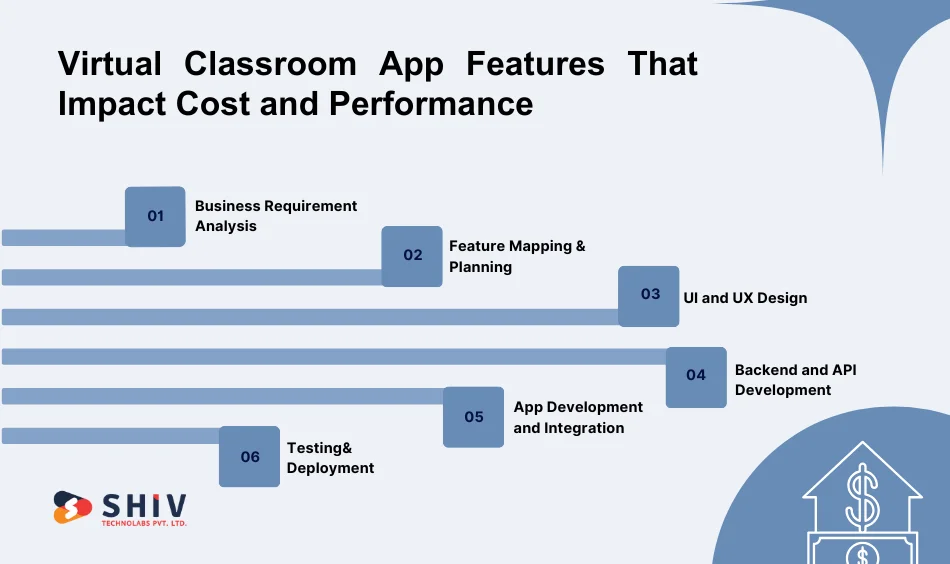
A structured workflow ensures predictable delivery and reduces technical risk.
Business Requirement Analysis
This phase defines goals, target users, monetization models, and compliance requirements. Clear documentation at this stage prevents scope creep.
Feature Mapping and Planning
Features are ranked into phases. The addition of MVP features is isolated, and subsequent improvements would be managed in the same way to control the budget and deadlines.
UI and UX Design
Design is about usability, accessibility, and interaction. Low adoption occurs when the platform has poor UX.
Backend and API Development
The server handles user management, sessions, analytics, and integrations. APIs link to front-end apps to core services.
App Development and Integration
There is integration between the front-end and back-end, and third-party services such as payment gateways and video providers are added.
Testing and Deployment
Thorough testing is a guarantee of performance stability, security, and usability before launching to the general audience.
Timeline
| Development Stage | Time Required |
|---|---|
| Planning and Design | 2 to 3 weeks |
| Backend Setup | 3 to 4 weeks |
| App Development | 6 to 8 weeks |
| Testing and Launch | 3 weeks |
Custom Virtual Classroom App vs Ready-Made Online Teaching Tools
Ready-made tools are fast to set up, but restrict customization, branding and scalability. Custom apps have a higher initial investment but are owned, flexible and enable long-term cost control. A custom development is the strategic option of choice in most cases among organizations that have serious growth plans.
How to Select the Right Partner for Virtual Classroom App Development
Selecting an appropriate development partner is among the most critical decisions in any virtual classroom program. The abilities of the team you work with are very important in determining the quality of architecture, security planning, scalability and long-term support. An effective partner is not only a feature builder but also one that helps you resist technical debt, avoid cost increases and address adoption issues and is an excellent fit for the actual processes of learning.
Education Domain Expertise
An educational technology partner has known the functionality of a virtual learning environment in the real world. This incorporates the knowledge of teacher-student interaction models, attendance logic, content delivery patterns and assessment workflows. Domain knowledge will make the platform more effective at teaching, rather than requiring educators to fit into strict systems.
Secure and Scalable Architecture Planning
Virtual lessons involve confidential student information, live lecturers and documentation. The security is designed by the right partner into the core architecture, including authentication, access control, data encryption and secure APIs. Scalability planning is also necessary to maintain peak live class usage without performance degradation.
Transparent Pricing and Cost Breakdown
The development partner will provide a reasonable estimate of the prices presented in items, not in estimates. This will encompass the cost of development, the infrastructure required, third-party service charges and maintenance. The transparency aids the decision makers in making realistic budgets and eliminating the chances of incurring unforeseen costs once the development has started.
Experience with Live Streaming and Real-Time Systems
Live video, chat and interactive solutions are technology-intensive. Your partner should demonstrate familiarity with real-time streaming technologies, optimal latency and concurrent use by multiple users. This experience guarantees stable live meetings and a frictionless learning experience even at scale.
Long-Term Support and Upgrade Strategy
Virtual classroom systems are continually evolving to accommodate new functions, compliance requirements and user expectations. The appropriate partner provides long-term support, performance evaluation and well-defined upgrade opportunities. Constant cooperation will ensure your platform remains secure, up to date and competitive in the long run.
Conclusion
The creation of an effective virtual classroom platform cannot be done solely by creating the technology, but involves being able to see the price, features, and implementation plan clearly. Learning institutions that invest in structured workflows and scalable architecture achieve long-term operational and financial returns.
Shiv Technolabs, a reputable Education App Development Company, provides secure, scalable, and performance-based solutions for virtual classrooms to achieve business objectives. We have an all-star team of technicians well-versed in education, which is why all platforms are future-proofed.
When you need clarity on cost, functionality, or the framework for a personalized virtual classroom platform, contact Shiv Technolabs now.
Frequently Asked Questions (FAQs)
1. How much does virtual classroom app development cost for a full platform?
Costs typically range from $30,000 to $55,000, depending on features, platforms and streaming infrastructure.
2. What features are mandatory in a virtual classroom app?
Live video, role-based dashboards, attendance, chat tools and secure content access are required.
3. How long does it take to build a virtual classroom app?
It normally takes between 3 and 5 months to develop, based on complexity.
4. Can virtual classroom apps support both live and recorded classes?
Yes, the majority of platforms are prepared to handle live sessions that can be recorded and played later.
5. Is a custom virtual classroom app scalable for future growth?
Yes, it scales well when built on cloud infrastructure and a modular architecture.