Table of Contents
A customer visits your Odoo store, but the page takes too long to load, the layout does not feel right, the fonts look inconsistent, and they leave in less than ten seconds without taking any action.
This happens every day with businesses that use ready-made or poorly built Odoo themes, and that is why Odoo theme development is not just about making your website look better. It affects your page speed, user experience, visitor trust, and the chances of turning a visitor into a customer.
Odoo gives your business the base to manage ERP solutions smoothly, while your theme shapes how customers experience your website. In 2026, your Odoo store needs to load quickly, work smoothly on every device, and show your brand clearly from the homepage to the checkout page.
This guide explains what you should know before investing in custom Odoo theme development, including what makes a good theme, what features matter, and how much it can cost.
Custom Odoo theme development creates a storefront or business site built around your brand, speed goals, and module needs. Unlike ready-made themes, custom builds work across all Odoo modules, load faster, and hold up through version upgrades. Costs range from $800 for basic builds to $6,000-plus for advanced, fully integrated designs.
Why Odoo Themes Matter for Business Growth?
Your theme controls how customers see your brand. It affects how long they stay on your site. It determines if they buy something or leave right away.
How Does Theme Impact Branding, Speed, and Customer Trust?
Your design talks to customers before you say anything. A custom Odoo development services shows your brand on every page. People see your style from product pages to the checkout screen. But attractive design is just one part of the story.
Website speed affects sales. When pages take one extra second to load, the majority of customers slip away. Customers trust websites that work fast and look professional.
Good Odoo UI customization makes people stay longer on your site. They abandon their shopping carts less often. They come back to buy more things later. Therefore, it is important to choose experts for Odoo theme development services.
Why Pre-Built Themes Often Fall Short?
Ready-made themes look easy to use. They cost less money and go live quickly. Problems with ready-made themes:
- Standard layouts that do not match how you sell things
- Poor connection with custom Odoo modules
- Old code that breaks when you upgrade versions
- Few options for SEO and speed improvements
These themes also struggle when your business grows. If you use custom workflows or need third-party apps, you will face problems quickly.
Benefits of Custom Odoo Themes

Custom Odoo Theme gives you better results:
- User experience designed around your products and services
- Full control over design that matches your brand
- Code built for better performance and SEO
- Templates that connect easily with sales, CRM, inventory, and other modules
- Design that adjusts with your business for future upgrades
The return on investment shows up fast. The loading of pages becomes speedy, user experiences improve, and customers remember your brand.
What Features Should a Custom Odoo Theme Include?
A well-built Odoo theme in 2026 goes beyond good looks. It needs to handle real business requirements across devices, languages, and modules.
Mobile Performance and Core Web Vitals
- Fast loading on mobile devices: Your Odoo theme should load quickly on mobile, tablet, and desktop screens without depending on heavy images, extra scripts, or unnecessary animations.
- Smooth experience on weak connections: Many visitors browse on mobile data or slower networks, so the theme should stay lightweight enough to open product pages, category pages, and checkout pages without delay.
- Stable layout while the page loads: Buttons, banners, product images, and checkout fields should not shift after the page starts loading because sudden movement creates a poor experience and hurts Core Web Vitals.
- Better scores for Google page experience: A performance-focused Odoo theme helps improve Largest Contentful Paint, Cumulative Layout Shift, and Interaction to Next Paint by reducing bloated code and loading important content faster.
- Quick response after user actions: Menus, filters, add-to-cart buttons, and checkout fields should respond quickly after users tap them, so the website feels smooth even after the page has loaded.
Multi-language and Multi-currency Support
If you sell across regions, your theme must handle language and currency differences without visual glitches or layout breaks. A properly built theme includes:
- Right-to-left language support: For languages like Arabic and Hebrew, the theme should adjust text direction, menus, buttons, icons, sliders, and checkout fields so the layout feels natural.
- Clean layouts for translated content: Translated words can be longer or shorter than the original text, so the theme should handle different languages without broken spacing or messy sections.
- Region-based currency display: Prices should appear in the correct local format for dollars, euros, dirhams, rupees, and other currencies through Odoo’s multi-currency settings.
- Translated navigation and checkout labels: Category names, filter labels, product attributes, buttons, and checkout fields should support clean translations without requiring manual design changes.
- Consistent experience across markets: A properly built Odoo theme helps customers from different regions browse, compare, and buy without confusion caused by language or currency issues.
Product Navigation and Layout Flexibility
How customers browse your products directly affects whether they buy. A strong custom theme gives your team control over layout without needing a developer for every small update.
- Visual mega menus for large catalogues: Mega menus can show category images, featured products, quick links, or product highlights to help customers find the right section faster.
- AJAX-based product filtering: Customers should be able to filter by price, size, color, category, or availability without waiting for the full page to reload every time.
- Smooth pagination on listing pages: AJAX-based pagination keeps product browsing faster and reduces friction when customers move through large product collections.
- Flexible grid and list views: Fashion, retail, industrial, and B2B products need different layouts, so the theme should allow grid or list views based on the product type.
- Easy layout control for internal teams: Your team should be able to update product sections, category layouts, and display formats without asking a developer for every small change.
Built-in SEO and Schema Markup
Your theme should include clean SEO infrastructure from day one. This means:
- Editable meta titles and descriptions: Product pages, category pages, blogs, landing pages, and CMS pages should all have editable meta fields for better search visibility.
- Canonical URLs for duplicate pages: Odoo stores can create multiple URLs through filters and sorting, so canonical tags help search engines identify the main version of each page.
- Product schema for rich search results: Structured data helps Google read product details like price, rating, availability, and reviews, which can improve how products appear in search results.
- Clean OpenGraph and Twitter Card tags: Shared links should show the right title, description, and image on LinkedIn, WhatsApp, Facebook, and X.
- SEO-ready theme structure: A strong Odoo theme should include clean code, proper heading structure, metadata, schema markup, and social sharing tags from the start.
What Do Odoo Theme Development Services Include?
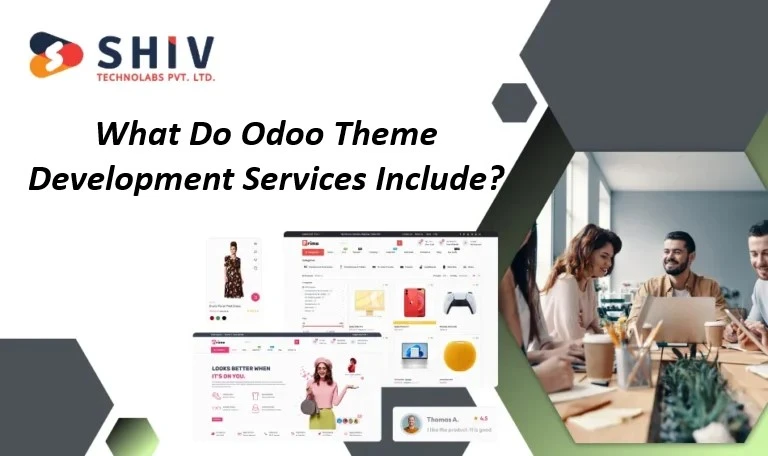
Custom Odoo theme development is not a single task. It covers design, coding, module integration, testing, and often migration from older versions. Understanding what is included helps you compare quotes and avoid surprises.
Full theme design and QWeb template coding
Developers start with UI mockups tied to your brand guidelines. Once approved, they convert those designs into Odoo-compatible XML templates using QWeb, Odoo’s native templating system. SCSS handles styling. JavaScript adds interactive behavior like sliders, sticky menus, and dynamic filters.
Everything gets tested across Chrome, Safari, Firefox, and Edge. The final code follows Odoo’s asset bundling rules so pages load with minimal requests.
Module integration for Sales, CRM, POS, and Inventory
Odoo is more than a website. It connects your storefront to your ERP. A properly built theme works with:
- Sales and invoicing: Product pages, pricing rules, and cart logic all need to reflect Odoo sales module settings without breaking the visual design.
- CRM pipeline visibility: For B2B sites, lead capture forms and customer portal sections need to connect directly to Odoo’s CRM module.
- Point of Sale interface: If you run a physical location alongside your online store, the theme needs to handle POS-specific views and session states correctly.
- Inventory and stock display: Real-time stock availability shown on product pages pulls from the Odoo inventory module. The theme code must handle this gracefully.
Backend theme improvements
Many businesses focus only on the frontend. But a cleaner backend layout helps employees work faster and make fewer errors. Backend theming includes improved dashboard layouts, color-coded module views, and simplified navigation for non-technical staff.
Migration from older Odoo versions
Moving from Odoo 14 or 15 to Odoo 17 or 18 usually breaks your existing theme. Developers handle:
- Data migration scripts and compatibility checks: Old template syntax changes between versions. Developers rewrite affected templates to match the new QWeb standard.
- UI updates for new Odoo features: Each major Odoo release introduces new frontend components. A migration update aligns your theme with the platform’s current capabilities.
- Full regression testing post-migration: All modules, payment gateways, and custom views get tested after the update to catch any regressions before go-live.
How Is a Custom Odoo Theme Built?
Custom Odoo theme development follows a clear, planned process.
Gathering Design and Branding Inputs
This step includes:
- Researching on your target customers
- Obtaining logos, colors, fonts, and brand suggestions
- Observing the websites of competitors and changing trends in the industry
- Setting success measures like conversion rates and page time
Creating XML Templates and QWeb Views
QWeb is Odoo’s template system. Developers use it to create:
- Homepage layouts
- Category and product pages
- Blog and article templates
- Checkout process flows
These templates focus on performance, reusability, and working with future versions.
Linking with SCSS and JS Files
SCSS provides styling flexibility, while JS adds interactive features. Files are modular, so teams can update design parts without breaking others. Developers use Odoo’s asset bundling to make pages load faster.
Testing for Device and Module Compatibility
Before launch, the theme goes through:
- Browser testing on Chrome, Safari, Firefox, and Edge
- Device testing on mobile, tablet, and desktop
- Module testing with Sales, CRM, and Inventory
- Speed and SEO audits
What Are the Latest Trends in Odoo Theme Development?
Design standards change. What worked well in Odoo 15 may feel outdated now. Here are the approaches that lead teams use today.
Tailwind CSS and Utility-first Styling
Tailwind CSS continues to grow in adoption for Odoo frontend work. Its utility-first approach reduces stylesheet bloat and makes responsive design faster to implement. Teams using Tailwind can build and modify layouts without writing custom CSS for every element. Bootstrap 5 remains the standard for teams that prefer a component-based structure.
WCAG Compliance as a Baseline Requirement
Web accessibility is no longer optional. Businesses in the US, UK, and EU face legal risk from inaccessible websites. A compliant Odoo theme includes:
- Screen reader labels on all interactive elements: Buttons, form fields, and navigation links need descriptive ARIA labels for users relying on assistive technology.
- Keyboard navigation support: Every feature accessible by mouse must also work via keyboard. This includes dropdowns, modals, and filters.
- Color contrast ratios that meet WCAG AA standards: Text and background combinations must meet minimum contrast requirements for readability.
- Visible focus indicators: Users navigating by keyboard need to see which element is currently active on the page.
Dark Mode and Interaction Design
Users expect choice. Many Odoo themes now include a dark mode toggle that saves the preference across sessions. Micro-interactions, such as subtle hover effects, loading animations, and smooth scroll behavior, keep users engaged without distracting from the content.
Also Read: Odoo Development – Features, Cost, and Steps
How Much Does Odoo Theme Development Cost?
The cost of Odoo theme development depends on your design scope, module requirements, integration needs, and the location of your development partner. A simple theme customization may cost less, while a fully custom enterprise theme with integrations, accessibility, and testing will need a larger budget.
| Package Type | Estimated Cost | Best For | Includes |
|---|---|---|---|
| Basic Theme Package | $800 to $1,500 | Small websites | Existing theme customization, responsive layout, brand colors, and homepage design |
| Mid-Level Theme Package | $2,000 to $3,500 | Growing businesses | Custom responsive design, product page templates, brand styling, and core Odoo module support |
| Advanced Theme Package | $4,500 to $8,000+ | Enterprise or eCommerce sites | Custom design, backend theming, multi-language support, accessibility, integrations, and testing |
One-Time vs. Ongoing Costs
- One-time cost: Covers design, development, responsive setup, module alignment, and launch support.
- Ongoing cost: Covers maintenance, bug fixes, security patches, Odoo version updates, and new feature changes.
- Monthly retainer: Useful if you need regular updates, quick fixes, and priority support after launch.
Hidden Costs to Plan For
- Odoo version migration: Moving from Odoo 14 or 15 can add around 20% to 40% to the base cost.
- Post-launch fixes: Keep a 10% to 15% testing buffer for bugs found after launch.
- Third-party integrations: Payment gateways, shipping APIs, analytics tools, and marketing tools may cost extra.
- Performance testing: Speed checks, image compression, and Core Web Vitals fixes may need extra budget.
How Do You Choose the Right Odoo Theme Development Partner?
Finding the right team prevents problems and saves money.
What to Ask Before Signing the Contract
- Have you ever worked on Odoo 17 or a later version?
- Do you have any live examples of the real clients?
- Do you support post launch?
- What is your process for upgrades and bug fixes?
Clear answers now prevent confusion later.
Red Flags in Cheap Theme Providers
- One-size-fits-all solutions for all clients
- No code documentation provided
- No testing reports available
- Refusal to offer post-launch support
If the price seems too low, important parts are probably missing.
How Shiv Technolabs Handles Odoo Theme Development?
Shiv Technolabs has delivered Odoo projects across eCommerce, real estate, manufacturing, and logistics. Our Odoo team works with QWeb templates, module architecture, and frontend performance standards that align with current Odoo 17 and 18 builds.
We do not use one-size-fits-all templates. Every project starts with a discovery session, runs through a structured design and testing process, and ends with full documentation. Our ISO 27001:2022-certified processes apply to client code and data throughout the project.
Whether you need a full custom theme, a backend redesign, or a migration from an older Odoo version, our team handles the full scope from first mockup to post-launch support.
Conclusion
Custom Odoo theme development is not just about changing colors, fonts, or page layouts. It affects how fast your website loads, how clearly customers understand your brand, and how smoothly your Odoo modules work together.
A good theme supports mobile performance, Core Web Vitals, SEO, schema markup, multi-language needs, multi-currency selling, product navigation, and future Odoo upgrades. It also helps your internal team manage pages and products with fewer technical issues.
Before choosing a theme or development partner, look beyond the starting price. Check the team’s Odoo experience, testing process, upgrade support, documentation, and post-launch service. A cheap theme may save money at first, but it can cost more later through slow pages, broken layouts, poor SEO, and upgrade problems.
With the right custom Odoo theme, your website becomes more than a digital storefront. It becomes a faster, cleaner, and more reliable business experience for your customers and your team.
Frequently Asked Questions (FAQs)
What is Odoo theme development?
Odoo theme development is the process of designing and coding a custom visual interface for an Odoo-based website or eCommerce store. It covers homepage layout, product page templates, mobile responsiveness, module integration, and performance coding.
How long does it take to develop a custom Odoo theme?
A basic custom theme takes 2 to 4 weeks. A mid-level build with full module integration runs 4 to 8 weeks. Advanced builds with backend theming, accessibility compliance, and multi-language support typically take 8 to 14 weeks.
Will a custom theme break when I upgrade Odoo?
A theme built with clean, modular QWeb code is much easier to migrate than a heavily modified pre-built theme. Ask your developer to write upgrade-compatible code from the start. Migration still requires developer time but is far less costly than a full rebuild.
Can I update my Odoo theme without a developer?
Odoo’s website builder allows non-technical users to update text, images, and basic layout elements. Structural changes like adding new page templates, modifying QWeb views, or editing SCSS require developer access.
Does Odoo theme design affect SEO?
Yes. Your theme controls page load speed, heading structure, meta tag implementation, schema markup, and mobile responsiveness. All of these directly affect how Google ranks your pages. A poorly coded theme can hurt your rankings even if your content is strong.
What is the difference between Odoo theme and Odoo template?
A theme is the overall design system that controls colors, fonts, layout, and global styling. A template is a specific page layout within that theme, such as a product page template or a blog post template. A custom Odoo theme includes multiple templates.
Is backend theming possible in Odoo?
Yes. Developers can redesign the Odoo backend dashboard for improved usability, cleaner navigation, and role-specific layouts. This is especially useful for companies with large teams where different departments need different views.
How much does Odoo theme development cost in 2026?
Costs range from $800 for basic customization to $8,000 or more for a fully custom build with backend theming and multilingual support. The final cost depends on scope, module integration requirements, and the experience level of the development team.