Table of Contents
Beauty and personal care businesses are rapidly shifting toward digital booking and mobile-first customer engagement. Salon owners, spa chains, and beauty service startups are investing in mobile apps to manage appointments, attract new customers, and deliver convenient on-demand services.
A well-designed beauty salon app allows customers to browse services, select professionals, book appointments, make payments, and receive reminders directly from their smartphones. For salon owners, it simplifies scheduling, reduces missed appointments, improves customer retention, and helps track business performance in real time.
From single-location salons to large beauty service platforms offering home appointments, mobile applications have become a key tool for modern beauty businesses.
However, one of the most common questions business owners ask before starting development is:
How much does beauty salon app development cost?
The answer depends on the app’s complexity, feature set, platform choice, and integrations. Understanding these factors helps businesses estimate the investment required to build a scalable salon booking platform.
Quick Answer: Beauty Salon App Development Cost
The cost of building a beauty salon app typically ranges between $8,000 and $80,000+, depending on the app’s complexity, features, and development approach.
Typical development ranges:
| Type of Beauty Salon App | Estimated Cost |
|---|---|
| Basic salon booking app | $8,000 – $15,000 (6 – 10 weeks) |
| Custom beauty salon mobile app | $15,000 – $35,000 (3 – 5 months) |
| Multi-branch salon management app | $30,000 – $60,000 (4 – 7 months) |
| Marketplace or on-demand beauty services app | $40,000 – $80,000+ (5 – 9 months) |
The final cost depends on factors such as online booking features, payment gateway integration, service provider dashboards, real-time notifications, analytics tools, and customer management systems.
Beauty Salon App Industry Statistics
The beauty and personal care industry continues to grow rapidly, creating strong demand for digital platforms such as salon booking apps and on-demand beauty service platforms.
Some key industry insights include:
- The global beauty and personal care market exceeded $550 billion in 2023 and is projected to surpass $930 billion by 2030.
- The beauty salon services industry is expected to grow at over 8% CAGR, driven by rising consumer spending and demand for premium services.
- Studies show that over 70% of customers prefer booking beauty appointments online rather than calling salons directly.
- Mobile booking apps significantly reduce no-show rates through automated reminders and digital scheduling.
- Many salon chains and beauty startups are investing in on-demand beauty service platforms that allow professionals to deliver services to customers’ homes.
Because of these trends, businesses across the beauty industry — from local salons to large service platforms — are adopting mobile apps to improve customer convenience, increase bookings, and manage operations more efficiently.
Beauty Salon App Development Cost Breakdown
The cost of building a beauty salon mobile application varies depending on several factors, such as the development team’s location, developer experience, hourly rates, and the complexity of the project.
Businesses often receive different price estimates from development companies because each team follows different pricing structures and resource allocation models.
Below are 3 key perspectives that influence the overall development cost of a beauty salon app.
1. Cost by Country
Development rates differ significantly depending on the country where the development team is located. Companies based in countries with higher operational costs generally charge higher hourly rates, which increases the total project budget.
| Country | Typical Hourly Rate | Estimated Project Cost |
|---|---|---|
| United States | $120 – $200 / hour | $70,000 – $150,000+ |
| United Kingdom | $90 – $150 / hour | $55,000 – $120,000 |
| Germany | $90 – $150 / hour | $55,000 – $120,000 |
| Canada | $100 – $170 / hour | $60,000 – $130,000 |
| Australia | $100 – $160 / hour | $60,000 – $125,000 |
These higher development costs often reflect premium agency pricing, local collaboration advantages, and access to senior product teams.
2. Cost by Developer Experience
Another factor that significantly impacts the total project cost is the experience level of the development team working on the project. Senior developers generally charge higher hourly rates but may deliver faster development cycles, stronger architecture, and more scalable applications.
| Developer Experience | Typical Hourly Rate | Estimated Project Cost |
|---|---|---|
| Junior Developers | $20 – $40 / hour | $8,000 – $20,000 |
| Mid-Level Developers | $40 – $80 / hour | $20,000 – $45,000 |
| Senior Developers | $80 – $150 / hour | $45,000 – $90,000+ |
Choosing the right development team depends on the project’s complexity.
3. Beauty Salon App Development Cost by Development Stage
The overall budget of a beauty salon app is typically distributed across multiple development stages. Each stage contributes to building a stable, user-friendly, and scalable application that supports both customers and salon businesses.
| Development Stage | Description | Estimated Cost |
|---|---|---|
| UI/UX Design | Wireframes, user journeys, booking flow design, mobile interface design | $1,500 – $10,000 |
| Customer Mobile App | User app for browsing services, booking appointments, and making payments | $4,000 – $20,000+ |
| Salon / Provider Panel | Dashboard for managing staff, bookings, and service schedules | $3,000 – $12,000 |
| Admin Panel | Central system to manage users, services, payments, and reports | $4,000 – $15,000 |
| Backend Development | API development, database architecture, and authentication systems | $5,000 – $20,000+ |
| Integrations | Payment gateways, maps, SMS alerts, push notifications | $1,500 – $8,000 |
| Testing & QA | Performance testing, security testing, bug fixes | $2,000 – $6,000 |
| Deployment | App store submission and server configuration | $500 – $2,000 |
This breakdown helps businesses understand how development resources are allocated across design, development, integration, and launch stages. The exact cost may vary depending on the app’s feature complexity, integrations, and overall project scope.
Overall, the total development cost of a beauty salon app is influenced by multiple factors, including development location, developer expertise, feature complexity, and the overall product vision. Businesses planning to build a salon app should evaluate these factors carefully when estimating their project investment.


Factors That Affect Beauty Salon App Development Cost
The cost of developing a beauty salon app is influenced by several technical and business factors. The final project budget depends on the app’s feature requirements, development approach, integrations, and scalability needs.
Below are some of the key factors that impact the overall development cost.
- App Complexity: The complexity of the app significantly affects development cost. A basic salon booking app requires fewer development hours, while marketplace-style apps or multi-branch salon platforms require more advanced architecture and longer development timelines.
- Platform Selection: Developing the app for both Android and iOS increases development cost compared to building it for a single platform. Some businesses choose cross-platform development to reduce costs while still reaching a wider audience.
- Feature Set: The number and type of features included in the app also influence the total cost. Features such as loyalty programs, membership plans, real-time notifications, analytics dashboards, and advanced booking systems require additional development effort.
- Third-Party Integrations: Integrations with external services like payment gateways, maps, SMS notifications, email systems, CRM tools, and analytics platforms increase development scope and cost.
- Custom UI/UX Design: Highly customized app interfaces with branded designs, animations, and interactive elements require more design time and development resources compared to template-based layouts.
- Scalability Requirements: Apps designed to handle a large number of users, multiple salon branches, or marketplace-style services require stronger backend infrastructure and database optimization, which increases development cost.
- Security & Compliance: Implementing secure payment systems, encrypted data storage, and privacy compliance features adds additional development effort and testing.
Maintenance & Updates: After the app is launched, ongoing maintenance, bug fixes, feature updates, and performance improvements contribute to the long-term cost of maintaining the application.
Considering these factors early in the planning stage helps businesses estimate a realistic development budget and choose the right technology approach for their beauty salon app.
Beauty Salon App Development Process
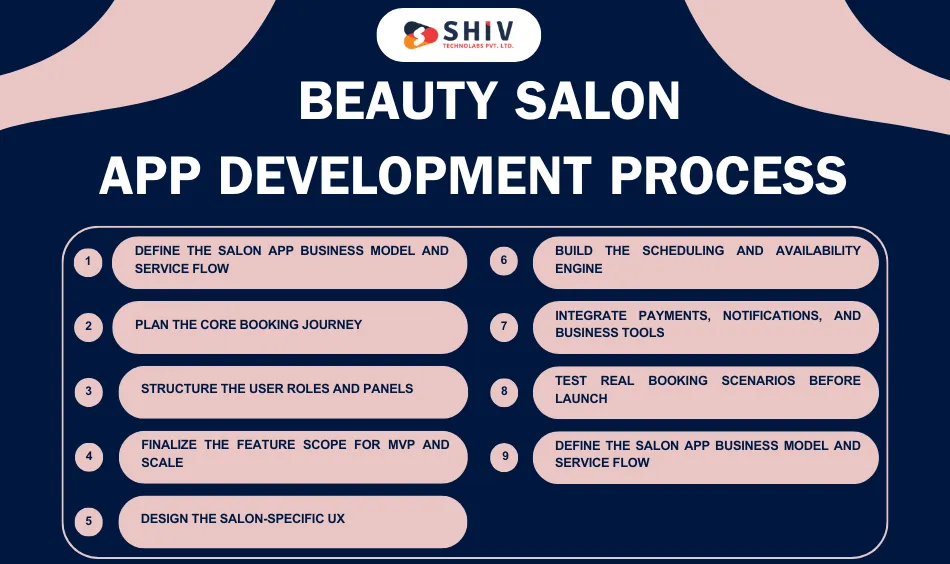
A beauty salon app should not be built like a generic booking app. The development process needs to account for service catalogs, stylist availability, time-slot management, multi-role flows, secure payments, customer retention, and, in many cases, home-service or marketplace logic.
A stronger process section for your blog should show how a salon app moves from business model to booking flow to launch. That makes the content more useful for salon owners, founders, and beauty startups who are comparing development partners.
1. Define the salon app business model and service flow
The first step is to decide what kind of beauty salon app you are building. A single-salon booking app, a multi-branch salon platform, and an on-demand beauty marketplace all require different user journeys, admin logic, and revenue models.
At this stage, the project team should define:
- Whether the app is for one salon, many branches, or many providers
- Whether services are in-salon only or at-home / on-demand
- How bookings will be assigned to staff
- Whether revenue will come from appointments, commissions, subscriptions, memberships, or product sales
This step is important because the rest of the app structure depends on it. A marketplace app like a StyleSeat-type platform needs provider onboarding, commission control, and richer admin workflows, while a single-salon app can stay much simpler.
2. Plan the core booking journey
In salon app development, the booking journey is the heart of the product. The process should map how a user moves from opening the app to selecting a service, choosing a stylist, picking a time slot, making a payment, and receiving confirmation.
This planning stage should answer questions such as:
- Can users book by service, professional, or branch
- Can they choose the date, time, and duration
- Will the app support rescheduling and cancellations
- Should payment happen before booking, after booking, or at the salon
- How will reminders reduce no-shows
A weak booking flow creates friction, while a well-planned one directly affects conversions and repeat usage.
3. Structure the user roles and panels
A salon app usually has more than one user type, so the process should define each role early. At a minimum, most salon platforms need a customer app, a salon or provider panel, and an admin panel.
Each role should be planned around its actual tasks:
- Customer app: browse services, view prices, select staff, book, pay, rate, and rebook
- Salon or provider panel: manage schedules, staff calendars, service availability, pricing, and booking status
- Admin panel: manage users, branches, providers, commissions, reports, offers, and disputes
This makes the process more realistic and shows readers that salon software is an operational product, not just a front-end booking screen.
4. Finalize the feature scope for MVP and scale
A practical salon app process should separate must-have features from scale-stage features. Recent competitor content emphasizes cost differences based on complexity, which is a signal that feature prioritization should happen before development starts.
A sensible MVP scope often includes:
- User registration and profiles
- Service listing
- Stylist or staff selection
- Appointment booking
- Payment integration
- Booking notifications
- Ratings and reviews
- Basic admin management
Scale-stage features may include:
- Memberships and loyalty programs
- Subscription packages
- Multi-branch controls
- Promo codes and referrals
- Home-service staff dispatch
- Analytics dashboards
- CRM or POS integration
- AI-based recommendations or smart scheduling
This approach helps businesses control launch costs while still leaving room for growth.
5. Design the salon-specific UX
The UI/UX stage should focus on salon behavior, not just visual polish. The screens must support service discovery, time-slot clarity, staff selection, add-ons, cancellations, rescheduling, and quick rebooking.
Important screens usually include:
- Home screen with categories or featured services
- Service detail pages with pricing and duration
- Stylist or professional profile pages
- Real-time slot selection
- Checkout and payment screens
- Upcoming bookings and booking history
- Salon dashboard and calendar views
For on-demand beauty apps, the UX should also account for location selection and appointment logistics.
6. Build the scheduling and availability engine
This is one of the most important parts of salon app development and one of the biggest reasons a generic process is not enough. A salon app needs logic for staff schedules, service durations, overlapping appointments, break times, branch-level availability, and rescheduling rules.
Because competitor blogs repeatedly center their feature lists around appointment scheduling and real-time availability, this scheduling engine is clearly a core build phase.
During this stage, the team should build:
- Time-slot generation
- Working-hour rules
- Buffer times between services
- Service-duration logic
- Staff assignment rules
- Cancellation and reschedule workflows
- Reminder triggers
This is often the difference between a simple “booking app” and a salon product that actually works in daily operations.
7. Integrate payments, notifications, and business tools
After the booking logic is stable, the app should connect with the services that make the platform usable in real life. Recent competitor pages repeatedly mention payment gateways, SMS, push notifications, and maps as cost drivers and key app components.
Typical integrations include:
- Payment gateways for booking deposits or full payment
- SMS, email, or push notifications for reminders and confirmations
- Maps or geolocation for at-home beauty services
- Analytics tools for usage and performance tracking
- CRM, POS, or salon management tools where needed
This stage is especially important for reducing no-shows, improving communication, and supporting repeat bookings.
8. Test real booking scenarios before launch
Testing a salon app should focus on business-critical workflows, not just generic bug testing. The QA phase needs to validate real-life cases such as double-booking prevention, failed payment handling, booking modifications, staff unavailability, reminder delivery, and admin-side updates.
Competitor guidance also highlights testing and quality assurance as core contributors to development cost and launch readiness.
The team should test:
- Appointment creation and cancellation
- Staff and slot conflicts
- Payment success and failure flows
- Customer and admin notifications
- Multi-device behavior
- App performance during peak booking windows
This makes the platform more reliable at launch and protects salon operations from scheduling errors.
9. Launch with an MVP, then expand based on usage
A strong process should not end at release. Recent competitor content repeatedly suggests starting with an MVP to manage cost and validate demand before scaling to more advanced functionality.
For a salon app, the best launch model is often:
- Launch with core booking, payments, notifications, and admin controls
- Measure booking volume, drop-off points, repeat usage, and no-show rates
- Add advanced features such as loyalty, memberships, referrals, provider onboarding, or home-service expansion
Also Read: Which Platform to Choose for Your Startup
Hidden Costs of Beauty Salon App Development
Apart from development expenses, businesses should also consider additional costs that arise during or after the app launch. These hidden costs can impact the overall budget if they are not planned.
Some common hidden costs include:
- App Store Fees – Apple charges $99 per year for developer accounts, while Google Play requires a $25 one-time registration fee.
- Cloud Hosting – Servers are required to store data, manage bookings, and run the application smoothly.
- Third-Party APIs – Services such as payment gateways, SMS notifications, maps, and analytics tools often charge usage-based fees.
- Payment Transaction Fees – Payment providers typically charge 2%–3% per transaction.
- Maintenance and Updates – Ongoing bug fixes, security updates, and feature improvements add to long-term costs.
Planning for these expenses helps businesses estimate a more realistic budget for building and maintaining a beauty salon app.
Build a Custom Beauty Salon App for Your Business
Planning to launch a beauty salon booking app or upgrade your existing salon management system? A well-designed mobile app can help salons manage appointments, reduce no-shows, improve customer retention, and streamline daily operations.
Our development team at Shiv Technolabs builds custom beauty salon apps with advanced booking systems, staff scheduling, secure payments, and scalable admin dashboards tailored for salons, spas, and on-demand beauty service platforms.
If you are planning to build a salon booking app, multi-branch salon management platform, or on-demand beauty services marketplace, our team can help you plan the right feature set and development roadmap.
Contact us today and discuss your beauty and salon app idea with our experts!
Conclusion
Beauty salon mobile apps have become an important digital tool for salons, spas, and beauty service startups that want to simplify appointment management and improve customer engagement. With features such as online booking, staff scheduling, secure payments, and automated reminders, salon apps help businesses streamline operations while offering customers a convenient way to book services.
The cost of building a beauty salon app depends on factors such as app complexity, platform selection, integrations, and development team expertise. Businesses that clearly define their requirements, prioritize essential features, and plan for long-term scalability can build a reliable salon booking platform that supports growth and improves service delivery.
Whether the goal is to launch a simple appointment booking app, manage multiple salon branches, or build an on-demand beauty service marketplace, a well-planned development approach helps businesses create a scalable and user-friendly mobile application.
FAQs About Beauty Salon App Development
How much does it cost to develop a beauty salon app?
The cost of beauty salon app development typically ranges between $8,000 and $80,000+, depending on the app’s complexity, features, integrations, and platform requirements. Basic booking apps cost less, while marketplace or multi-branch salon platforms require a higher investment.
How long does it take to build a salon booking app?
The development timeline usually ranges from 2 to 6 months. Simple salon booking apps may take around 6–10 weeks, while advanced platforms with multiple panels, integrations, and custom features can take 4–9 months to complete.
What features should a beauty salon mobile app include?
Most salon apps include essential features such as service browsing, appointment booking, stylist selection, payment integration, booking reminders, customer reviews, and push notifications. Advanced apps may also include loyalty programs, memberships, analytics dashboards, and CRM integrations.
Can a beauty salon app support multiple salon branches?
Yes, many salon apps are designed to support multi-branch salon management. These apps allow businesses to manage different locations, staff schedules, service pricing, and appointments from a centralized admin dashboard.
Should businesses build a custom salon app or use ready-made software?
Custom development is ideal for businesses that require unique branding, advanced features, or marketplace functionality. Ready-made software may work for smaller salons with basic appointment booking needs but offers limited customization.
How do beauty salon apps reduce appointment no-shows?
Salon apps help reduce no-shows by sending automated reminders through push notifications, SMS, or email. Some apps also allow salons to require advance deposits or online payments, which encourages customers to honor their bookings.
What platforms should a salon app support?
Most businesses launch salon apps on both Android and iOS to reach a wider audience. Some development teams use cross-platform frameworks to build apps for both platforms efficiently.