
Table of Contents
Most enterprises do not fail at technology. They fail at coordination. A company spends months selecting an ERP, another quarter deploying a CRM, and another budget cycle adding analytics tools. But six months later, the systems still do not sync with each other, reports still require manual exports, and teams are still working around the tools instead of through them.
The gap is rarely about technology. It is about the absence of a plan that connects strategy to execution at every layer.
A digital transformation roadmap solves this. It gives enterprises a structured, phased approach to move from fragmented systems to an integrated, data-driven operating model. A digital transformation company helps align each initiative with clear, measurable business outcomes.
This guide breaks down every step of building that roadmap, from initial assessment to continuous optimization, so enterprises can execute transformation with clarity and control.
What Is a Digital Transformation Roadmap?
A digital transformation roadmap is a structured execution plan that defines how an enterprise will evolve its systems, processes, data, and teams from their current state to a more efficient and scalable operating model. It is not a project plan, a technology list, or a strategy document. It is a framework that bridges business intent and technical reality.


What makes it useful is not the document itself but the alignment it creates. When every team, from operations to IT and leadership, works from the same roadmap, priorities stay consistent, resources are allocated correctly, and transformation moves faster.
How a Roadmap Differs from a Strategy
This distinction matters in practice because enterprises often confuse having a strategy with having an execution plan. A digital transformation strategy defines the vision and intent, what the business wants to become and why. A roadmap, on the other hand, converts that vision into specific initiatives, sequences them logically, assigns ownership, and tracks progress against milestones.
Think of strategy as the destination on a map and the roadmap as the turn-by-turn navigation. Without the roadmap, strategy stays aspirational. Without the strategy, the roadmap becomes a list of disconnected projects with no unified purpose.
| Aspect | Digital Transformation Strategy | Digital Transformation Roadmap |
|---|---|---|
| Vision and Direction | Defines the “why” and long-term business goals | Defines the step-by-step path to achieve those goals |
| Output | Produces goals, priorities, and strategic focus areas | Produces tasks, timelines, ownership, and KPIs |
| Scope | High-level and directional | Detailed, phased, and execution-focused |
| Flexibility | Changes slowly based on business shifts | Updated frequently as phases progress |
| Audience | Owned by leadership and decision-makers | Used by cross-functional teams for execution |
| Measurement | Focuses on broad success indicators | Tracks specific KPIs at each stage |
Why Enterprises Need a Digital Transformation Roadmap
Enterprises operate at a scale and complexity that makes informal transformation impossible. Without a roadmap, transformation becomes reactive, where teams chase tools, projects overlap, and investments do not produce visible returns. A roadmap creates the structure that prevents this.
It ensures that business goals drive technology decisions instead of the other way around. It gives leadership a way to monitor progress without getting lost in implementation details. And it gives execution teams a shared reference point that reduces misalignment and rework.
Digital transformation is not about adopting new tools. It is about changing how the business operates, makes decisions, and serves customers at a fundamental level. For enterprises, this matters more than it does for smaller organizations because the operational inefficiencies compound at scale.
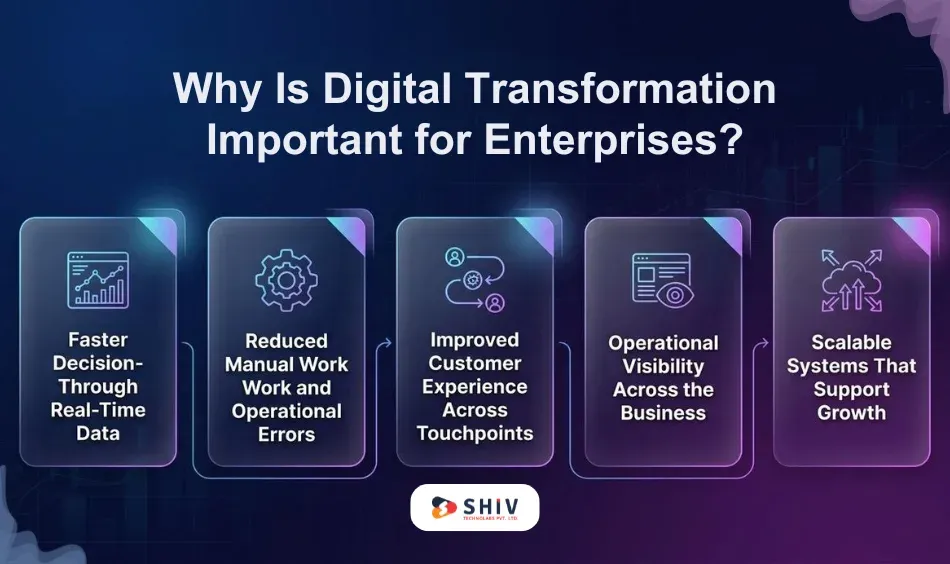
# Faster Decision-Making Through Real-Time Data
Enterprises often operate with a two-to-three-week lag between an operational event and a decision made in response to it. Reports are generated from systems that do not integrate, compiled manually, and reviewed by leadership after the window for action has closed. Digital transformation eliminates this lag by connecting systems and surfacing data as it is generated. This becomes clear when enterprises implement tools like ERP and CRM systems that unify information flow.
# Reduced Manual Work and Operational Errors
Many enterprise processes involve steps that exist only because systems do not communicate. Data is re-entered, reconciled, or reformatted by hand because integration was never built. Digital transformation identifies and eliminates these steps, replacing them with automated workflows. The result is not just time savings, but a measurable reduction in errors, rework, and the operational cost that comes with them.
# Improved Customer Experience Across Touchpoints
When enterprise systems are siloed, the customer experience reflects that fragmentation. Support teams do not have order history. Sales teams do not see service interactions. Marketing campaigns go out without awareness of active renewals. Digital transformation connects these systems so that every team that touches the customer has a complete and current view, which directly improves response times, personalization, and resolution rates.
# Operational Visibility Across the Business
Leadership in most enterprises operates on approximations. Dashboards lag behind operations. Inventory figures are estimates. Revenue forecasts are built on assumptions because the underlying data is inconsistent. A digital transformation roadmap addresses this by creating a connected data architecture that gives leadership accurate, real-time visibility into operations,shifting management from reactive to proactive.
# Scalable Systems That Support Growth
Legacy systems were built for the business environment at the time of deployment. As operations grow, these systems become constraints. Order volumes, customer counts, and data loads begin to exceed the limits of the original architecture. Digital transformation removes these bottlenecks by introducing systems designed for scale, turning growth into an operational advantage instead of a source of instability.
What Should an Enterprise Assess Before Building a Digital Transformation Roadmap?
The assessment phase is where most enterprises either build a strong foundation or create problems that surface later in execution. Skipping it leads to technology investments that do not solve the right problems, timelines that do not reflect actual complexity, and change management that arrives too late.
A thorough assessment covers five layers. Each layer reveals a different category of risk and opportunity.
| Assessment Area | What to Evaluate | Why It Matters |
|---|---|---|
| Systems | ERP, CRM, analytics tools, legacy applications | Reveals duplication, technical debt, and integration gaps |
| Processes | Manual workflows, handoff points, approval chains | Highlights inefficiencies that technology alone cannot fix |
| Data | Accuracy, consistency, availability across systems | Poor data quality undermines analytics and automation |
| Teams | Digital skills, tool familiarity, change readiness | Shapes training requirements and adoption strategy |
| Integrations | Data flow between systems, API availability | Determines what can be automated versus rebuilt |
The assessment should produce a clear picture of the current state, not a list of complaints, but a structured inventory of gaps and capabilities that informs every subsequent decision in the roadmap. Skipping this step is one of the most common reasons enterprise transformations overrun their budgets and miss their timelines.
The Core Elements of a Strong Digital Transformation Roadmap
A strong roadmap is not a list of technology projects. It is a structured framework that connects business outcomes to execution activities at every phase. Enterprises that treat their roadmap as a project plan often end up managing timelines and budgets without improving the underlying operations that transformation was supposed to address.
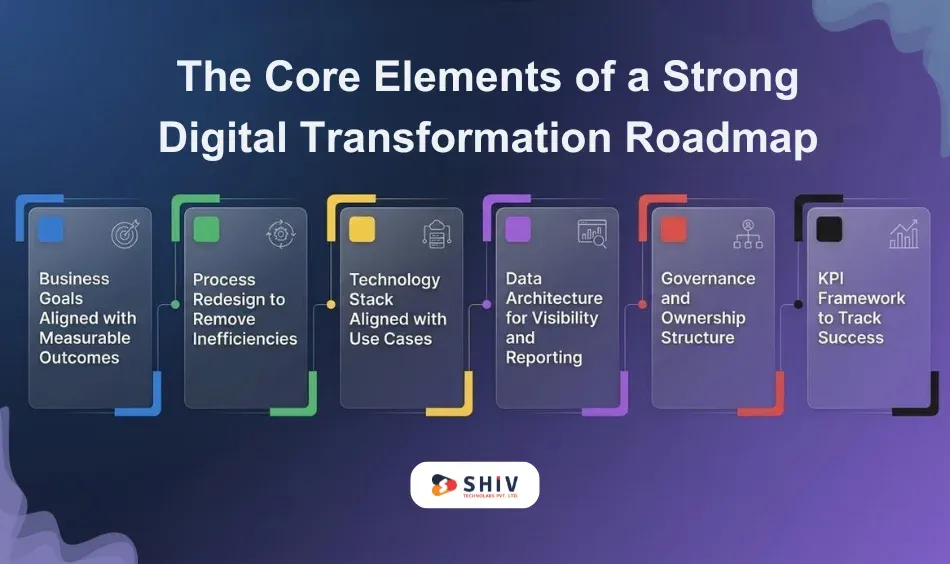
The following six elements form the foundation of a roadmap that delivers real business value.
# Business Goals Aligned with Measurable Outcomes
Every initiative in the roadmap should trace back to a specific business goal. Not a general aspiration like “improve efficiency” but a measurable outcome like “reduce order processing time from five days to two.” This alignment ensures that technology investments are evaluated against business impact rather than technical capability.
# Process Redesign to Remove Inefficiencies
Technology cannot fix a broken process. It can only make it faster, which sometimes makes it worse. Before deploying new systems, the roadmap should identify which processes need to be redesigned. This often involves removing unnecessary steps, clarifying ownership, and simplifying approval chains so that the new technology operates on a foundation that supports it.
# Technology Stack Aligned with Use Cases
Tool selection should happen after use cases are defined, not before. Many enterprises select platforms based on vendor relationships, market reputation, or feature lists, then try to fit their operations into the tool. A strong roadmap flips this approach. It starts with the use case and then chooses the tool that fits it best. In many cases, this leads to a simpler and more cost-effective solution than what the enterprise first had in mind.
# Data Architecture for Visibility and Reporting
Data is the infrastructure that makes transformation measurable. The roadmap should define how data will flow between systems, where it will be stored, how it will be governed, and how it will be made available for reporting and analytics. Without this layer, enterprises add systems without gaining visibility, and the fragmentation problem persists in a more expensive form.
# Governance and Ownership Structure
Each initiative in the roadmap should have a clearly defined owner, someone directly responsible for delivery, not just a team or department. The roadmap should also outline governance, including how decisions are made, how conflicts are handled, and how progress is reviewed. Without this structure, transformation often slows down due to coordination gaps.
# KPI Framework to Track Success
KPIs convert transformation into accountability. They make it possible to assess whether an initiative delivered what it promised, and to adjust course when it did not. The KPI framework should be defined before execution begins, not after, so that baselines can be established and progress measured from the first phase forward.

Step-by-Step Guide to Building a Digital Transformation Roadmap
Building a transformation roadmap is an iterative process, not a linear one. The steps below follow a logical sequence, but enterprises should expect to revisit earlier steps as they learn more through execution. The goal is a living document that improves with every phase, not a static plan that becomes obsolete by the time implementation begins.
# Step 1: Define the Business Vision and Strategic Goals
Transformation begins with clarity about what the business is trying to achieve. Not at a technology level, but at a business outcome level. This step is often rushed because it feels like it should be obvious, but most enterprise transformations that fail do so because the goals were too vague to guide real decisions.
Effective goals at this stage are specific, time-bound, and tied to operations. Examples include reducing order processing time by 30% within 12 months. Another example is improving cross-department reporting speed from weekly to real-time. It can also mean reducing manual data reconciliation hours by 50% within the first two quarters.
A useful exercise at this stage is to list the top five operational problems that senior leadership agrees are limiting growth, and then work backward to define what success would look like if each were solved. That outcome definition becomes the foundation of the roadmap.
# Step 2: Assess Your Current Digital Maturity
Digital maturity describes how ready an organization is to execute transformation. It is a map of where the current systems, processes, data, and teams are strong and where they have gaps that need to be addressed before transformation can succeed.
The assessment should cover five key dimensions. These include system capabilities and technical debt, as well as data flow and reporting gaps. It should also address integration limitations between key platforms. In addition, it needs to identify process bottlenecks in high-volume workflows. Finally, it should evaluate team readiness to adopt new tools and ways of working.
Many enterprises discover at this stage that legacy systems are the primary constraint. When systems cannot be integrated through standard APIs, transformation planning must account for selective replacement or the introduction of middleware.
# Step 3: Prioritize High-Impact Use Cases
Transformation cannot happen everywhere at once. Enterprises that try to transform all processes simultaneously spread execution capacity too thin and rarely succeed at any of them. The prioritization step ensures that the roadmap focuses on the initiatives that will deliver the most measurable value in the shortest time, creating momentum and demonstrating ROI to stakeholders.
Use cases should be evaluated across four key dimensions. These include the business impact they can generate, the effort needed for implementation, the risk of failure based on current capabilities, and the speed at which they can deliver visible results. Initiatives that score high on impact and speed with manageable risk are natural candidates for the first phase.
| Criteria | Description | What to Look For |
|---|---|---|
| Impact | Business value generated by the initiative | Revenue improvement, cost reduction, time saved |
| Effort | Resources, complexity, and time required | Team size, integration complexity, dependencies |
| Risk | Probability and cost of failure | Legacy constraints, skill gaps, change resistance |
| Speed | Time to deliver measurable results | Initiatives delivering value within 60 to 90 days |
High-impact use cases often focus on workflow automation in high-volume operations. They also include ERP and CRM integration to unify customer and operational data. Another common area is real-time dashboards that replace manual reporting cycles. Customer data centralization is also important for improving service and aligning sales efforts. In addition, backend process optimization helps reduce delays in orders, inventory, and payments.
# Step 4: Build the Roadmap Across Phases
A phased roadmap reduces risk by breaking transformation into manageable segments, each with its own deliverables, timelines, and success metrics. It also creates natural review points where the organization can assess what is working, adjust priorities, and incorporate lessons learned before committing resources to the next phase.
Four phases cover most enterprise transformation journeys, though the duration and specific activities of each will vary based on the scope of transformation and the maturity of the current state.
| Phase | Focus | Key Activities and Outcomes |
|---|---|---|
| Phase 1: Discovery | Assessment and planning | Current-state analysis, goal definition, stakeholder alignment, baseline KPI documentation |
| Phase 2: Foundation | Core system improvements | Process redesign, core system upgrades, initial integrations, data architecture setup |
| Phase 3: Expansion | Automation and analytics | Workflow automation, BI deployment, advanced integrations, team training and adoption |
| Phase 4: Scale | Optimization and continuous improvement | KPI-driven refinement, new use case deployment, governance strengthening, capability building |
Each phase should end with a formal review that compares results against the KPIs defined at the start, documents lessons learned, and confirms priorities for the next phase. This review process is what turns a static plan into a living roadmap that improves with execution.
# Step 5: Choose the Right Technology Stack and Integration Plan
Technology selection is where many enterprises make costly mistakes. A common pattern appears in many cases. A vendor presents a compelling platform, and leadership approves the investment before use cases are clearly defined. As a result, implementation teams spend months customizing the tool to fit processes it was not originally built to support.
A well-built roadmap prevents this by defining use cases first and selecting tools second. Each layer of the technology stack should be selected based on how well it supports the use cases defined in Step 3. This includes ERP systems for process management and CRM platforms for managing the customer lifecycle. It also covers BI tools for reporting and APIs for integration between systems. In addition, cloud infrastructure should support scalability, while application layers should handle frontend and backend operations effectively.
The integration plan is as important as the tool selection. Systems that cannot share data create the same fragmentation problem that transformation was meant to solve. A clear integration architecture, documenting which systems need to communicate, through what mechanisms, and with what data governance rules, should be completed before any implementation begins.
Enterprises also need to distinguish between transformation and modernization when making these decisions. These are related but different efforts with different planning requirements.
# Step 6: Plan Change Management and Team Adoption
The most technically sound transformation can fail if the people expected to use the new systems do not adopt them. Change management is not a soft add-on to the roadmap; it is a parallel workstream that begins at the same time as technical planning and continues throughout execution.
Effective change management starts with communicating the purpose of transformation clearly and consistently. Teams need to understand not just what is changing but why it is changing and what it means for their work. Communication that focuses only on implementation timelines without addressing team concerns creates resistance that slows adoption and undermines the value of new systems.
The change management plan should identify change champions at the department level, team members who understand the transformation goals, can answer peer questions, and serve as a feedback channel between execution teams and leadership. Training should be role-specific, not generic, covering the exact workflows each team will use rather than the full feature set of every new tool. Adoption milestones should be tracked with the same rigor as technical deliverables, because adoption is what converts system deployment into business value.
# Step 7: Track KPIs and Measure Transformation Success
A transformation initiative without measurement is an assumption. KPIs convert transformation goals into accountable targets and provide the feedback loop that makes continuous improvement possible. They also protect the roadmap from a common risk in enterprise transformation. Over time, focus can shift away from business outcomes and move toward tracking activities instead of real results.
KPIs should be defined before the first phase begins so that baselines can be established. Without a baseline, there is no way to assess whether the transformation delivered what it promised. The KPI framework should cover five areas, each connected to the business goals defined in Step 1.
| KPI Area | Example Metrics | Purpose |
|---|---|---|
| Operations | Process cycle time, error rate, throughput | Measure efficiency improvement from process redesign and automation |
| Financial | Cost per transaction, ROI on technology investment | Track whether transformation is generating measurable economic value |
| Customer | Response time, first-contact resolution, satisfaction score | Assess impact on customer-facing operations and experience |
| Adoption | Active users, feature utilization, training completion | Measure whether teams are using new systems and workflows as intended |
| Data | Reporting accuracy, data freshness, integration uptime | Track the quality and availability of data that supports all other KPIs |
KPI reviews should take place at the end of each phase and at regular intervals within each phase. When a metric does not improve as expected, the review process should identify the root cause. The issue may be a technical implementation problem, a process gap, or an adoption challenge. Each of these requires a different response.
Common Digital Transformation Roadmap Mistakes Enterprises Should Avoid
Most enterprise transformations fail because of planning and execution patterns that were predictable and avoidable. Understanding these patterns before the roadmap is built is more valuable than any post-mortem conducted after a failed initiative.
# Starting with Tools Instead of Business Goals
When tool selection precedes goal definition, the roadmap becomes shaped by vendor capabilities rather than business needs. Teams spend energy customizing platforms to fit processes instead of selecting platforms that support the right processes. The result is over-engineered implementations that solve the wrong problems.
# Running Too Many Initiatives Simultaneously
Transformation scope tends to expand under pressure from stakeholders who want to see faster change across more areas. But spreading execution capacity too thin produces initiatives that all move slowly, none of which reach completion in time to demonstrate value. Phased prioritization prevents this by concentrating effort on high-impact use cases first.
# Treating Change Management as an Afterthought
Change management that begins after technical deployment is too late. By that point, teams have already formed workarounds, resistance has crystallized, and the window for shaping adoption behavior has passed. Change management needs to be built into the roadmap from the first phase as a parallel workstream, not added at the end.
# Poor Data Quality as a Foundational Problem
Enterprises frequently underestimate the impact of data quality on transformation outcomes. Analytics tools, automation systems, and integrated platforms all depend on data that is accurate, consistent, and available. When the underlying data quality is poor, transformation initiatives produce unreliable outputs, which erodes confidence in the systems and slows adoption.
# No Clear Ownership of Initiatives
When an initiative is owned by a team rather than a named individual, accountability diffuses and decisions slow down. Every transformation initiative in the roadmap should have a single accountable owner who is responsible for delivery, escalation, and outcome reporting. Ownership by committee is a common cause of missed milestones.
# No KPI Tracking After Deployment
Many enterprises treat system go-live as the finish line. But deployment is only the beginning of transformation. Without ongoing KPI tracking, it is impossible to distinguish between systems that are working and systems that have been deployed but not adopted. Measurement needs to continue through every phase and into steady-state operations.
Digital Transformation Roadmap Example for Enterprises
The following example illustrates how a 12-month roadmap might be structured for a mid-to-large enterprise beginning a cross-functional transformation program. The structure reflects the phased approach described throughout this guide.
| Quarter | Phase Focus | Key Activities |
|---|---|---|
| Q1 | Discovery and Assessment | Current-state audit across systems, processes, data, and teams; goal definition; KPI baseline establishment; stakeholder alignment sessions |
| Q2 | Foundation Building | Process redesign in priority areas; core system upgrades and initial integrations; data architecture design; change management kickoff |
| Q3 | Execution and Expansion | ERP and CRM integration deployment; BI and dashboard rollout; workflow automation in high-volume processes; team training by role |
| Q4 | Optimization and Scale | KPI review against baselines; process refinement based on operational data; additional use case deployment; governance strengthening |
This structure is intentionally flexible. Enterprises that complete the Q1 assessment with a clear picture of their current state will be able to execute Q2 with greater precision. The quarterly review cadence ensures that priorities remain aligned with business goals even as operational realities shift during execution.
How the Right Technology Partner Can Support Enterprise Digital Transformation
Most enterprises have the operational expertise to know what needs to change. What they often lack is the technical capability to architect the solution, the implementation experience to execute it at scale, and the cross-functional bandwidth to run a transformation while keeping the business operating normally.
A technology partner fills these gaps. The most effective partners do not arrive with a standard platform or a preferred implementation methodology. They begin with the business goals defined in the roadmap and work backward to architecture, tool selection, and execution planning. The deliverable is not a deployed system; it is an operating capability that produces the outcomes the enterprise was trying to achieve.
Partner selection should be evaluated on the depth of the assessment they conduct before proposing solutions, the quality of their integration architecture, rather than just platform expertise, their ability to support change management alongside technical delivery, and their commitment to KPI-based progress tracking throughout the engagement.
Need Help Building a Digital Transformation Roadmap for Your Enterprise?
Turning a digital transformation roadmap into real outcomes requires more than planning. It requires clear execution, system alignment, and measurable progress across departments sustained over multiple phases while the business continues to operate.
Shiv Technolabs works with enterprises to translate business goals into structured transformation programs. The approach focuses on connecting processes, data, and technology in a way that supports long-term operational growth, not just system upgrades.
# What Shiv Technolabs Helps You With
- Define a Practical Roadmap Aligned with Business Goals: Every engagement begins with an assessment of current-state systems, processes, and data. The roadmap is built around measurable outcomes, not technology preferences, so every initiative ties back to a business case.
- Map Processes and Identify Gaps Across Departments: Process mapping reveals where inefficiencies exist, where systems create bottlenecks, and where integration gaps are generating manual workarounds. This analysis shapes the priority order of the entire roadmap.
- Plan ERP, CRM, BI, and Integration Architecture: System selection and integration planning are done after use cases are defined, not before. This ensures that the technology stack is configured to solve real operational problems rather than matched to vendor capability lists.
- Execute Transformation in Phases with Clear Milestones: Phased delivery keeps execution manageable, allows for early value delivery, and creates natural checkpoints for reviewing progress and adjusting priorities before committing to the next phase.
- Track KPIs and Improve Performance Continuously: KPI frameworks are defined before execution begins. Post-deployment tracking continues through every phase, creating the feedback loop that turns deployment into sustainable operational improvement.
Frequently Asked Questions
# 1. What is a digital transformation roadmap?
A digital transformation roadmap is a structured plan that defines how a business will improve its operations using technology, processes, and data. It outlines the current state, defines target outcomes, sequences initiatives across phases, assigns ownership, and tracks measurable progress through KPIs.
# 2. How do enterprises build a digital transformation roadmap?
Enterprises build a roadmap by first assessing their current systems, processes, and data quality. They then define business goals, prioritize high-impact use cases, plan phased execution, select technology aligned to those use cases, and establish a KPI framework to measure outcomes at every stage.
# 3. What are the key steps in a digital transformation roadmap?
The key steps begin with defining the business vision and goals. The next step is assessing the current level of digital maturity. This is followed by prioritizing high-impact use cases and building a phased execution plan. After that, the focus shifts to selecting and integrating the right technology stack. It also includes planning for change management and team adoption. Finally, KPIs should be tracked to measure performance and improve outcomes continuously.
# 4. What is the difference between digital transformation and modernization?
Digital transformation focuses on fundamentally improving the entire business model, how the organization operates, makes decisions, and delivers value. Modernization focuses specifically on upgrading existing systems to more current technologies without necessarily changing core business processes. Both require different planning approaches and often intersect within a larger transformation roadmap.
# 5. How long does digital transformation take for enterprises?
Timelines vary significantly based on organizational complexity, current system maturity, and scope of transformation. Most enterprises execute in phases over 12 to 36 months, with initial phases delivering measurable value within the first two quarters and deeper transformation continuing through subsequent phases.
# 6. What are the biggest challenges in digital transformation?
The most common challenges start with legacy systems that resist integration. There is often misalignment between IT and business priorities. Poor data quality can also weaken analytics and automation efforts. In addition, insufficient change management slows down adoption. A lack of clear ownership further creates accountability gaps during execution.
# 7. How do you measure success in digital transformation?
Success is measured through KPIs tied to the business goals defined at the start of the roadmap. These typically cover operational efficiency, cost reduction, customer experience improvement, system adoption rates, and data quality metrics. KPIs should be baselined before transformation begins so that progress can be tracked from the first phase forward.
# 8. Why do enterprises need a digital transformation roadmap?
A roadmap creates the structure, alignment, and accountability that transformation requires at enterprise scale. Without it, technology investments become disconnected, teams work toward different priorities, and results stay unclear. The roadmap ensures that every initiative is connected to a business outcome, and that progress toward that outcome is tracked and managed throughout execution.