Table of Contents
Generative AI is no longer experimental; it is becoming a core pillar of AI-driven digital transformation across industries. According to reports, Generative AI could contribute $2.6–$4.4 trillion annually to the global economy, reshaping workflows, customer engagement, and innovation cycles.
Nonetheless, companies that invest in Generative AI Development services soon realize that model experimentation does not create enterprise value. Risk mitigation, cost estimation, security architecture, and performance scalability need to be addressed before deployment commences.
So, let’s learn how Generative AI consulting helps businesses through idea validation, strategy design, implementation, full-scale enterprise deployment, and AI experimentation to production-grade success.
What Is Generative AI Consulting and Why Is It Critical for Enterprise AI Success?
Generative AI consulting is a structured advisory and execution support service that enables enterprises to design, validate, implement, and scale AI initiatives securely and efficiently. It connects business goals and technical implementation through use-case alignment, data infrastructure, enterprise AI architecture, compliance models, and an ROI predictor.
In contrast to solo AI pilot projects, consultation helps AI projects integrate into the enterprise AI system architecture, avoiding fragmentation and technical debt. Enterprises lack efficiency without oversight:
Inefficient Manual Workflows
Organizations tend to use AI to automate routine functions, such as document drafting, customer emails, and code development. Nevertheless, until process redesign is structured, adoption does not exceed 30-40%. Consulting ensures workflows are redesigned, not just digitized.
High Customer Support Costs
Generative AI chat systems can cut support overhead by 20-50%. However, poorly designed solutions add to escalations and errors. Consulting models align with the deployment of LLMs with customer data and enterprise systems.
Slow Product Innovation Cycles
AI-based product teams can reduce the release cycle by 25% or more through prototyping and content generation. Consulting will ensure AI tools are incorporated into R&D operations.
Poor Data Utilization
Generative models require clean, well-structured, and unstructured enterprise data. Consulting reviews data preparedness before massive investments.
Integration Gaps in Enterprise Systems
Disconnected AI systems lead to duplication and confusion in their operation. Consulting aligns with AI deployments with ERP, CRM, and analytics platforms.
How Does Idea Validation Work in Generative AI Consulting Engagements?
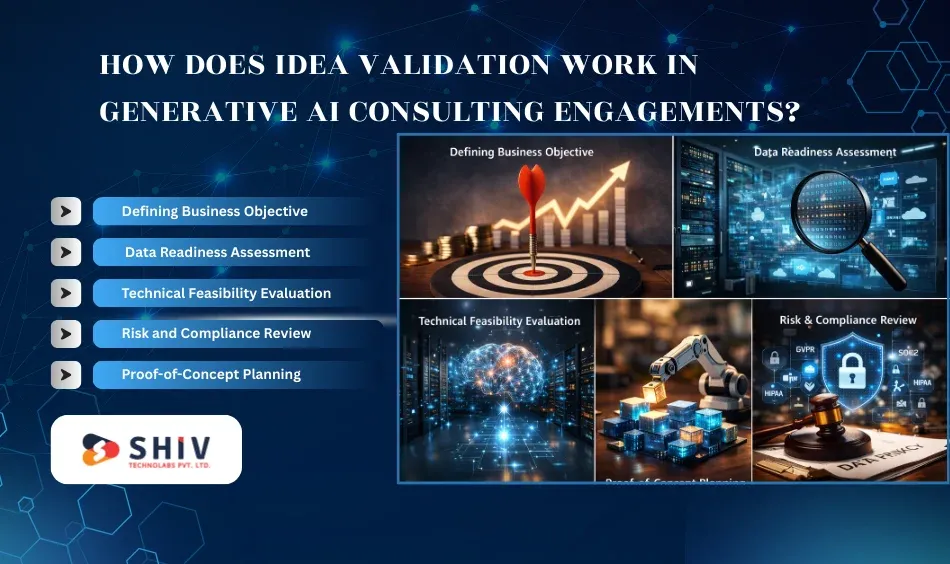
Before investing $100,000+ in full deployment, validation prevents costly missteps. A well-organized Generative AI plan, coupled with AI development offers, will make every use case both commercially viable and technically feasible.
1. Defining Business Objective
Consultants clarify:
- Revenue growth targets
- Automation objectives (% improvement)
- Cost-reduction thresholds
- Time-to-market expectations
Clear KPIs reduce AI initiative failure rates by over 35%.
2. Data Readiness Assessment
Evaluation includes:
- Data quality audits
- Proforma vs informatic data availability.
- Access permissions
- Storage compliance preparedness.
Without clean data, model performance declines by 15–40%.
3. Technical Feasibility Evaluation
Consultants assess:
- Infrastructure capability
- LLM compatibility
- API readiness
- Integration complexity
This step prevents overcommitment to incompatible technologies.
4. Risk and Compliance Review
Enterprises must evaluate:
- GDPR, HIPAA, SOC2 exposure
- Residency requirements of data.
- Model explainability risks
Compliance-first validation reduces legal risk.
5. Proof-of-Concept Planning
A PoC defines:
- Success metrics
- Budget range
- Performance benchmarks
- Deployment roadmap
This is the viability test stage before committing capital.


AI Idea Validation Assessment Matrix
| Assessment Area | Evaluation Criteria | Enterprise Impact |
|---|---|---|
| Data Readiness | Structured vs unstructured data availability | Determines model accuracy |
| Infrastructure | Cloud/on-prem capacity | Impacts scalability |
| Compliance | GDPR, HIPAA, SOC2 alignment | Reduces regulatory risk |
| ROI Feasibility | Cost vs expected automation savings | Investment justification |
How Should Enterprises Build a Generative AI Strategy Before Implementation?
Strategy sets the way forward; architecture sets the way to do it.
Use Case Prioritization
Rank initiatives by:
- Revenue potential
- The efficiency of operation increases.
- Risk profile
- Implementation complexity
Multimodal AI (LLMs, Model Selection)
Choose between:
- Open-source LLMs
- Proprietary APIs
- Fine-tuned domain models
- Multimodal AI: text + image + speech.
Integration Roadmap
Plan integration across:
- ERP
- CRM
- Internal dashboards
- Customer-facing platforms
For more on AI integration into enterprise workflows, see Integrate Generative AI Into Enterprise Applications.
Governance Framework
Define:
- Data access control
- Audit logging
- Bias detection policies
Security Architecture
Incorporate:
- Encryption standards
- API authentication
- Secure model hosting
Strategic Planning Timeline for Generative AI Projects
| Phase | Duration | Deliverable |
|---|---|---|
| Discovery & Assessment | 3–4 weeks | AI Opportunity Report |
| Strategy Design | 4–6 weeks | Enterprise AI Roadmap |
| Architecture Planning | 2–3 weeks | Technical Blueprint |
What Does Generative AI Implementation Involve in Enterprise Environments?
Implementing generative AI requires more than simply activating a model. It requires a regulated implementation within enterprise-grade infrastructure.
Model Fine-Tuning
Fine-tuning improves:
- Domain relevance
- Output accuracy
- Brand alignment
- Compliance sensitivity
API Integration
Integration includes:
- ERP connectivity
- CRM automation
- Secure API gateways
- Middleware orchestration
MLOps
MLOps ensures:
- Continuous monitoring
- Version tracking
- Automated retraining
- Performance benchmarking
AI Development Services
Enterprise AI development services include:
- Custom model engineering
- Backend integration
- Data pipeline optimization
- Deployment automation
Generative AI Implementation.
This stage finalizes:
- User testing
- Scalability validation
- Security audits
- Go-live execution
Enterprise AI Deployment Models Comparison
| Deployment Model | Best For | Security Level | Scalability |
|---|---|---|---|
| Public Cloud | Fast deployment | Medium | High |
| Private Cloud | Regulated industries | High | Medium |
| On-Premise | Sensitive environments | Very High | Limited |
| Hybrid | Large enterprises | High | High |
What Challenges Do Businesses Face During Generative AI Deployment?
Even mature enterprises encounter friction.
- Data Bias: Unchecked bias damages trust and decision quality. Risk is mitigated through responsible AI audits.
- Model Hallucination: LLMs can also produce inaccurate results. Guardrails + validation layers decrease the incidence of hallucinations.
- Security Vulnerabilities: API exposure, data leakage, and misconfigured endpoints create risk.
- Poor System Integration: Disconnected systems decrease the value of automation.
- Budget Overruns: Uncontrolled infrastructure expansion drives up AI enterprise costs.
Risk Mitigation Framework in Generative AI Consulting
| Risk | Mitigation Strategy |
|---|---|
| Data Bias | Responsible AI audits |
| Compliance Violations | Regulatory assessment |
| Scalability Issues | Phased deployment |
| Cost Escalation | ROI tracking dashboards |
How Does Generative AI Consulting Improve ROI and Long-Term Performance?
The value of generative AI only arises when it leaves the experimental stage of its development and enters the orderly implementation. Most businesses invest in models but lack consulting oversight, and thus, they do not translate pilots into tangible financial gains.
1. Automation Rate Improvement
The unorganized implementation of AI leads to fragmented automation. Consulting frameworks identify high-impact processes that can be repeated first to ensure tangible benefits.
Business outcomes include:
- 20-50% increase in document construction processes.
- 30% faster internal approvals
- Minimized handwork within service teams.
2. Cost Reduction Percentage
Generative AI consulting guarantees that costs are forecasted before execution. Planned, non-reactive infrastructure scaling, API utilization, retraining and governance overhead.
AI programs that are consulting-based usually deliver:
- 15-40% decrease in costs of customer support.
- Reduced outsourcing costs with AI-driven processes.
- Reduced rework due to better model governance
3. Customer Response Time
Direct influence on revenue velocity is driven by customer-facing AI systems. Response times are greatly reduced when consulting teams combine AI with CRM, knowledge bases and workflow engines. Improvements that are usually measured include:
- 40–60% faster first-response times
- 24/7 automated query handling
- Increased customer satisfaction (CSAT) scores.
4. Revenue Growth from AI Initiatives
Generative AI consulting identifies alternative ways to monetize, not through automation.
Drivers of revenue acceleration:
- AI-powered personalization → 5–15% higher conversions
- Smart product suggestions.
- Sales assistance technology based on AI.
- Faster product prototyping cycles
5. Risk Mitigation
Stability and compliance have long-term performance. Consulting frameworks incorporate the principles of governance, auditability and responsible AI.
This reduces:
- Regulatory penalties
- Security breaches
- Model bias incidents
- Reputational damage
Conclusion
Generative AI success is not accidental; it requires validation, structured strategy, disciplined advisory oversight, secure implementation and controlled deployment.
Collaborating with a reliable Generative AI Development Company gets your AI projects out of the experimental phase and into quantifiable business results.
Shiv Technolabs provides Generative AI consulting, architecture design, AI development and end-to-end Generative AI implementation services at the enterprise level. From validation and deployment to optimization, our experts align technology with measurable business value.
Frequently Asked Questions (FAQs)
1. What does Generative AI consulting include?
Generative AI consulting involves designing strategies, validating them, planning an architecture, checking for compliance, implementing models, providing deployment support and optimizing performance.
2. How long does Generative AI implementation take?
The time-span of enterprise implementations is usually 8-16 weeks in case of complexities, integration and compliance needs.
3. What is the cost of Generative AI consulting services?
Prices depend on the complexity of the data, infrastructure scale, regulatory scope and deployment scale; they typically range from $50,000 to $250,000+.
4. How does a Generative AI strategy reduce enterprise risk?
Strategy decreases risk by legitimising ROI, meeting compliance requirements, forecasting costs and defining how governance controls will be exercised by the process of defining the controls before execution starts.
5. Can Generative AI be integrated with legacy enterprise systems?
Yes. Generative AI solutions can be connected to ERP, CRM and internal platforms with the help of APIs, middleware and secure connectors.
6. What industries benefit most from Generative AI consulting?
Automation, personalizationand compliance optimization needs are highly relevant across the finance, healthcare, eCommerce, SaaS, legal, and manufacturing sectors.