Table of Contents
Your first AI project sets the tone for every AI investment that follows. Founders, CTOs, product leaders, and operations teams often feel pressure to move fast on AI. That pressure pushes many teams to hire an AI development team before the use case is even clear. A first AI budget usually gets wasted for four reasons: an unclear use case, weak data readiness, missing proof checks, and the wrong hiring model. Smart hiring fixes these before any code gets written.
This guide gives you a clear, step-by-step way to hire the right team and protect your first budget. Teams with early, uncertain ideas can start with AI development services before committing to a full build. You will move through seven simple steps, from defining the use case to funding your first milestone. Each step removes a specific risk, so your money funds proof instead of guesswork.
Quick answer: To hire an AI development team without wasting your first budget, define a clear use case, run a data readiness check, map only the roles you need, choose the right hiring model, split your budget by purpose, ask for proof of similar work, and fund one small milestone before you approve a full build.
What Should You Know Before You Hire an AI Development Team?
Hiring for AI works differently from hiring for standard software. AI talent is expensive, and the wrong scope multiplies that cost fast. A few current facts help you plan before you spend.
AI and machine learning salaries sit at the top of the pay scale. According to Robert Half’s 2026 AI/ML engineer salary guide, these roles range from about $134,000 to $193,250 in the United States. The same guide reports that AI, machine learning, and data science roles received the highest starting salary gains of any tech specialty. One senior AI hire can cost more than a small vendor team working on a fixed scope.
AI adoption is now common, yet mature, scaled results remain rare. Poor data readiness, vague use cases, and missing human oversight cause most stalled AI projects.
How to Hire an AI Development Team Step by Step
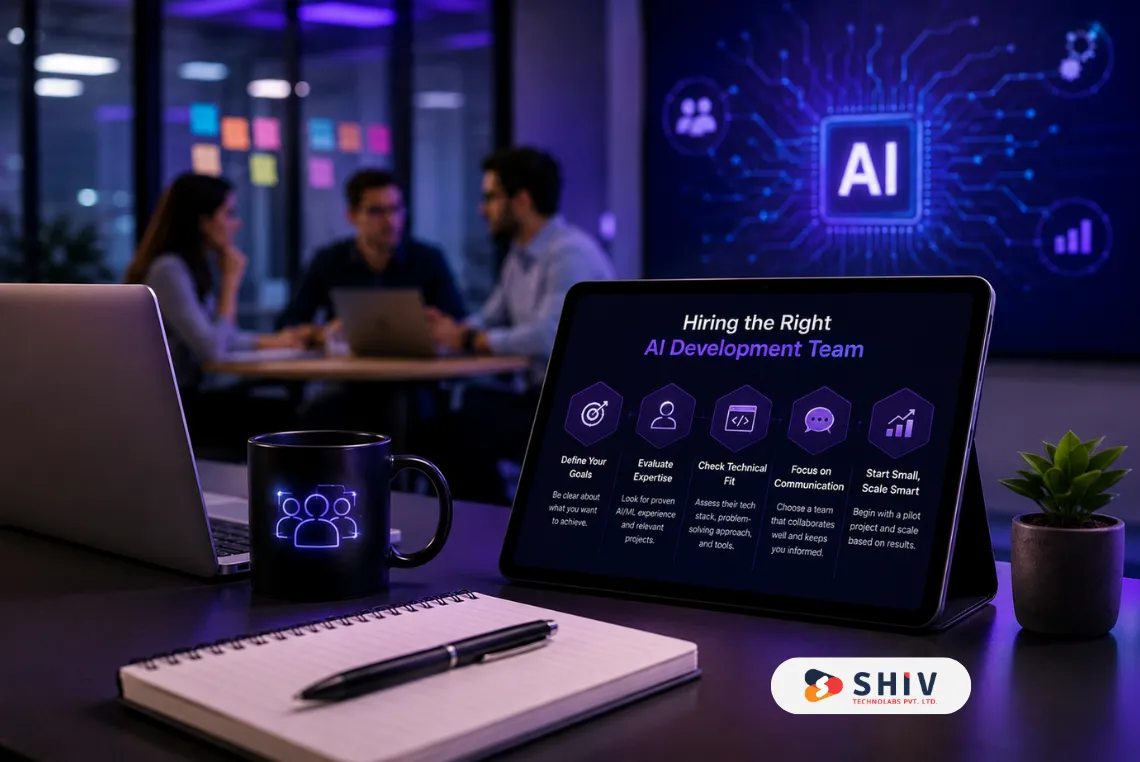
Hiring works best as a clear sequence, not a rushed decision. Each step below removes a specific risk before you spend money. Follow them in order, and your first AI team will fit the scope you truly need.
# Step 1: Define the Use Case and Success Metric
Start with one clear problem and one measurable outcome. A sharp use case keeps scope small and cost predictable. Write down what success looks like as a single number, such as hours saved or tickets resolved per week.
# Step 2: Run a Data Readiness Check
Your model is only as good as the data behind it. Check whether your data is available, clean, labeled, and legal to use. Weak data readiness stalls many first AI projects, so close the gaps before you build anything.
# Step 3: Map the Team Roles You Truly Need
Your first version needs a small core, not a full department. The table below shows common AI team roles and which ones your first budget truly needs. Complex model work often calls for specialized AI/ML development services rather than generalist AI developers who split their time.
| Role | What They Handle | Needed for First Budget? |
| AI Solution Architect | Designs the overall approach, data flow, and model strategy | Yes, part-time or fractional |
| AI/ML Engineer | Builds, trains, and tunes the models | Yes |
| Data Engineer | Prepares, cleans, and pipelines your data | Yes |
| Backend Developer | Connects models to your systems and APIs | Yes |
| Frontend Developer | Builds the interface for the AI feature | Only if users interact directly |
| MLOps Engineer | Handles model release, scaling, and monitoring | Later, unless usage is heavy |
| QA Engineer | Tests accuracy, edge cases, and reliability | Yes, even if part-time |
| Product Manager | Owns scope, priorities, and success metrics | Yes |
| Security or Compliance Reviewer | Checks privacy, risk, and rules | Yes, if data is sensitive |
| Domain Expert | Validates outputs against real business context | Yes |
A solution architect, a data engineer, an AI/ML engineer, a product manager, and a domain expert form a strong first core. You can add MLOps and heavy frontend work once the core proves value.
# Step 4: Choose Your Hiring Model
Your hiring model shapes both cost and risk on the first project. Each option fits a different stage, budget, and level of certainty. Compare them before you commit real money.
| Hiring Model | Best For | Approx. Cost Level | Main Risk | Best First Step |
| Freelancer | Tiny tasks or quick tests | $30 to $150+ / hour | Thin proof, low accountability | Give a small paid test task |
| In-House AI Hire | Long-term core products | $134,000 to $193,250+ / year | Slow, costly, hard to reverse | Hire after scope is proven |
| Dedicated AI Developer | Focused ongoing build | $2,500 to $12,000+ / month | Needs your direction to stay useful | Start a one-month engagement |
| AI Development Team | First MVP or full product | $25,000 to $150,000+ / project | Scope creep if goals are loose | Fund one milestone first |
| AI Development Company | End-to-end delivery with process | $40,000 to $500,000+ / project | Higher cost if scope is padded | Ask for a scoped proposal |
| Fractional AI Advisor | Early scope and strategy | $150 to $400+ / hour | Advice without build capacity | Book a discovery block |
| Hybrid Model | Advisor plus small build team | Varies by the mix | Coordination overhead | Pair advisor with a developer |
For a first project, a scoped team or dedicated developer usually balances cost and control best. When you hire an AI development team for a first build, fund one milestone before the full project.
# Step 5: Split Your First AI Budget
Your first AI budget works best when you split it by purpose, not by guesswork. Your AI development cost depends on scope, data quality, model needs, integrations, security, UI needs, QA depth, deployment, monitoring, and team model.
Typical ranges help you plan. AI discovery and scoping runs about $2,000 to $10,000 or more. A proof of concept runs about $10,000 to $40,000 or more. An MVP AI product or internal tool runs about $25,000 to $100,000 or more. An AI agent or workflow automation system runs about $40,000 to $150,000 or more. An enterprise AI system with integrations and governance runs about $150,000 to $500,000 or more. Ongoing maintenance and monitoring can run about $2,000 to $20,000 or more per month, based on usage, model costs, and reliability needs.
Once you know the range, split the first budget across the areas below.
| Budget Area | Suggested Share | Why It Matters |
| Discovery and Use-Case Validation | 10% to 15% | Confirms the problem is worth solving before you build |
| Data Audit and Preparation | 15% to 25% | Clean data drives accuracy more than any model choice |
| Model and Prototype Work | 20% to 35% | Turns the idea into a working, testable version |
| Integrations | 15% to 25% | Connects the AI to your real systems and workflows |
| Testing and Evaluation | 7% to 10% | Catches accuracy, bias, and edge-case failures early |
| Security and Governance | 3% to 5% | Keeps data safe and outputs compliant with rules |
| Deployment and Monitoring | 3% to 6% | Keeps the live system stable and watched |
| Post-Launch Improvements | 2% to 4% | Funds fixes and tuning after real usage |
The exact split changes with your use case, data readiness, business risk, and integration depth.
# Step 6: Shortlist Vendors and Run Proof Checks
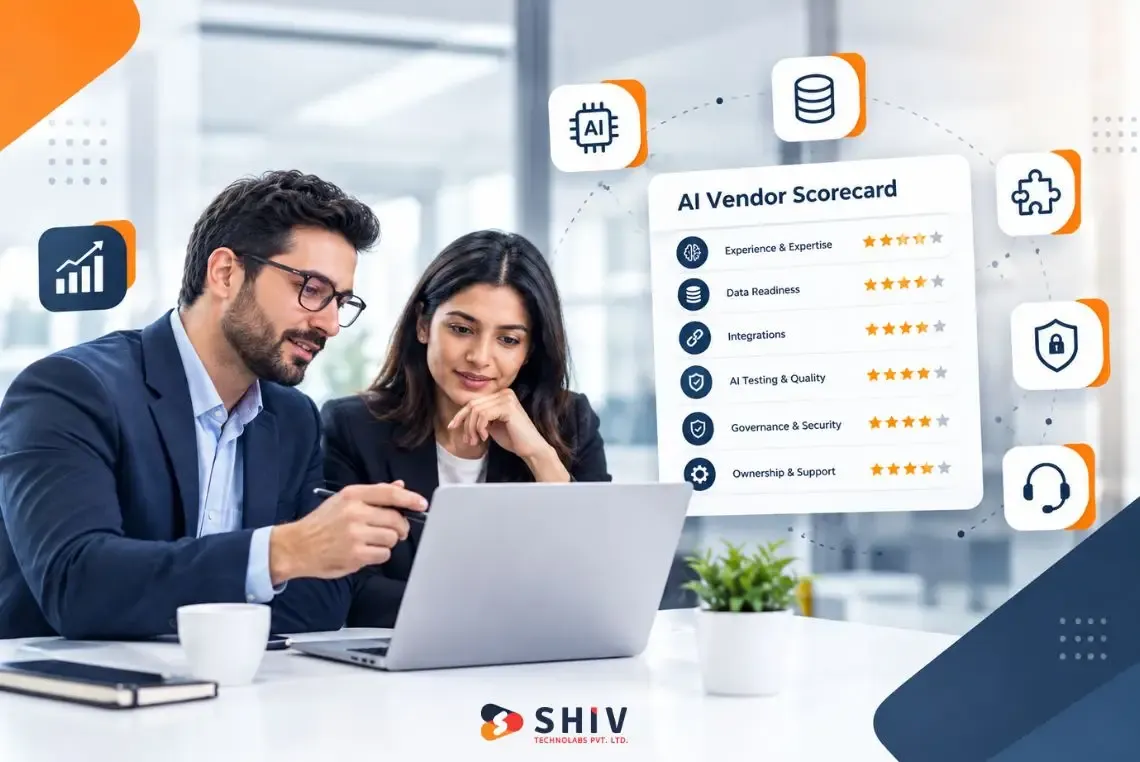
Proof separates a capable AI team from a confident pitch. Strong vendors show their thinking, not just their promises. Score each shortlisted team with the card below.
| Evaluation Area | What to Ask | Score 1 to 5 |
| Similar Project Proof | Can you show a similar AI project you shipped? | ___ / 5 |
| Data Readiness Process | How do you check and prepare our data? | ___ / 5 |
| Architecture Thinking | How will you design the system and data flow? | ___ / 5 |
| Model Selection Logic | Why this model, and what were the options? | ___ / 5 |
| Integration Experience | How have you connected AI to live systems? | ___ / 5 |
| Testing Approach | How do you test accuracy, bias, and edge cases? | ___ / 5 |
| Security Awareness | How do you protect sensitive data? | ___ / 5 |
| Monitoring Plan | How will you track the model after launch? | ___ / 5 |
| Cost Transparency | What drives the price, and where can it change? | ___ / 5 |
| Post-Launch Support | What support do you give after go-live? | ___ / 5 |
| Communication Quality | How often will we hear from your team? | ___ / 5 |
Score each area from one to five, then total the results. A team that scores well on proof, data, and testing usually protects your budget best. Low scores on cost transparency or monitoring are early warning signs.
# Step 7: Fund One Milestone, Then Expand
Fund one small milestone before you approve the full build. A single proof point tells you more than any long proposal. Keep the first scope narrow, since ambitious first versions usually burn budget and delay proof. Start with one workflow, one data source, and one measurable result, then grow into AI agent development services once the first version earns its budget. Teams needing bespoke logic can move into custom software development after the core proves value.

How Do the First 30 Days Map to These Steps?
A first month gives you enough time to run these steps before full development. The plan below turns the sequence into a simple weekly rhythm. By day 30, you can hire an AI development team against a clear, fundable milestone.
| Timeline | Focus (Mapped to the Steps) |
| Week 1 | Steps 1 and 2: clarify the use case, set a success metric, and audit your data |
| Week 2 | Step 3: map the team roles your first version needs |
| Week 3 | Steps 4 and 5: choose the hiring model and split the first budget |
| Week 4 | Steps 6 and 7: run proof checks, then lock the milestone plan and roles |
These 30 days cost far less than a full build, yet they remove most early risk. You will know the scope, the data gaps, and the right team size before you spend big.
Which Hiring Mistakes Waste Your First AI Budget?
Most wasted AI budgets trace back to a handful of avoidable hiring mistakes. These errors usually happen before a single line of code gets written. The checklist below flags the traps that drain first budgets fastest, so you can catch them during hiring.
- Hiring before you define the use case
- Skipping the data readiness check
- Starting with the model instead of the workflow
- Underestimating integration work
- Overlooking privacy and compliance needs
- Choosing vendors without proof of similar work
- Building too many features in the first version
- Forgetting testing and evaluation
- Ignoring monitoring and model-running costs
- Using AI where simple automation would do the job
A quick scan of this list often reveals two or three risks on any first project. Fixing them during hiring costs far less than fixing them after launch.


How Shiv Technolabs Helps You Hire AI Experts for the Right Scope
Shiv Technolabs helps companies define AI use cases, check data readiness, plan realistic budgets, and build the right first team. The team maps your scope before any build, so your first budget funds proof, not guesswork. That approach fits founders and product leaders who want clarity before they commit.
Support spans discovery, data preparation, model selection, integrations, testing, and post-launch monitoring. Teams can start small with generative AI consulting or move straight into a scoped build. When you are ready to hire AI experts for a focused first version, Shiv Technolabs can plan the scope, roles, and budget with you.
Conclusion
A first AI project rewards clear scope far more than fast spending. When you follow the steps in order, from a sharp use case to a funded first milestone, your money buys proof instead of guesswork. The right hiring model and honest proof checks protect that budget at every stage.
Start small, fund one milestone, and expand only after the first version earns its place. When you are ready to hire AI experts for a focused, well-scoped build, begin with discovery and a clear success metric. That first step keeps your budget safe and your first AI build on solid ground.
Frequently Asked Questions
# What Should I Check Before I Hire an AI Development Team?
Check the use case, data readiness, and proof of similar work first. Confirm the team explains its architecture and testing approach clearly. Fund one small milestone before a full build, so you protect your first budget and reduce hiring risk.
# How Much Does It Cost to Hire an AI Development Team?
Costs depend on scope, data, and model needs. Discovery runs about $2,000 to $10,000, a proof of concept about $10,000 to $40,000, and an MVP about $25,000 to $100,000 or more. Final pricing shifts with integrations, security, and monitoring.
# Which Roles Should My First AI Team Include?
Your first team usually needs a solution architect, an AI/ML engineer, a data engineer, and a product manager. Add a domain expert to validate outputs. You can add an MLOps engineer and frontend help once the core version proves real value.
# Should I Hire Freelancers or an AI Development Company?
Freelancers fit small tests and quick experiments. An AI development company fits full delivery with process and support. For a first project, a scoped team or dedicated developer often balances cost, control, and risk better than either extreme.
# How Do I Avoid Wasting My First AI Project Budget?
Start with a clear use case and a data readiness check. Split your budget across discovery, data, model work, integrations, testing, and monitoring. Ask for proof, fund one milestone first, and expand only after the first version works.
# What Is the Best First Step Before Hiring AI Experts?
Run a short discovery phase before you hire anyone full-time. Clarify the problem, check your data, and set one success metric. This small step usually costs $2,000 to $10,000 and saves far more by preventing wrong scope.