Table of Contents
Odoo is raising its Custom plan by 20% and adding a paid Light User seat for 2027. Standard pricing is unchanged and One App Free continues, but the Light User fee now applies to employee records that were previously free, so many businesses will need to revisit their ERP budgets and how they assign system access.
However, the subscription price is only one part of the total cost. Implementation, hosting, customization, integrations, and support can also influence how much a business spends.
This guide explains the announced Odoo pricing changes, compares available plans, and provides practical budget calculations. It also identifies pricing details that businesses should confirm before committing to a new contract or renewal.
Quick Answer: Odoo announced a 20% price increase for its Custom plan for 2027, while Standard pricing is unchanged. In the US, Custom costs $49 per user per month in the first year and $61 after that, and Standard costs $24.90 in the first year and $31.10 after that (annual billing). A new Light User fee of €7.90 (US $8.90) per month applies to each active HR employee record without a user account. One App Free continues. Confirm your own quote before finalizing a budget.
What Is Changing in Odoo Pricing for 2027?
The most significant announced change is the 20% increase in the Odoo Custom plan. Businesses using advanced customization, external API connections, or multi-company features should review how this affects their future subscription costs.
The new Light User fee applies to every active employee record in the HR app that has no user account, so many businesses will pay for employees who were previously free. Odoo has not announced a comparable increase for the Standard plan.
Odoo 2027 Pricing Changes at a Glance
| Odoo Plan | Announced Change | What Businesses Should Review |
| One App Free | Continues | Eligibility for the free single-app offering |
| Standard | No price increase announced | Required applications and user count |
| Custom | 20% price increase announced | Contract renewal and advanced features |
| Light User | New fee per employee record | HR employee records without a user account |
These changes were described in Odoo’s September 24, 2026 announcement, Odoo Takes Stock of 2026 and Unveils Its Ambitions for 2027. The announcement provides the basis for the confirmed changes discussed here.
Why Is Odoo Increasing the Custom Plan Price?
Odoo attributed the increase to cumulative inflation since 2022, which it put at 26%, and to higher salary, hosting, and AI costs. It is Odoo’s first price increase in about four years. The Custom plan supports businesses with more advanced ERP requirements, including features and technical capabilities beyond the Standard offering. Its announced increase makes it important to review whether those capabilities remain necessary for each implementation.
The announcement establishes the pricing change, but businesses should avoid assuming that every Custom subscription will increase by exactly 20% on the same date. Contract conditions, discounts, and renewal terms can affect when a new rate applies.
What Does the Light User Tier Change?
Odoo counts a Light User as any active employee record in the HR app that is not linked to an active user account, as well as any user account designated as a Light User. The fee applies on both Standard and Custom from Odoo 20, requires at least one full user, and does not get the first-year discount.
For many companies this is a new cost rather than a cheaper seat. Employees who only had an HR record, for example to receive payslips, record attendance, or use the Point of Sale, were previously free and will now be billed as Light Users.
How Much Does Odoo Cost Per User in 2027?
Odoo pricing depends on the subscription plan, billing period, country, and contract conditions. The official US pricing page currently displays Standard at $24.90 per user per month and Custom at $49 per user per month under its annual billing presentation. After the first 12 months, the regular rates are $31.10 for Standard and $61 for Custom.
Odoo states that its promotional discount applies for 12 months to the initial users ordered, so businesses should compare their actual quotes rather than assume the website price will continue indefinitely.
Current Odoo Pricing in the United States
| Plan | First-Year US Price | Regular Price (After Year 1) | Important Conditions |
| One App Free | $0 | $0 | One app, subject to eligibility |
| Standard | $24.90/user/month | $31.10/user/month | Annual billing, introductory discount |
| Custom | $49.00/user/month | $61.00/user/month | Annual billing, introductory discount |
| Light User | $8.90/employee/month | $8.90 (no first-year discount) | Per HR employee record without a user account; needs one full user |
Prices checked November 20, 2026. Source: Odoo’s official pricing page. Taxes, location, billing period, and contract terms may change the amount payable.
One App Free: When Is It Enough?
Odoo’s One App Free offering allows eligible businesses to use a single application without a subscription fee. It can be suitable for organizations that need one specific business function rather than a connected ERP system.
However, businesses planning to use multiple applications should review the eligibility conditions carefully. Some related functionality may be included, but the free offering should not be assumed to cover every combination of apps or custom requirements.
Standard Plan: Core ERP at a Lower Subscription Cost
The Standard plan includes Odoo’s applications under one subscription and uses Odoo Online hosting. It can suit businesses that need connected sales, inventory, accounting, CRM, or other supported applications without advanced custom development.
Odoo’s announced pricing update does not specify a Standard plan increase. However, individual contracts may still be affected by introductory discounts ending, billing changes, or additional users.
Custom Plan: Advanced ERP Capabilities
The Custom plan supports more advanced requirements, including Odoo Studio, multi-company operations, external API access, and supported custom development environments.
The US pricing page already shows the post-increase Custom price: $49 per user per month in the first year and $61 after that (annual billing). The 20% figure is Odoo’s headline number, and the increase differs by country.
Light User: A New Fee on Employee Records
Odoo bills a Light User for every active employee record in the HR app that is not linked to an active user account, and for user accounts designated as Light Users. The fee applies on Standard and Custom from Odoo 20, requires at least one full user, and has no first-year discount.
Light Users can manage their own time off, expenses, appraisals, attendance, and planning, and can receive payslips or use the Point of Sale and the manufacturing shop floor. Light User prices by region, per employee record per month:
| Region | Light User Price per Month |
| United States | $8.90 |
| Eurozone | €7.90 |
| India | ₹195 |
Before upgrading to Odoo 20, count the active employee records without a user account. Each one adds a Light User fee.
How Do Annual Billing and Renewal Discounts Affect Cost?
The first-year subscription amount may differ from the renewal amount because introductory discounts have limited validity. Businesses adding users during an existing contract should also confirm how those users are billed.
Before comparing plans, check:
- The displayed introductory rate and its validity.
- The standard rate after promotional discounts expire.
- Annual versus monthly billing conditions.
- The number of full users and active employee records without a user account.
- Contract renewal dates and applicable taxes.
- Additional hosting or development charges.
Expert Insight: Compare the full contract value rather than the lowest advertised monthly rate. A discounted first year can make a subscription appear less expensive than its longer-term cost.
Who Will Pay More or Less Under Odoo’s 2027 Pricing Changes?
The announced changes will not affect every Odoo customer in the same way. Businesses with many Custom plan users may face higher subscription costs, and businesses with many employees in the HR app will pay a new Light User fee for each record without a user account.
The actual impact depends on existing contracts, the features employees use, and how many HR records have no user account.
| Business Situation | Potential 2027 Impact | Recommended Action |
| Many full Custom users | Higher subscription cost | Review renewal pricing |
| Employees with HR records but no user account | New Light User fee for each record | Count and clean up HR records |
| Standard plan users | No announced plan-rate increase | Review contract and user count |
| One App Free users | Free offering continues | Confirm eligibility |
| Growing businesses | Higher total cost as users increase | Forecast new users |
| Multi-company businesses | Custom requirements may remain necessary | Review feature dependencies |
For example, a manufacturing business with full ERP users and warehouse employees may have different licensing needs across departments. Some employees may require full inventory management permissions, while warehouse staff who only exist as HR records will each be billed as a Light User.
Expert Insight: The best licensing decision starts with the work employees perform. Assigning licenses based only on job titles can result in unnecessary costs or insufficient system permissions.
Odoo Standard vs Custom vs Light User: Which Plan Fits Your Business?
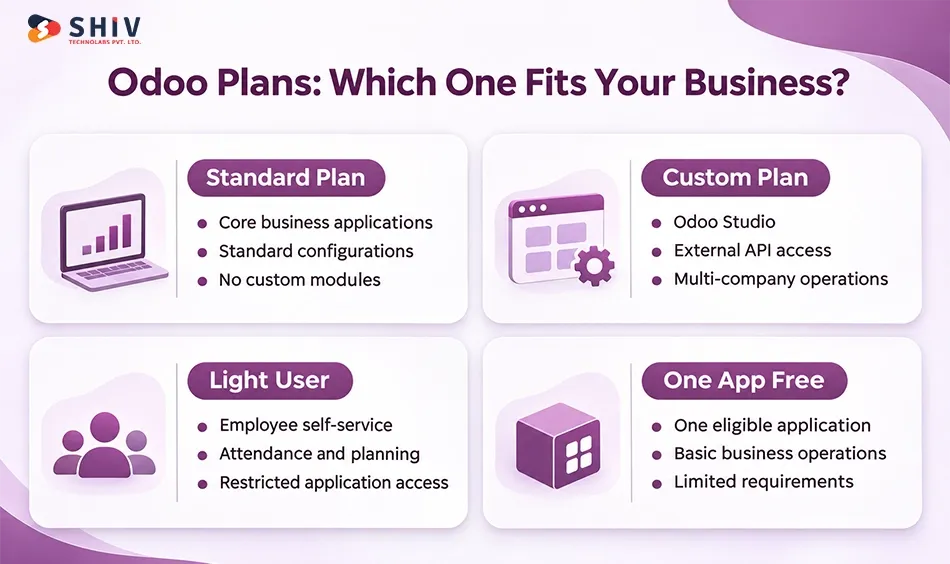
Choosing an Odoo plan requires more than comparing subscription prices. Businesses should consider which applications they use, whether they need custom development, and how employees interact with the system. Standard and Custom support different technical requirements, while Light User is a fee on employee records without a user account, not a replacement for either plan.
Standard Plan for Core Business Operations
Standard is suitable when a business can operate using Odoo’s supported applications and configuration capabilities without custom modules or advanced external API requirements.
It can support common processes involving sales, CRM, accounting, inventory, and other applications. However, businesses should review technical requirements before selecting Standard based only on its lower price.
Custom Plan for Advanced ERP Requirements
Custom is appropriate when businesses need capabilities such as Odoo Studio, external API access, multi-company operations, or supported custom modules.
For example, a company connecting Odoo with several external platforms may need Custom, depending on how those integrations work. Businesses can assess these dependencies as part of their Odoo development planning before committing to a subscription.
Light User for Employees Without a User Account
Light User is not a plan you choose. Odoo bills it automatically for each active employee record in the HR app that has no user account, and for user accounts designated as Light Users.
Light Users can handle their own time off, expenses, appraisals, attendance, and planning, use barcode operations and field service, and read Knowledge articles. As employees, they can receive payslips and use the Point of Sale and the manufacturing shop floor. Anyone who needs more than this needs a full user.
When One App Free May Be Sufficient
A small business using one eligible Odoo application may not need a paid plan immediately. This can be practical when its requirements are limited and the free offering supports the necessary workflow.
However, businesses planning wider ERP adoption should assess future application needs. Selecting a free option without considering upcoming requirements may lead to avoidable configuration changes later.
How Will Odoo Pricing Changes Affect Your 2027 ERP Budget?
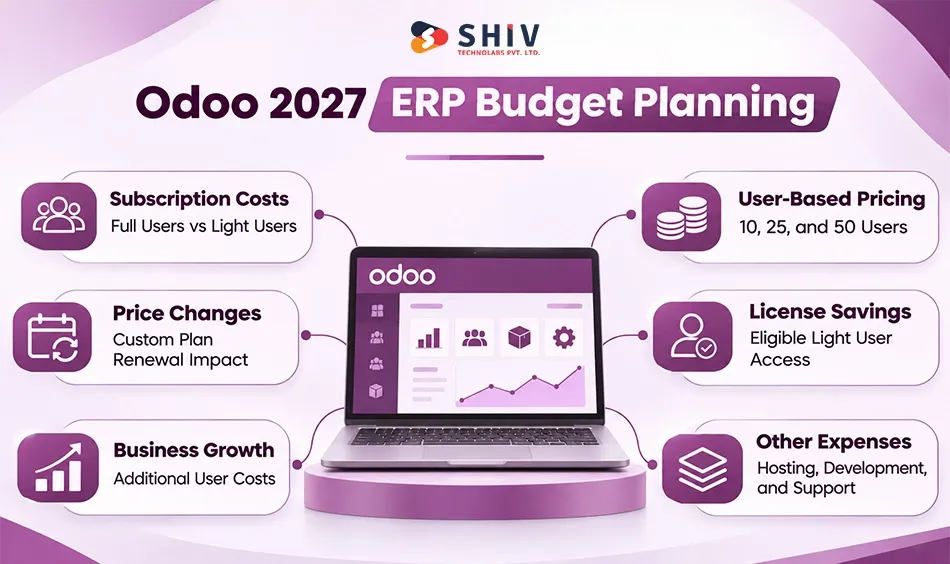
The financial impact of Odoo’s 2027 pricing changes depends on the number of users, subscription type, contract rates, and additional ERP expenses. A company with 10 full users will have a different cost structure from a company with 50 users across several departments. The most useful budgeting approach is to calculate subscriptions by user category and then add implementation, hosting, integrations, and support. This gives decision-makers a clearer picture of total ERP spending.
1. Calculate Subscription Costs by User Type
Begin by separating people according to their access. Full users need sales, accounting, inventory, or administrative permissions. Every other active employee record in the HR app counts as a Light User.
For a simple annual subscription estimate, use:
Annual cost = (Full users × full-user rate × 12) + (Light Users × Light User rate × 12)
This calculation assumes that the selected monthly-equivalent rates apply for all 12 months. It does not include taxes, implementation, hosting, or other additional charges.
2. Compare Odoo Costs for 10, 25, and 50 Users
The following examples use Odoo’s US Custom rates: $49 per user per month in the first year and $61 at renewal.
| Full Custom Users | Monthly Equivalent | 12-Month at $49 (Year 1) | 12-Month at $61 Renewal |
| 10 | $490 | $5,880 | $7,320 |
| 25 | $1,225 | $14,700 | $18,300 |
| 50 | $2,450 | $29,400 | $36,600 |
Most existing customers will pay the renewal rate, so budget from the $61 column unless your contract says otherwise.
3. Estimate the Impact of the Custom Plan Increase
For an existing Custom customer, the starting point is the rate in the current contract.
For example, Odoo’s US Custom plan renewed at $46.80 per user per month before the change. The US pricing page now shows $61.00 after the first year, an increase of about 30%.
For 25 users, the annual difference would be:
- Previous annual cost at $46.80: $14,040.
- Annual cost at $61.00: $18,300.
- Annual increase: $4,260.
The US increase is larger than the 20% headline because rates differ by country. Use the rate in your own contract and your renewal quote.
4. Check How Light Users Change Licensing Costs
Light Users can lower costs where an employee would otherwise need a full user. Consider an organization with 25 employees: instead of 25 full Custom users, it has 20 full users and five employees who only need Light User capabilities.
| User Type | Number of Users | Illustrative Monthly Rate | Annual Amount |
| Full Custom | 20 | $49.00 | $11,760 |
| Light User | 5 | $8.90 | $534 |
| Total | 25 | $12,294 |
At the same displayed rates, 25 full Custom users would total $14,700 annually. The mixed-user illustration is $2,406 lower.
The more common case runs the other way. A business with 25 full users and 40 employees who only exist as HR records, such as warehouse or shop-floor staff, did not pay for those 40 records before. From Odoo 20 it pays 40 × $8.90 × 12 = $4,272 a year in Light User fees. That is the main budget risk of the change.
5. Account for New Employees and Business Expansion
ERP budgets should reflect expected hiring, new departments, and changes in business operations. A company may begin the year with 25 users but require additional licenses as its workforce grows.
Finance teams should estimate expected user growth and identify which new roles require full system access. This prevents annual budgets from relying on an unrealistic assumption that the current user count will remain unchanged.
6. Compare Introductory Pricing With Renewal Costs
The displayed subscription rate may be lower during the initial contract period. Businesses should therefore prepare separate first-year and renewal estimates.
A practical budget should distinguish between:
- Initial subscription costs.
- Renewal subscription costs.
- New users added during the contract.
- Hosting and infrastructure charges.
- Implementation and development expenses.
- Recurring support and maintenance.
What Costs Should Businesses Include Beyond Odoo Subscriptions?
Odoo ERP pricing includes more than the amount charged for software access. Implementation, data migration, customization, integrations, training, and technical maintenance can significantly affect total ownership costs. Not every business requires all these services.
Main Odoo ERP Cost Components
| Cost Component | Cost Type | Main Cost Drivers |
| Software subscription | Recurring | Plan, user count, contract |
| Implementation | Usually initial | Modules, processes, configuration |
| Custom development | Initial and ongoing | Features, workflows, complexity |
| Odoo.sh hosting | Recurring when applicable | Hosting requirements |
| Third-party integrations | Initial and ongoing | External systems and maintenance |
| Data migration | Project-based | Data volume, quality, mapping |
| Employee training | Initial and periodic | Departments, roles, processes |
| Technical support | Recurring or on demand | Support scope and service terms |
| AI and usage-based services | Variable where applicable | Consumption and applicable charges |
Odoo’s official pricing documentation identifies exclusions such as implementation services, custom-code maintenance, certain in-app purchases, and separate Odoo.sh hosting charges.
Implementation and Configuration
Implementation costs depend on the number of modules, business processes, and departments involved. A small company using standard accounting and CRM features may require less work than a manufacturer with inventory, purchasing, production, and finance requirements.
A structured implementation process typically includes requirements analysis, configuration, data preparation, testing, and employee training. These activities should be estimated separately from the software subscription.
For businesses planning a new rollout, Odoo implementation services can help identify the technical work needed before project costs are finalized.
Custom Development and Odoo Studio
Custom development may be necessary when standard functionality cannot support a required workflow. Examples include specialized approval processes, industry-specific modules, custom reports, and additional automation.
Businesses should also consider future maintenance. A feature that requires custom code may need testing or updates when Odoo releases new versions. The decision should balance the value of customization against its long-term cost, rather than treating every requested feature as an immediate development requirement.
Third-Party Integrations and APIs
Integrations connect Odoo with other business applications, such as eCommerce platforms, payment systems, logistics software, and reporting tools.
Integration costs depend on the number of connected systems, data complexity, security requirements, and ongoing maintenance. Businesses should also confirm whether the planned integration requires Custom plan capabilities.
For example, connecting an external commerce platform with inventory and accounting workflows may involve both ERP configuration and custom integration work. These requirements are part of the technical planning covered by Odoo integration and development services.
Odoo.sh Hosting and Infrastructure
Odoo Online hosting is included in eligible subscriptions, while Odoo.sh hosting is charged separately. Businesses using on-premise infrastructure must also account for their own hosting and administration costs.
Hosting requirements depend on the system architecture, custom modules, development environments, and operational needs. The lowest hosting cost may not be appropriate for every implementation.
Data Migration, Training, and Support
Migrating information from an existing ERP can require data cleaning, field mapping, validation, and testing. Poor data quality can increase project time and create problems after launch.
Employee training and ongoing support also deserve budget allocations. Businesses may need additional assistance when workflows change, new departments adopt Odoo, or custom modules require maintenance.
How Can Businesses Reduce Odoo Costs Without Losing Important Features?
Managing Odoo expenses begins with reviewing how the system supports daily operations. Businesses may find opportunities to reduce unnecessary licenses, avoid duplicate functionality, and limit custom development without affecting essential processes. However, reducing cost should not mean removing permissions or features that employees need to perform their jobs.
Practical Ways to Control Odoo Expenses
1. Review User Access Regularly
Check inactive accounts and employees who no longer need full access. Adjust permissions based on their current responsibilities to avoid unnecessary license costs.
2. Count Light User Records
Light User fees apply to every active employee record without a user account. Archive records for people who have left, and check which employees need a full user rather than a Light User.
3. Use Standard Features Where Possible
Review existing Odoo applications before requesting custom development. Using built-in features for routine business processes can reduce development and maintenance expenses.
For example, a business may have several custom reports that duplicate information available through standard Odoo reporting features. Reviewing these reports could reduce future maintenance work.
4. Prioritize Essential Integrations
List the external platforms your business needs to connect with Odoo. Start with integrations that support critical workflows, such as accounting, payments, inventory, or CRM.
5. Match Hosting to Business Needs
Choose hosting based on user volume, data requirements, performance, and technical complexity. Review infrastructure costs as your business grows.
6. Plan Custom Development Carefully
Document functional requirements before developing custom modules. Prioritize features that address specific business problems and avoid unnecessary modifications.
7. Review Renewal Terms Early
Check upcoming subscription rates, contract terms, available discounts, and expected user additions before renewal. Early planning gives finance teams more time to prepare for potential cost changes.
What Should Existing Odoo Customers Check Before Their 2027 Renewal?
Existing customers should review their contracts before assuming that announced pricing changes will apply immediately. Renewal dates, discounts, hosting arrangements, and the number of licensed users may affect the final amount.
Businesses should request a current quotation and compare it with their existing agreement. This is especially important for Custom customers and organizations considering the Light User category.
Odoo 2027 Renewal Checklist
| Checkpoint | Question to Answer |
| Current plan | Are we using Standard or Custom? |
| Contract period | When does the current pricing agreement end? |
| Renewal price | What rate will apply after renewal? |
| Promotional discounts | Which discounts expire and when? |
| Full users | How many employees need full ERP access? |
| Light Users | How many active employee records have no user account? |
| Hosting | Are separate Odoo.sh charges applicable? |
| Custom modules | Which developments need ongoing maintenance? |
| Integrations | Are additional API or technical charges expected? |
| Future growth | How many users may be added next year? |
| Support | Which services are included or billed separately? |
Finance, operations, and technical teams should review the same information before approving the budget. This helps prevent decisions based on incomplete user counts or overlooked technical dependencies.
Migration and upgrade requirements should also be part of the ERP budget, especially when businesses need data transfers, integration updates, or system modifications. These technical considerations are closely linked to Odoo architecture, integrations, and long-term system stability.
Which Odoo Pricing Details Still Need Confirmation for 2027?
Odoo has confirmed the broad pricing changes in its announcement, but the published information does not establish every customer’s future invoice amount.
The US pricing page already shows the new Custom rates, but your invoice depends on your renewal date, any negotiated discount, and how many Light Users your HR records generate.
Important details to verify include:
- Effective date: When the revised rate applies to a particular contract.
- Existing subscriptions: Whether the increase applies at renewal or under another contractual condition.
- Discounts: Whether existing promotional or negotiated discounts continue.
- Light User count: How many active employee records have no user account.
- Regional pricing: How the published prices apply in each country and currency.
- Renewal amounts: What the business will pay after introductory pricing expires.
For confirmed figures, businesses should consult Odoo’s September 2026 announcement and current pricing page, then request a contract-specific quotation.
Odoo Community vs Enterprise: Which Offers Better Cost Control?
Odoo Community and Odoo Enterprise follow different cost structures. Community is the open-source edition without the Enterprise per-user subscription fee, while Enterprise provides access to additional applications, services, and commercial functionality.
However, Community is not automatically free to operate. Businesses may still need to pay for hosting, implementation, custom development, integrations, and ongoing maintenance.
Odoo Community vs Enterprise Cost Comparison
| Factor | Odoo Community | Odoo Enterprise |
| Software license | No Enterprise subscription fee | Subscription-based |
| Application availability | Community features | Enterprise application offering |
| Hosting | Business-managed or third-party | Odoo Online, Odoo.sh, or on-premise, depending on plan |
| Implementation | Additional project cost | Additional project cost |
| Custom development | May be required | Depends on requirements |
| Maintenance | Business or technical partner | Included standard services, with custom code handled separately |
| Best suited for | Businesses comfortable managing technical requirements | Businesses needing Enterprise features and services |
A company with a capable internal development team may find Community suitable for certain requirements. Another business may prefer Enterprise because its available features and services reduce the need for custom work.
Expert Insight: Compare total ownership costs over several years rather than only the license fee. A lower software subscription cost may be offset by higher development or maintenance expenses.
How Can Shiv Technolabs Help Businesses Plan Odoo Costs for 2027?
The announced Odoo pricing changes give businesses a reason to review their ERP requirements, licensing structure, and future development plans. A technical assessment can help identify which features are necessary and where implementation or maintenance costs may arise.
Shiv Technolabs provides Odoo development, implementation, customization, integration, migration, and support services. Its team can help businesses review technical requirements and prepare a project scope before they commit to additional development work.
Areas Where Technical Planning Can Help
- ERP requirements assessment: Review business processes, modules, and system dependencies.
- User-role planning: Map employee activities to the access permissions they require.
- Implementation estimates: Identify configuration, migration, and training requirements.
- Customization review: Assess which workflows need custom development.
- Integration planning: Review external applications and API dependencies.
- Maintenance planning: Identify ongoing support and upgrade requirements.
For example, a growing business may need to connect Odoo with an existing eCommerce platform while supporting additional warehouse employees. Reviewing the integration architecture and employee permissions together can provide a more useful cost estimate than calculating licenses alone.
Shiv Technolabs does not set Odoo’s subscription prices or determine licensing eligibility. Those details must be confirmed directly with Odoo. Its Odoo development services can support the technical assessment and implementation planning that form part of the wider ERP budget.
Frequently Asked Questions
Is Odoo Increasing Its Prices in 2027?
Yes. Odoo announced a 20% increase for its Custom plan and a new paid Light User category for 2027. Standard pricing is unchanged and One App Free continues.
How Much Is the Odoo Custom Plan Price Increase?
Odoo’s headline figure is 20%, but the change varies by country. In the US, the pricing page already shows the new Custom price: $49 per user per month in the first year and $61 after that (annual billing).
Is the Odoo Standard Plan Price Changing?
Odoo’s September 2026 announcement states that Standard pricing remains unchanged. However, customers may still experience different invoice amounts when introductory discounts expire, user counts change, or contract terms are updated.
What Is the Odoo Light User Tier?
A Light User is any active employee record in the HR app that is not linked to an active user account, plus any user account designated as a Light User. Odoo applies the fee automatically from Odoo 20 on both Standard and Custom; it is not an opt-in tier. It costs €7.90 (US $8.90) per month, needs at least one full user, and has no first-year discount.
How Much Does Odoo Cost Per User Per Month?
As of November 20, 2026, Odoo’s US pricing page shows Standard at $24.90 per user per month in the first year and $31.10 after that, and Custom at $49 in the first year and $61 after that (annual billing). Light User is $8.90 per employee record per month, with no first-year discount. Rates vary by country and contract.
Does Odoo Charge for Every Employee?
Not at the full-user rate, but most active employee records now carry a fee. From Odoo 20, every active employee record in the HR app that is not linked to an active user account is billed as a Light User, at US $8.90 per month each (€7.90 in the eurozone, ₹195 in India). Only employees with a full user account are billed at the Standard or Custom rate.
Will the Odoo Price Increase Affect Existing Customers?
The announcement does not establish a universal effective date for every existing contract. Customers should check their renewal conditions, negotiated discounts, and current quotations to determine when and how the announced Custom plan increase applies.
Is Odoo.sh Hosting Included in the Custom Plan?
No. The Custom plan supports Odoo.sh hosting, but Odoo states that Odoo.sh hosting charges are separate. Businesses should include applicable infrastructure expenses in their budgets alongside subscriptions, development, and maintenance.
Does Odoo One App Free Still Exist?
Yes. Odoo confirmed that its One App Free offering continues. Eligible businesses can use one application without a subscription fee, subject to the applicable conditions. Organizations requiring multiple applications or advanced capabilities should review the paid plans.
How Should a Business Budget for Odoo in 2027?
Start with confirmed subscription rates and the number of users in each eligible category. Then add implementation, hosting, customization, integrations, migration, training, and support. Prepare separate initial and renewal estimates, and request a current Odoo quotation before approving the final budget.
Final Verdict: What Odoo Pricing 2027 Means for Businesses
Odoo pricing in 2027 brings two changes: a 20% headline increase for Custom subscriptions and a new Light User fee on employee records that have no user account. Standard pricing is unchanged, and One App Free continues for eligible use cases.
Businesses using Custom should budget for renewal at the regular rate, not the first-year price. Businesses with many employees in the HR app should count the records without user accounts, because each one adds a Light User fee.
The most reliable budget combines confirmed subscription rates with implementation, hosting, integrations, customization, and support costs. A structured assessment helps businesses make informed decisions without relying on promotional prices or unconfirmed renewal assumptions.