Table of Contents
When an agency wins a large ERP project but does not have the internal team to deliver it, the options narrow fast. Hiring slows things down, and missing the delivery window costs the client relationship. That is exactly where white label development services become the practical answer for agencies that want to grow without adding permanent headcount. With this model, you offer a full enterprise resource planning system under your own brand while a trusted development partner handles the engineering, testing, and post-launch support.
This guide covers how white label ERP works for agencies, what it costs across different project sizes, and the best practices that keep delivery on track. You will also find a platform comparison, industry use cases, and updated pricing guidance to help you plan margins and present credible timelines to clients.
Quick Answer
White label ERP for agencies is a delivery model where a development partner builds and maintains an ERP system that your agency sells and supports under your own brand. Your agency manages the client relationship, sets the price, and owns the roadmap. The partner handles design, engineering, integration, testing, and post-launch support, which is not visible to the client.
What Is White Label ERP and How Do Agencies Use It?
White label ERP development means a partner handles the full technical build while your agency owns the client relationship. You present the product as your own service, under your name and branding. This setup works for agencies, IT consultancies, and SaaS companies that want to offer ERP through a trusted software development partner without the overhead of a permanent development team.
The typical engagement runs from discovery through delivery and ongoing support. Your team gathers requirements, validates scope, and presents the proposal. The partner creates the solution blueprint, sets up environments, and manages sprints. Together, you move through user acceptance testing, cutover planning, user training, and go-live. The partner handles technical support after launch while you stay front-facing with the client.
1. Core ERP Modules Typically Covered
Most white label ERP projects cover a combination of modules that can be planned through custom ERP development, chosen based on the client’s industry and process maturity.
- Finance and Accounting – Covers the general ledger, accounts payable and receivable, bank reconciliation, and audit reporting. Multi-currency and multi-entity configurations are common for growing businesses with operations across regions.
- Customer Relationship Management – Tracks sales pipelines, contact records, communications history, and deal progress. It connects to email tools, marketing platforms, and customer support systems to give teams a single view of every client relationship.
- Human Resources and Payroll – Manages employee records, leave tracking, payroll processing, and performance review cycles. Agencies often pair this with attendance systems for clients in retail, manufacturing, or field services.
- Supply Chain and Inventory – Handles purchase orders, warehouse stock levels, vendor management, and fulfillment tracking. This is a core requirement for clients in distribution, retail, and light manufacturing who need real-time stock visibility.
- Reporting and Analytics – Pulls data from all modules into custom dashboards, scheduled reports, and export-ready formats. Clients use this to track margins, monitor approval cycles, and review performance against business targets.
Most partners work under a signed NDA, follow your delivery playbook, and appear on client calls as part of your team. Proposals, demo environments, and onboarding materials carry your branding throughout the engagement. You keep all client-facing assets and maintain trust with your client while your partner focuses on quality delivery.
How Much Does White Label ERP Development Cost for Agencies?
ERP outsourcing costs depend on the platform, scope, team composition, integrations, data migration complexity, and post-launch support level. A well-scoped discovery phase is the most reliable way to size the budget before committing to a delivery timeline.
Start with a discovery engagement to map processes, user roles, approval flows, and reporting requirements. Build an organized backlog that covers all environments, migration steps, test plans, and training activities. This detail improves margin accuracy and helps your sales team present credible delivery timelines during the proposal stage.
1. Typical Price Ranges by Project Size
- Entry-Level Builds (2-3 modules, minimal integrations): $25,000-$60,000 – These suit small businesses or single departments moving off spreadsheets. They cover core finance or CRM with basic reporting. Build timelines typically run 6-12 weeks with a small team.
- Mid-market builds (5-8 modules, SSO, custom reports, 2-3 integrations): $80,000-$180,000 – These cover multi-department rollouts for clients in services, retail, or distribution. Expect a 4-6 month delivery timeline with a business analyst, two or three developers, and a QA resource.
- Enterprise builds (multi-company, complex approvals, deep integrations): $200,000+ – These include multi-entity finance, complex approval hierarchies, and integration with WMS, eCommerce, and external CRM systems. Build timelines that extend 6-12 months with a larger cross-functional team.
2. Key Cost Drivers To Plan For
Hourly rates vary by platform and partner location. Odoo specialists typically range from $35-$90 per hour. Microsoft Dynamics and Salesforce experts typically range from $65-$130 per hour, with solution architects at the higher end of that range.
Cost increases with the number of users, legacy system complexity, data quality issues, and the depth of integration requirements. Common connectors include payment gateways, WMS, eCommerce platforms, CPQ tools, BI dashboards, and system integration services for external CRM tools. Each integration adds mapping, testing, security review, and ongoing support scope that affects both timeline and budget.
Pricing model comparison:
| Pricing Model | Best For | Risk Profile |
|---|---|---|
| Fixed-price | Well-scoped builds with stable requirements | Low for agencies with locked scope |
| Time-and-materials | Evolving scope or discovery-led projects | Shared between agency and client |
| Monthly retainer | Long-term support, phased module rollouts | Predictable recurring margins |
Protect margins by locking scope before sprints start, planning a change order process, and including contingency for data quality surprises. Add a support menu with response time tiers, escalation paths, and an optional hypercare period for the first 30 days after go-live.
What Are the Real Benefits of White Label ERP for Your Agency?
The benefits of white label ERP go beyond cost savings. They change how your agency scales, competes, and retains clients across complex delivery programs. The gains are real, but they depend on how the partnership is structured and managed from day one.
1. Reduced Overhead Without Sacrificing Delivery Quality
You avoid full-time salaries, recruitment fees, and ongoing tool licenses for an internal ERP team. The partner brings ready skills, tested playbooks, and a QA discipline your team does not need to build from scratch. Your cost base stays lean while delivery quality remains consistent across builds of varying size and complexity.
2. Faster Time-to-Value For Your Clients
Partners come prepared with reusable module libraries, sprint templates, and integration patterns. They set up environments quickly, complete integrations in parallel with other build tracks, and manage UAT with structured test plans. Your clients reach working software faster, which builds confidence and reduces pressure on your account team during delivery.
3. Access To Rare ERP Expertise Without Hiring
Finding skilled Odoo implementers, Dynamics architects, or Salesforce ERP specialists through traditional hiring is expensive and slow. A white label partner gives you access to these skills immediately, along with data migration experts, security reviewers, and performance engineers. You get the depth needed for complex builds without the long-term payroll commitment that makes hiring risky.
4. Freedom To Focus On Growth and Client Strategy
When delivery is in capable hands, your core team can focus on discovery, stakeholder alignment, and executive reporting. Account managers can pursue cross-sell and upsell conversations instead of managing sprint boards. Sales teams can close more deals without worrying about capacity. This shift raises win rates, improves client satisfaction scores, and positions your agency as a strategic growth partner rather than a transactional project vendor.
Which ERP Platforms Work Best for White Label Projects?
Agencies that offer white label ERP software typically standardize on one or two platforms. Matching the platform to client size, budget, industry, and compliance requirements is the most important decision before scoping begins.
| Platform | Cost Tier | Best Fit |
|---|---|---|
| Odoo | Low-Mid | Modular builds, fast MVPs, broad app coverage, SMB to mid-market |
| Microsoft Dynamics 365 | Mid-High | Multi-entity finance, complex approvals, regulated industries, enterprise |
| Salesforce (with ERP add-ons) | High | CRM-first firms, partner ecosystems, sales operations |
| Zoho ERP | Low-Mid | Small businesses, quick rollouts, straightforward admin requirements |
Odoo implementation services are popular for agency white label work because of Odoo’s modular structure, active app store, and strong community. It suits fast MVPs and mid-market clients well. Microsoft Dynamics is the right choice for multi-company finance or clients in regulated industries. Salesforce suits clients already invested in its CRM ecosystem who need ERP capability without switching platforms. Zoho fits budget-conscious small businesses with simpler process needs.
Plan your data model early on every platform. Late-stage data model changes are expensive regardless of the platform and are a common cause of go-live delays on ERP projects.
What Best Practices Should Agencies Follow for ERP Outsourcing?
The difference between a smooth ERP delivery and a costly overrun often comes down to process discipline before a single sprint starts. These practices apply across all platforms and project sizes.
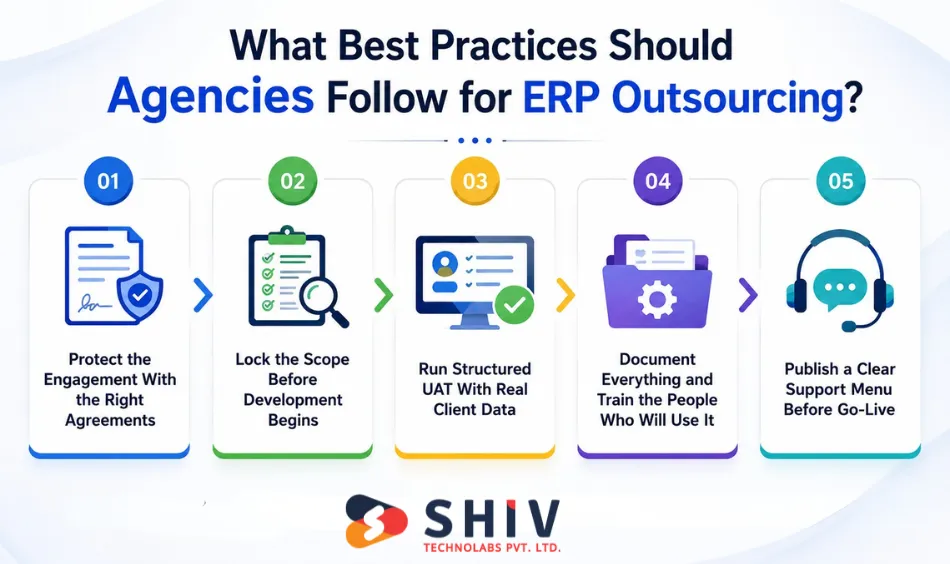
1. Protect the Engagement With the Right Agreements
Sign an NDA and Master Services Agreement before sharing any client data or documentation with your partner. Define IP ownership, support SLAs, confidentiality terms, and escalation processes in writing. Agencies should retain all custom code and configurations. Partners typically retain their internal frameworks and generic tooling. Confirming this before the project starts avoids disputes after delivery.
2. Lock the Scope Before Development Begins
Write acceptance tests for every feature before coding starts. Define sprint milestones, user stories, and sign-off criteria with the client before the team begins work. Uncontrolled scope change is the most common cause of ERP budget overruns. A signed change order process helps manage additions without damaging the client relationship or compressing the delivery timeline.
3. Run Structured UAT With Real Client Data
Test the system using actual client data, not synthetic records. Real data surfaces edge cases that synthetic records miss. Plan a hypercare window of two to four weeks after go-live so your team can resolve issues before they escalate into complaints.
4. Document Everything and Train the People Who Will Use It
ERP systems fail in practice when users cannot operate them confidently. Deliver role-based training sessions, recorded walkthroughs, and written user manuals for each module. Document all configurations, integrations, and customizations so the support team can troubleshoot effectively without escalating to the original development team for routine questions.
5. Publish a Clear Support Menu Before Go-Live
Define response times, escalation tiers, and out-of-scope boundaries in a written support agreement before launch. Clients who understand what to expect make fewer emergency escalations and build more trust with your agency. Tiered support packages also create predictable recurring revenue after each go-live, which improves your agency’s annual revenue stability.
Which Industries Get the Most Value From White Label ERP?
White label ERP fits best where clients need process traceability, cross-department reporting, and operational control as their teams grow. Several industries generate strong and consistent demand for this type of delivery.
- Manufacturing – Bill of materials, material requirements planning, quality checks, and vendor portals are high-demand features. These clients want real-time production visibility and procurement automation to cut cycle times, reduce waste, and improve supplier accountability.
- Retail and eCommerce – Stock synchronisation across locations, returns management, promotion tracking, and POS integration are core requirements. White label ERP helps these clients move off spreadsheets and disconnected point solutions faster than any off-the-shelf package can.
- Professional Services – Timesheets, project milestones, client invoicing, and margin tracking are typical priorities. Agencies serving consultancies and managed service providers find strong demand for ERP that connects billing directly to project delivery in a single system.
- Healthcare Administration – Appointment management, inventory control, staff scheduling, audit trails, and healthcare software development planning are common requirements. These clients value accuracy, data security, and audit readiness above all else, which makes a structured delivery approach especially important.
- SaaS Companies – Usage tracking, subscription billing, dunning management, and revenue recognition are frequent pain points. ERP helps SaaS businesses move off manual billing and reporting as they scale across multiple pricing tiers or geographic markets.
Why Agencies Choose Shiv Technolabs for White Label ERP Delivery?
Shiv Technolabs works as a silent delivery partner for agencies, IT consultancies, and SaaS businesses across Odoo, Microsoft Dynamics, Salesforce ERP add-ons, and Zoho. Our team covers the full project lifecycle, from discovery and build through data migration, testing, and post-launch support, all under your brand and your name.
We sign NDAs on day one, follow your delivery playbook, and join client calls as part of your team. Our documentation standards, QA processes, and release protocols are built for agency workflows where your reputation is on the line at every milestone. We help sales teams quote realistic timelines and give project managers the visibility they need to keep clients confident from kickoff through go-live.
Conclusion
White label ERP gives agencies a practical path to winning and delivering complex enterprise projects without building a permanent internal development team. You keep control of the client relationship, brand, and margins. Your partner handles the engineering, integrations, testing, and post-launch care from start to finish.
The model works best when discovery is thorough, scope is locked before development starts, and UAT runs on real client data with a structured hypercare window. Platform choice, team composition, and post-launch support structure matter as much as the build quality itself.
Shiv Technolabs supports agencies with senior ERP delivery talent, transparent processes, and a white label approach built entirely around your brand. Contact us to plan your next ERP project and see how we deliver under your name with full confidence.
FAQs
What is white label ERP for agencies?
White label ERP is a delivery model where a development partner builds and maintains an ERP system that your agency sells and supports under your own brand. You manage the client, set the price, and own the roadmap. The partner handles all technical delivery, invisibly.
How is white label ERP different from reselling an ERP license?
Reselling covers licenses and basic configuration. White label ERP covers the full delivery cycle from scoping, custom builds, integrations, data migration, testing, training, and post-launch support, all presented as your agency’s service, not the vendor’s.
Who owns the code and configurations in a white label ERP project?
Ownership depends on the Statement of Work. Agencies typically retain all custom code and configurations developed for the client. The development partner retains their internal frameworks and generic tooling. Confirm this in writing before the project starts.
Can the development partner join client calls and respond to tickets under our brand?
Yes. Most white label ERP partners work under your brand in client calls, email exchanges, and ticketing systems. Define these protocols in your services agreement before the project begins to keep the client experience consistent throughout delivery and support.
How long does a white label ERP project typically take?
Timeline depends on scope and team size. A focused two-to-three module build typically runs 6-12 weeks. Mid-market programs with multiple integrations usually take 4-6 months. Enterprise builds with multi-company setups and complex integrations can run 6-12 months.
Which ERP platforms are best for white label agency projects?
Common choices include Odoo, Microsoft Dynamics 365, Salesforce with ERP add-ons, and Zoho ERP. The right platform depends on client size, industry, budget, and compliance requirements. Odoo suits fast MVPs and mid-market clients. Dynamics suits enterprise and regulated industries.
Is white label ERP suitable for small agencies?
Yes, as long as the agency manages the client relationship and discovery process confidently. The partner handles all engineering and delivery. Small agencies with strong account management and scoping skills can win and deliver ERP projects of any size with the right white label development partner.
What is a hypercare period in ERP delivery?
A hypercare period is an intensive support window, typically two to four weeks, immediately after a system goes live. The delivery team stays on standby to resolve issues quickly before they escalate. Including hypercare in every ERP delivery proposal protects client satisfaction and reduces post-launch stress for both agency and client.