Table of Contents
A report shows that 42% of startups fail due to a lack of a real market need for the product. In another study on global startups, almost 35% of founders began developing products without first ensuring they were wanted by customers. These figures indicate a significant risk of launching a startup product without adequate validation of the idea.
Most entrepreneurs spend thousands of dollars in development ($10,000-$100,000+) only to realize later that their solution is not of interest to the customers. This is the very reason why the idea verification of a startup should be the initial step before even writing a single line of code.
Professional startup development services usually recommend developing the idea as part of the validation process. Validation helps founders test market demand, refine their products, and make better decisions about how to develop their startups.
What Is Startup Idea Validation and Why Is It Important Before Development?
Startup idea validation is a process organized to determine whether a business idea addresses a specific group of customers’ actual problem before committing resources to develop it. Rather than basing their assumptions on speculation, founders collect data, user feedback, and market information to determine whether their idea has real demand.
Proper testing of a startup idea prevents founders from investing resources in solving the wrong problems and creating products no one wants.
Confirms Real Market Demand
The validation of startup ideas is one of the most significant advantages, as it ensures that there is a need for the solution.
Prevents Building Products Nobody Wants
The second mistake most start-ups make is developing features based on assumptions. Founders always believe they know the market and do not even need to talk to real users. This error is avoided by startup idea validation, which introduces:
- User interviews
- Surveys
- Early prototype testing
Helps Prioritize Product Features
It is common to find, during validation, that 70%-80% of the intended features are not needed. Validation helps identify:
- Basic functionality that users really require.
- Waiting for features that are not important and secondary.
- Characteristics to be discarded.
This keeps the product focused and avoids wasted development effort. It also makes the next stage of product development services more practical because the team is building around actual needs rather than a long wish list.
What Is the Complete Startup Idea Validation Process Founders Should Follow?
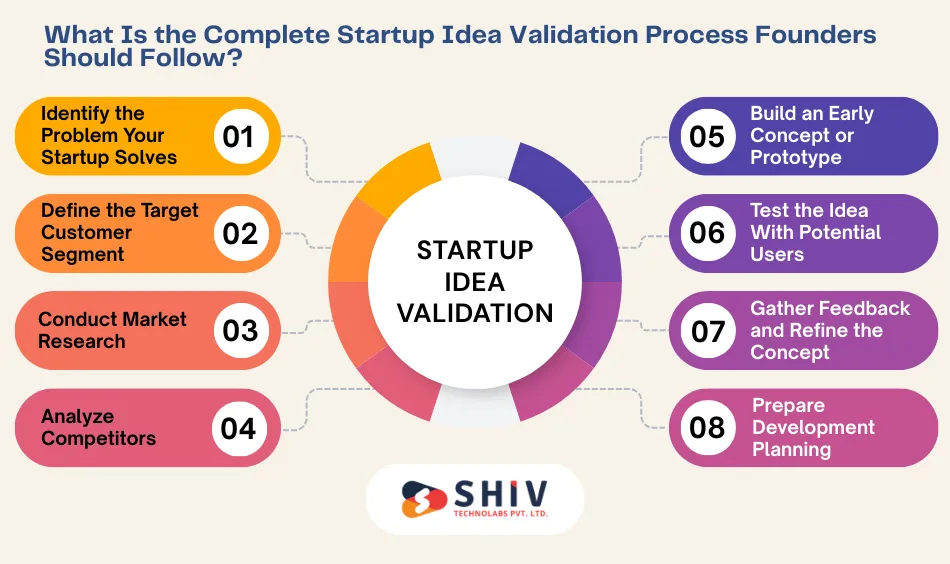
Startup idea validation is not a one-time process. It is a systematic guideline on procedures that allow the founders to test their idea without spending a lot of money on development. Founders should follow the startup idea validation process outlined below.
1. Identify the Problem Your Startup Solves
Every successful startup begins with a clear problem. Founders must define:
- What problem exists
- Who experiences it
- How frequently does it occur?
If the problem is weak or rare, the business opportunity is limited.
2. Define the Target Customer Segment
Not every product is designed for everyone. Startup founders must define a specific audience. Important factors for product idea validation for startups include:
- Demographics
- Industry Segment
- Business Size
- User Behavior
Precise audience identification improves product idea validation for startups by making feedback more relevant.
3. Conduct Market Research
Market research helps founders understand industry demand, competitors, and growth potential.
Key research metrics include:
- Total Addressable Market (TAM)
- Industry Growth Rate (%)
- Current Market Gaps
- Existing Product Limitations
Strong research significantly improves startup development planning.
4. Analyze Competitors
Competitor analysis reveals whether similar solutions already exist. Founders should examine:
- Competitor Features
- Pricing Strategies ($)
- Customer Reviews
- Market Positioning
Competitor insights help differentiate the product.


5. Build an Early Concept or Prototype
At this stage, founders should create a visual representation of the idea. This can include:
- Wireframes
- Clickable Prototypes
- Mockups
- Basic Landing Pages
A prototype helps users understand the product better and gives founders something concrete to test. If you want a better view of what comes after this stage, this guide on startup product development is also relevant.
6. Test the Idea With Potential Users
Testing the concept with real users is one of the most powerful ways to validate startup ideas.
Useful testing techniques include:
- Customer Interviews
- Usability Tests
- Surveys
- Feedback Sessions
User insights reveal whether the product truly solves the problem.
7. Gather Feedback and Refine the Concept
User feedback often highlights unexpected issues.
Common feedback includes:
- Confusing Features
- Unnecessary Functionality
- Missing Capabilities
Refining the concept improves the building of a startup product based on real user needs.
8. Prepare Development Planning
Once validation is complete, founders can begin planning for startup development. This includes:
- MVP feature roadmap
- Technology Selection
- Development Cost Estimation ($)
- Development Timeline
Depending on the product type, founders may also move into web development services or mobile app development services after the validation phase.
What Methods Can Founders Use for Startup Idea Validation?
Founders can use several methods to validate startup ideas before development. Each method helps gather different types of insights.
Most Effective Startup Idea Validation Methods
| Validation Method | Purpose | When to Use |
|---|---|---|
| Customer interviews | Identify real problems | Early validation stage |
| Market research | Understand industry demand | Idea planning stage |
| Surveys and questionnaires | Gather large-scale feedback | Concept testing |
| Landing page testing | Measure user interest | Pre-product stage |
| Prototype testing | Validate product usability | Product concept stage |
| MVP testing | Validate core features | Before full development |
How Does Product Idea Validation Help Before Building a Startup Product?
Before investing significant development resources, founders must confirm whether the idea has real potential. Product idea validation helps in several ways.
Identifying Real Customer Needs
Validation helps ensure that the startup is addressing a real pain point, not a perceived one.
The interviews with customers usually provide more insights into:
- User Frustrations
- Unmet Needs
- Workflow Inefficiencies
Detecting Strong Market Demand Signals
Demand signals indicate customers’ desire for the product. Examples include
- Customers Registering On A Homepage.
- High levels of survey interest rates (60% positive responses or above).
- Early Waiting Lists
Such indicators suggest a possible market.
Prioritizing Product Features
The validation process tends to show that there is one or a few features that customers need. Rather than releasing a product with many features, founders can focus on:
- core functionality
- Usability
- performance
Understanding Pricing Expectations
Pricing validation can always determine customers’ willingness to pay. Pricing tests that founders can make are:
- Surveys
- Landing Page Experiments
- Early Pre-Orders ($)
Identifying Product Differentiation Opportunities
Validation is also useful in making startups stand out among the competition. Founders can identify:
- Unavailable Features In Product Competition.
- Service Gaps
- Innovation Opportunities
What Should a Startup Idea Validation Checklist Include?
A startup idea validation checklist helps founders follow a structured path without skipping key steps. Once the idea passes early checks, many teams move into MVP software development to test the concept with lower risk.
Clearly Define the Problem
The startup must solve a clearly defined problem. Questions to answer:
- What problem exists?
- Who faces it?
- Why is it significant?
Identify the Target Audience
Understanding the target users is critical.
Define:
- Customer Demographics
- Industry Segments
- Behavioral Patterns
Research Market Demand and Industry Trends
Market research reveals whether the opportunity is worth pursuing.
Founders should analyze:
- Industry Growth (%)
- Emerging Trends
- Customer Demand Signals
Conduct Customer Interviews
Customer interviews provide direct insights from potential users.
Founders should conduct at least 15–30 interviews to gather meaningful insights.
Analyze Existing Competitors
Competitive analysis helps identify opportunities for innovation. Founders should review:
- Competitor Features
- Product Positioning
- Pricing Strategies ($)
Validate Product Concept Through Prototype or MVP
Prototypes or MVP development allow founders to test the concept before full development. This step reduces risk during startup development planning.
Gather Early User Feedback
User feedback helps refine the product. Early adopters often reveal usability issues and feature gaps.
Evaluate Business Model Viability
Founders must confirm whether the idea can generate revenue. Consider:
- Pricing Model ($)
- Customer Acquisition Cost (CAC)
- Lifetime Value (Ltv)
Conclusion
Success in startups is not an accidental occurrence. It occurs with keen research, validation, and planning. Early validation helps startups minimize product risk, improve feature prioritization, and increase the likelihood of product-market fit.
This is where Shiv Technolabs is the best startup development company. With over decades of experience working in startups in product engineering, MVP development, and startup development services, the team has helped founders move from a validated idea and MVP to a scalable platform quickly and accurately.
Frequently Asked Questions (FAQs)
1. What is startup idea validation?
Startup idea validation or testing involves testing a business idea or solution to determine whether it addresses a real customer problem before developing the product. It entails market research, customer interviews, surveys, and prototyping to validate demand and ensure the concept has real market potential.
2. Why should founders validate startup ideas before development?
Idea validation helps founders mitigate risk, eliminate wasted development expenditure ($), and achieve product-market fit. Through collecting user feedback from real users, the startups will be able to validate the demand, refine the product features, and increase the likelihood of creating a successful and scalable product.
3. What are the most effective startup idea validation methods?
The best ways of validation are customer interviews, market research, surveys, landing page experiments, prototype testing, and MVP testing. These methods help founders gather real user feedback and decide whether the product concept is worth building.