Table of Contents
You send a vendor one line about an AI chatbot and expect a price. Two discovery calls later, the estimate arrives as a range you cannot act on. The delay is rarely the vendor’s fault. The brief simply did not carry enough detail to price.
Every AI estimate is built from four parts: visible work, dependencies, risk, and unknowns. A vague brief pushes almost everything into the last group. Vendors price unknowns as contingency, not as effort. A written AI project scope template converts unknowns into visible work, and the contingency falls with them.
Estimates move on specifics. Name the use case, the data sources, the integrations, the expected outputs, the risks, the budget band, and the timeline. Vendors quoting AI development services read those seven items first.
This guide gives you a reusable AI project scope template, a filled example, and the quoting checklist vendors apply to every brief. Copy the fields, answer them accurately, and send the same document to every vendor.
What an AI Project Scope Must Include Before Vendors Can Quote
A quote-ready scope answers twelve questions in writing. Name the business problem, the users, and the workflow step where AI enters. List data sources, sample inputs, and expected outputs. State integrations, user roles, and approval rules. Add success metrics, security needs, timeline expectations, and phase-one limits. Vendors turn those answers into hours, roles, and risk buffers. Anything left blank becomes an assumption, and assumptions carry a price.
Why Vague AI Requirements Produce Wide Vendor Estimates
Estimators build numbers from measurable units: screens, endpoints, pipelines, test cycles, and review gates. A one-line request contains none of those units. The vendor then prices the widest reasonable version of your idea, because that version limits their exposure.
# Where AI Scope Documents Usually Fall Short
- Unclear business outcome, so the effort cannot be sized.
- No workflow detail, so the AI entry point stays undefined.
- Missing data sources, the largest cost driver in AI work.
- No sample inputs or outputs, so complexity remains a guess.
- Unknown integrations, each adding build and testing time.
- Unclear user roles, which change permission and admin work.
- No evaluation method, so quality targets cannot be priced.
- Unknown privacy or security needs, which alter hosting effort.
- Unclear phase-one scope, so vendors quote the full vision.
- Hidden assumptions, which resurface later as change requests.
# Vague AI Requirements and Their Quote-Ready Equivalents
| Vague Request | Quote-Ready Version |
|---|---|
| We need an AI chatbot. | An AI assistant answers billing questions for logged-in customers using help articles and order records, with human approval on refunds. |
| We want AI in our CRM. | A lead scoring model ranks inbound leads nightly using firmographic fields and 18 months of closed-won history. |
| We need document automation. | A document system reads supplier invoices as PDFs, extracts nine fields, and posts them to the ledger after finance review. |
The AI Scope Summary Vendors Read First
Open your AI project scope template with this summary. A reviewer who reads only this page can still place the project by scale, data requirement, and delivery approach.
| Scope Area | What to Include | Why Vendors Need It |
|---|---|---|
| Business problem | Cost or delay in numbers | Sets the effort ceiling |
| Target users | Teams, customers, partners, volumes | Drives interface and access work |
| Workflow | The exact step where AI enters | Fixes the build boundary |
| Data sources | Systems, documents, records, formats | Largest cost and schedule driver |
| Sample inputs | 10 to 20 real examples | Shows true complexity |
| Expected outputs | Format, length, tone, destination | Defines acceptance work |
| Integrations | Named platforms and API status | Adds build and testing hours |
| User roles | Who views, edits, approves, configures | Shapes permission logic |
| Approval rules | Actions needing human sign-off | Changes safety and review effort |
| Success metrics | Time saved, accuracy, resolution rate | Anchors acceptance criteria |
| Security needs | Hosting, encryption, residency, access control | Alters architecture and cost |
| Phase-one limits | Features in the first release | Prevents full-vision pricing |
| Budget range | A band, not a fixed number | Guides the solution scale |
| Timeline expectation | Target launch and hard deadlines | Determines team size |
The Complete AI Project Scope Template
This section holds the working document. Copy each field into your own file, answer it in two or three lines, and keep the order. A familiar AI project scope template works like a work breakdown structure, turning intent into countable work packages.
# Business Problem, Users, and AI Workflow
| Field | What to Write | Why It Matters | Example |
|---|---|---|---|
| Project name | Short descriptive title | Shared reference for every quote | Support Triage Assistant, Phase One |
| Business problem | Cost or delay in numbers | Sets the value ceiling | 40 agent hours weekly on repeats |
| Current process | How the work happens today | Reveals manual steps AI replaces | Agents search four systems per ticket |
| Desired AI outcome | The measurable change you want | Frames acceptance criteria | Draft replies within 30 seconds |
| Target users | Groups and daily volumes | Drives interface and load planning | 25 agents, 900 tickets weekly |
| User roles and permissions | Who views, edits, approves, configures | Shapes access and admin work | Agent, supervisor, administrator |
| AI use case type | Agent, RAG, machine learning, or automation | Selects the technical approach | RAG assistant with workflow trigger |
| Workflow steps | Trigger, retrieval, output, handoff | Fixes the build boundary | Ticket arrives, context retrieved, draft shown |
# Data Sources, Outputs, and Quality Expectations
| Field | What to Write | Why It Matters | Example |
|---|---|---|---|
| Data sources | Every system, document set, record type | Largest cost driver | Tickets, help centre, order records |
| Data readiness status | Cleanliness, gaps, duplicates, labelling | Decides preparation effort | 5,000 articles, 12 percent outdated |
| Sample inputs | 10 to 20 real examples | Shows true complexity | Twenty anonymised tickets attached |
| Expected outputs | Format, length, tone, destination | Defines acceptance work | Draft reply plus three source links |
| Accuracy expectations | Target rate and failure tolerance | Sizes evaluation and tuning | 85 percent of drafts usable unedited |
| Evaluation method | How quality gets measured before release | Prices the testing effort | Blind review of 200 drafts |
| Acceptance criteria | Conditions for signing off phase one | Prevents open-ended delivery | Metrics met across two review weeks |
| Reporting needs | Metrics, frequency, recipients | Adds dashboard work | Weekly usage and accuracy summary |
| Admin or dashboard needs | Configuration screens and controls | Adds interface scope | Prompt editing and source management |
# Approvals, Delivery Timeline, and Scope Limits
| Field | What to Write | Why It Matters | Example |
|---|---|---|---|
| Human approval rules | Actions needing sign-off before release | Changes safety and review effort | Agents approve every outbound reply |
| Integrations | Named platforms and API status | Adds build and testing hours | Helpdesk API, ecommerce admin API |
| Security and privacy needs | Hosting, encryption, residency, access rules | Alters architecture and cost | EU hosting, no customer-data training |
| Compliance needs | Regulations and audit expectations | Adds documentation and review | GDPR, annual security questionnaire |
| Timeline expectation | Target launch and hard deadlines | Determines team size | Live before the November renewal |
| Budget range | A band you can defend internally | Guides the solution scale | 45,000 to 70,000 US dollars |
| Phase-one requirements | Features in the first release | Prevents full-vision pricing | English only, one channel, drafts |
| Out-of-scope items | Features deliberately postponed | Removes hidden assumptions | Voice, autonomous sending, custom training |
| Post-launch support needs | Monitoring, tuning, response times | Prices the retainer | Monthly tuning, four-hour response |


How AI Use Case Type Changes Your Scope Requirements
Different AI project types carry different cost drivers. A recommendation engine depends on data volume, while a knowledge assistant depends on document quality. Name your type so vendors apply the right estimation model.
| AI Project Type | Scope Details Vendors Need | Common Quote Risk |
|---|---|---|
| AI chatbot | Channels, question types, escalation rules | Undefined topics expand testing |
| AI agent | Tools it may call, action limits, approvals | Autonomy creep raises safety work |
| RAG knowledge assistant | Document count, formats, refresh rate | Messy documents double preparation |
| Recommendation system | Catalogue size, behaviour history, cold-start rules | Thin data forces rebuilds |
| Predictive analytics model | Target variable, history depth, refresh schedule | Missing labels stall training |
| Document processing system | Layouts, fields, languages, volumes | Layout variety inflates extraction |
| Image or video AI system | Resolution, labelling status, latency needs | Unlabelled media adds annotation cost |
| Workflow automation with AI | Trigger, branches, systems touched, rollback rules | Hidden exception paths grow scope |
| AI-powered SaaS feature | Tenancy model, usage limits, billing hooks | Multi-tenant isolation surprises teams |
| Internal AI assistant | Departments, permissions, source systems | Access approvals delay schedules |
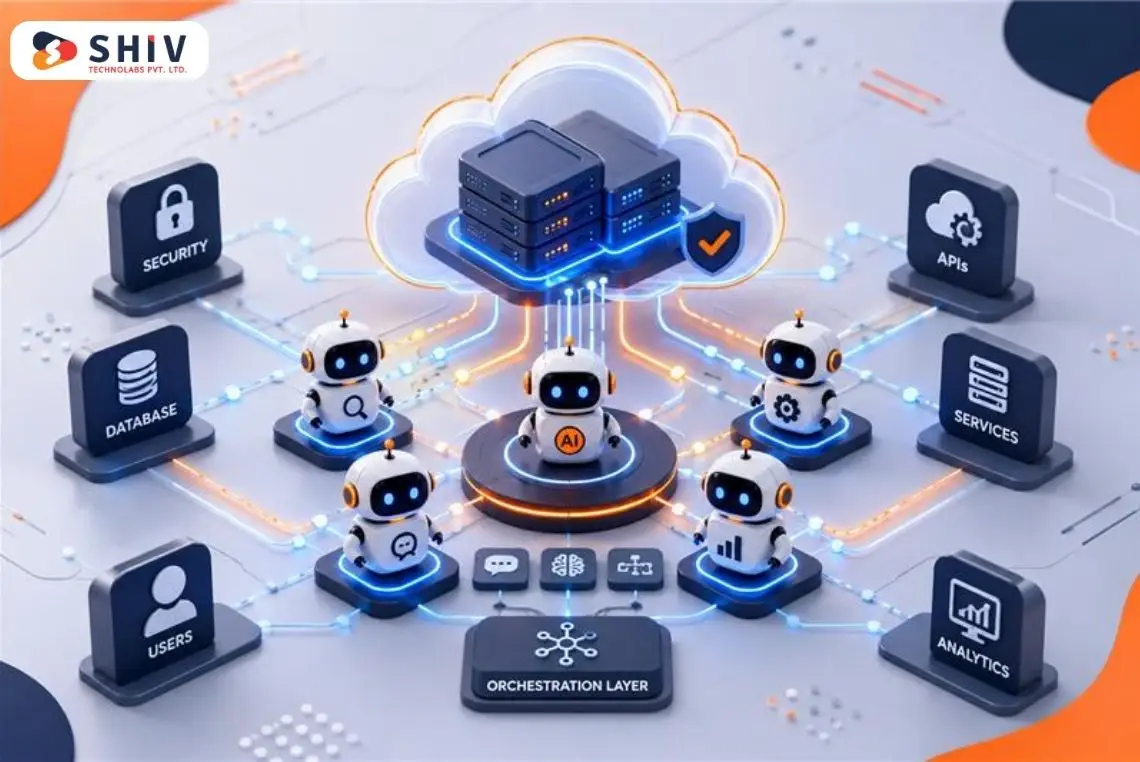
Buyers use two of these terms interchangeably, and the difference changes the quote. A RAG system searches your own documents, then answers using what it found. AI agent development extends that pattern, because the agent calls tools under rules you set. A predictive analytics model scores records instead of writing text, and an AI-powered SaaS feature adds tenancy and billing questions.
Data Readiness and Its Effect on AI Project Cost

Data drives more estimate variance than model choice. A clean labeled dataset and a folder of scanned PDFs produce very different numbers for the same request. Answer these items first.
# Data Details to Confirm Before Vendor Review
| Data Item | What to Share | Quote Impact |
|---|---|---|
| Data location | Systems and databases holding it | Access setup time |
| Data format | JSON, CSV, PDF, images, text | Parsing effort |
| Data ownership | Internal owner and approver | Approval delays |
| Data quality | Known errors and gaps | Cleaning hours |
| Missing fields | Columns often left empty | Fallback logic |
| Duplicates | Overlapping records across systems | Matching work |
| Update frequency | Real time, daily, or monthly | Pipeline design |
| Sensitive data | Personal, financial, or health fields | Masking and hosting |
| Access rules | Who may read production data | Environment setup |
| Labelled data | Existing tags or annotations | Annotation cost |
| Sample records | 20 to 50 anonymised rows | Complexity check |
| Data volume | Record counts and growth rate | Infrastructure sizing |
| API availability | Endpoints, limits, documentation | Integration effort |
| Document structure | Consistent templates or mixed layouts | Extraction accuracy |
Google Cloud’s MLOps lifecycle guidance makes the same point from the delivery side, because pipelines, validation, and retraining carry more production effort than model choice.
AI Integrations and Workflow Steps That Affect Pricing
Every integration adds build hours, credentials, testing, and failure handling. Naming platforms converts an assumption into a priced line item. State which systems the AI reads from and writes.
List each connected system: CRM, ERP, helpdesk, eCommerce platform, accounting software, internal databases, cloud storage, email tools, Slack or Teams, calendars, payment systems, analytics tools, and custom APIs. Mark each as read, write, or both.
- The AI agent should read tickets from Zendesk and draft replies for human approval.
- The AI assistant should search internal policy PDFs and show source references.
- The recommendation engine should use product data, purchase history, and browsing behavior.
Add API access status beside each system, since missing credentials delay system integration work more often than technical difficulty.
Human Approval, AI Risk, and Governance Requirements
Control rules change the price more than most buyers expect. An assistant that drafts text needs light review, while one that issues invoices needs audit logs and monitoring. Write these rules down.
- When the AI may respond automatically, and to which requests.
- When a person must approve before anything sends or updates.
- Which actions the AI may take, such as tagging or drafting.
- Which actions stay off limits, such as refunds or deletions.
- Audit logs covering prompts, sources, outputs, and approvals.
- Sensitive data handling, including masking and retention limits.
- Escalation rules for low confidence or repeated failures.
- Fallback behaviour when a source system becomes unavailable.
- Bias and accuracy checks across user groups.
- Hallucination controls, such as citation requirements and refusal rules.
- Compliance notes covering regulations and audit expectations.
- Monitoring after launch, including drift checks and review frequency.
These rules carry legal weight. A British Columbia tribunal held Air Canada responsible for wrong information its chatbot gave a customer. It rejected the argument that the chatbot answered for itself.
The NIST AI Risk Management Framework groups this work into govern, map, measure, and manage functions. Vendors price testing, review gates, and monitoring from these details, so a short governance section shortens the estimate cycle.
AI Project Budget and Timeline Ranges
Stating a budget band improves the quotes you receive. It tells vendors which scale of solution to price, and prevents proposals arriving at three times your ceiling. Treat these figures as planning references.
# AI Project Cost Ranges
- AI discovery and scope review: 2,000 to 10,000 US dollars or more.
- AI proof of concept: 10,000 to 40,000 US dollars or more.
- AI chatbot or RAG MVP: 20,000 to 80,000 US dollars or more.
- AI agent with integrations: 40,000 to 150,000 US dollars or more.
- AI feature inside SaaS or enterprise software: 50,000 to 200,000 US dollars or more.
- Enterprise AI system with governance and monitoring: 150,000 to 500,000 US dollars or more.
- Ongoing AI monitoring and support: 2,000 to 20,000 US dollars each month.
# AI Project Timeline Ranges
- Scope review: 1 to 2 weeks.
- Discovery: 1 to 3 weeks.
- Proof of concept: 3 to 6 weeks.
- MVP: 8 to 16 weeks.
- Enterprise rollout: 4 to 9 months or longer.
Final figures move with data condition, integration count, and approval depth. A short proof of concept often costs less than an incorrect assumption inside a fixed contract.
A Real AI Project Scope Example From Morgan Stanley
Morgan Stanley Wealth Management built an internal assistant with OpenAI and released it to advisors in September 2023. The published account of that rollout fills the AI project scope template fields above, which is why it functions as a working brief rather than an idea.
| Field | Entry |
|---|---|
| Project name | AI @ Morgan Stanley Assistant, first release |
| Business problem | Advisors could search only a fraction of the firm’s research library, so client answers took too long. |
| Current process | Manual keyword search across decades of research reports before each client conversation. |
| Desired AI outcome | Plain-language questions answered from the research corpus in seconds. |
| Target users | Financial advisors and their support staff across wealth management. |
| Workflow | The advisor asks a full-sentence question. The assistant retrieves from the research library and answers with grounded sources. |
| Data sources | Roughly 100,000 internal research reports and documents. |
| Data readiness status | An existing curated research library, later widened through tuned retrieval methods. |
| Integrations | Internal document systems, with Salesforce added for the later meeting tool. |
| Expected outputs | A written answer drawn from firm research, phrased for a client conversation. |
| Accuracy expectations | Governed by an evaluation framework built before wider release. |
| Evaluation method | Structured evals, later extended with translation evals for multilingual clients. |
| Human approval rules | The advisor remains the decision-maker. The later meeting tool records only with client consent and drafts emails for advisor review. |
| Success metrics | Advisor team adoption above 98 percent, with document access rising from 20 to 80 percent. |
| Phase-one scope | Internal question answering over the research library. |
| Phase-two additions | Meeting notes, action items, drafted follow-up emails, and CRM filing. |
| Budget range | Not disclosed publicly. A buyer scoping comparable retrieval work should state a band of their own. |
A UK example shows the same discipline at a smaller boundary. Octopus Energy released an assistant called Arlo in July 2026 that answers straightforward customer emails on tariff renewals, payment dates, and account details. Its published trial results recorded 76 percent customer satisfaction against 72% for comparable human replies, and customers can still reach a person at any point.


What to Move Out of Phase One
Phase-one clarity produces the most accurate quote available to you. Vendors price what they read, so an unbounded wish list returns an unbounded number. Move these items later.
- Multi-language support, which multiplies testing and content work.
- Advanced analytics beyond basic usage reporting.
- Complex admin dashboards with granular configuration screens.
- Extra integrations that few users need at launch.
- Voice support and telephony handling.
- Custom model training when retrieval already answers the need.
- Advanced personalisation based on individual behaviour history.
- Multi-agent orchestration across several connected agents.
- Automated decision-making without human approval.
- Enterprise single sign-on and directory provisioning.
- Full workflow automation across every department.
Klarna moved the boundary far in a single step, reporting 2.3 million conversations in the first month. By May 2025 its chief executive said the automation had gone too far, and the company began recruiting agents so customers could always reach a person.
Name these as phase two inside your AI project scope template. Vendors then quote a first build you can approve quickly, the discipline that keeps MVP development on schedule.
Scope Gaps That Make AI Vendor Quotes Unreliable
Some gaps affect estimates more than others. Each item below produces a wide range or a hidden assumption. Close them before sending your brief.
| Red Flag | Why It Distorts the Quote | Fix Direction |
|---|---|---|
| No data sample | Complexity stays unknown | Attach 20 anonymised records |
| No user role details | Permission work gets guessed | List every role and right |
| No expected outputs | Acceptance work has no shape | Write three sample outputs |
| No success metric | Delivery has no finish line | Name one measurable target |
| No integration clarity | Build hours carry contingency | Name platforms and API status |
| Unclear budget range | Vendors price the wrong tier | Share a defensible band |
| No phase-one boundary | The full vision gets priced | Mark phase-one features only |
| No human approval rules | Safety effort stays invisible | State which actions need sign-off |
| Vague accuracy expectations | Evaluation cannot be sized | Give a target rate and tolerance |
| No security requirements | Hosting decisions arrive late | State hosting, residency, access rules |
| No post-launch ownership | Support terms differ per vendor | Request monitoring and tuning separately |
How to Compare AI Vendor Quotes Side by Side
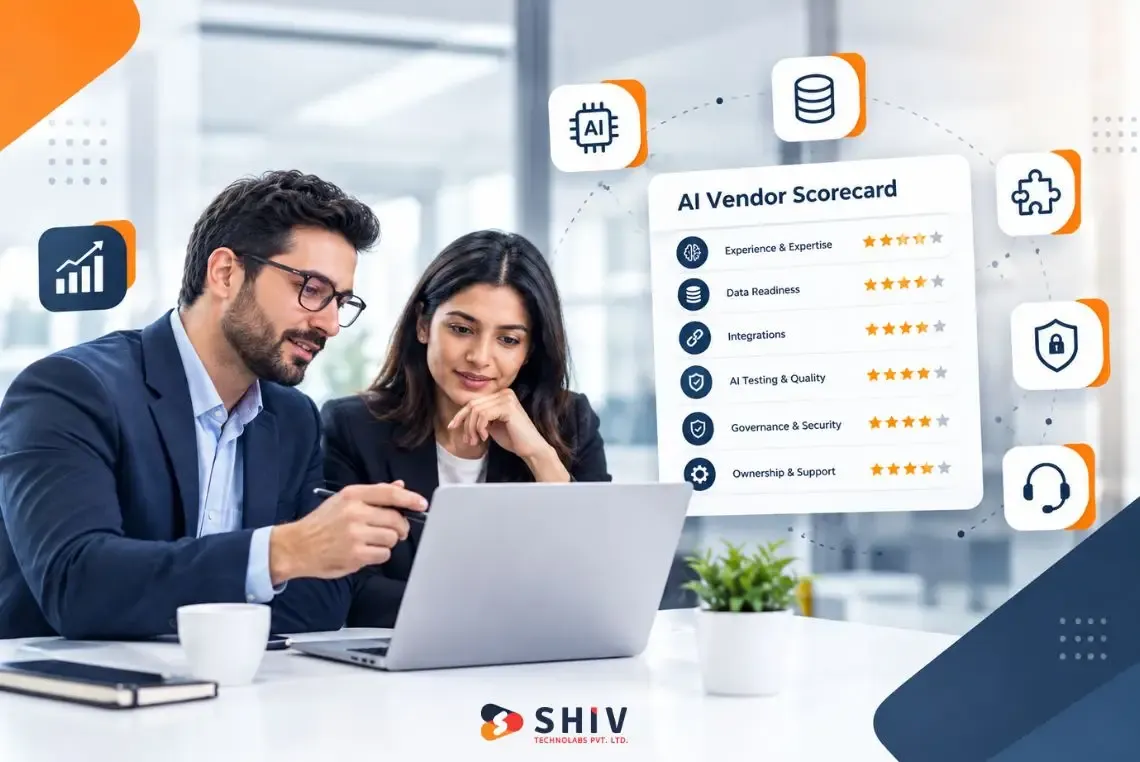
Identical briefs produce comparable quotes. Read each proposal against the same twelve areas, and the differences become visible immediately. Ask about anything a vendor leaves unstated.
| Quote Area | What to Compare | Red Flag |
|---|---|---|
| Discovery assumptions | Assumptions listed in writing | No assumptions section |
| Data preparation | Hours allocated to cleaning and structuring | Data work missing entirely |
| Model or AI approach | Retrieval, fine-tuning, or classical machine learning | Approach left unnamed |
| Integration scope | Systems named with read or write access | Integrations described generally |
| UI scope | Screens, states, and admin views | Interface effort unlisted |
| Testing scope | Test cases and review rounds | Testing bundled into development |
| Security scope | Hosting, encryption, access control | Security treated as standard |
| Evaluation method | How quality gets measured before release | No evaluation plan |
| Timeline | Phases with dependencies | One total duration only |
| Team structure | Named roles and allocation | Undefined team size |
| Post-launch support | Monitoring, tuning, response times | Support quoted later |
| Change request terms | Rate, approval path, notice period | Terms left open |
AI Scope Review Before You Contact Vendors
The strongest scope reviews come from teams that also deliver the work. Shiv Technolabs builds AI agents, retrieval assistants, and predictive models, so each review reflects what estimation requires: workflow mapping against real systems, data readiness checks on the sources you listed, integration planning, and approval rules written for production use.
Every review returns AI project estimation ranges, AI agent planning notes, generative AI consulting answers, MVP planning boundaries, and post-launch support expectations in writing.
Send us your scope, and the Shiv Technolabs team marks the fields vendors will question before they quote. A review takes a few working days and usually narrows the range you receive.
Final Thoughts on Writing a Quote-Ready AI Scope
Better scope produces better estimates. Vendors quoting from a completed AI project scope template return narrower ranges, fewer assumptions, and proposals you can compare line by line. The document takes a few hours to complete and removes weeks of clarification calls.
Write the fields, attach twenty sample inputs, mark the phase-one boundary, and state your budget band. Then send the same file to every vendor you are considering.
Send us your scope for a review before it goes out, and start vendor conversations with a document that already answers their first ten questions.
Frequently Asked Questions About AI Project Scope
# What should an AI project scope include?
Include the business problem, users, workflow entry point, data sources, sample inputs, expected outputs, integrations, user roles, approval rules, success metrics, security needs, timeline, budget band, and phase-one limits. Attach real examples so vendors can size complexity accurately.
# Why do vendors need data details before quoting an AI project?
Data condition drives most of the effort. Clean structured records need light preparation, while mixed PDFs and duplicated systems need pipelines and validation. Sharing formats, volumes, gaps, and access rules lets vendors price preparation instead of adding contingency to the estimate.
# How detailed should an AI scope document be?
Four to eight pages usually works. Cover every template field in two or three lines, attach 10 to 20 sample inputs, and mark phase-one boundaries clearly. Detail beyond that rarely changes the quote, while missing fields widen it considerably.
# How much does an AI project scope review cost?
A scope review or discovery engagement typically runs $2,000 to $10,000 or more, depending on workflow count and integration depth. Reviews usually take 1 to 2 weeks, and the output feeds directly into vendor estimates.
# Can I send a rough AI idea for review?
Yes. Send the material you already have, including notes, screenshots, or a workflow sketch. A reviewer returns the missing fields and the questions vendors would raise. Most rough ideas become a quote-ready scope within one to two weeks of focused work.
# What should be out of scope in the first AI version?
Keep multi-language support, voice, custom model training, multi-agent orchestration, enterprise single sign-on, and autonomous decision-making out of version one. Name them as phase two instead. A tight first release usually reaches production in 8 to 16 weeks.