Table of Contents
Choosing an AI development partner has become harder as AI projects move beyond basic prototypes. While a refined demo of a Chatbot is convincing, production AI requires real data, existing software, access to user permissions, and security measures, plus measurable business goals.
The right partner must know the business problem and the technical risks involved. Before signing an AI development services contract, businesses need to consider production experience, data readiness, integrations, AI testing, governance, ownership, and post-launch support.
This is particularly important for AI agents and generative AI systems that fetch data from the company or initiate business actions. The NIST GenAI profile suggests designing, developing, using, and evaluating AI systems with trustworthiness in mind.
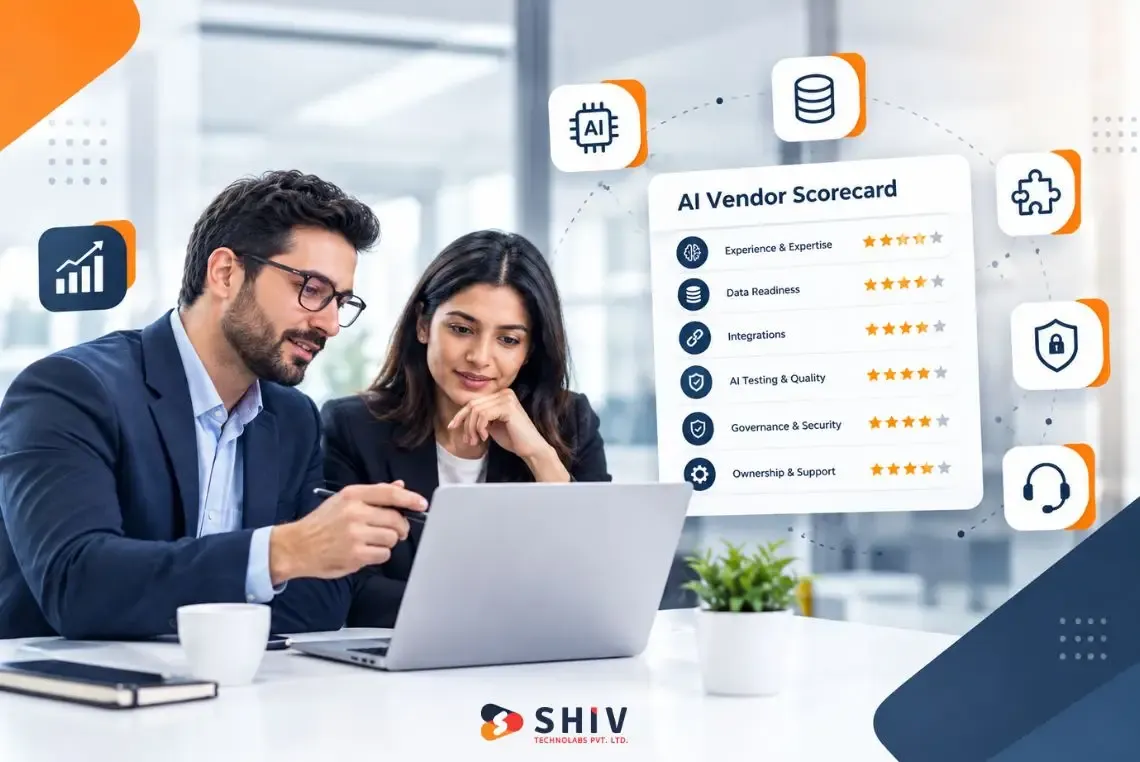
This guide provides you with a helpful AI vendor scorecard for comparison in 2026. You can use it during vendor calls, RFP reviews, technical assessments, and final procurement decisions.
Quick Answer: Choose an AI development partner by checking business fit, production experience, data readiness, security, governance, architecture, integration skills, AI testing, pricing, IP ownership, and post-launch support. Ask for evidence from live projects rather than relying on demos or general AI claims.
What Should You Look for in an AI Development Partner?
A strong AI development company should prove that it can move from business requirements to a reliable production system. Technical capability matters, but it should be supported by clear security practices, measurable outcomes, and long-term ownership terms.
Use these seven areas for your first vendor screening:
| Evaluation Area | What to Check | Why It Matters |
| Business fit | Knowledge of your workflow and users | AI needs a clear business purpose |
| Production experience | Live AI projects and measurable results | A prototype does not prove production ability |
| Data readiness | Data quality, access, permissions | AI output depends heavily on its data |
| Security | Privacy, RBAC, encryption, logging | AI may access sensitive information |
| Integration | CRM, ERP, SaaS, APIs, legacy systems | AI often needs access to existing workflows |
| AI evaluation | Accuracy, hallucinations, edge cases | Standard software QA is not enough |
| Support | Monitoring and improvement process | AI behavior can change after launch |
Expert Insight: Ask a vendor to explain what could make your proposed AI project fail. A partner who identifies weak data, unclear KPIs, security risks, or unnecessary AI work can provide more value than one who agrees with every requirement. If two vendors offer similar AI features, compare their evidence for production delivery, security, testing, and ownership before comparing presentation quality.
Why Is Choosing an AI Partner Different in 2026?
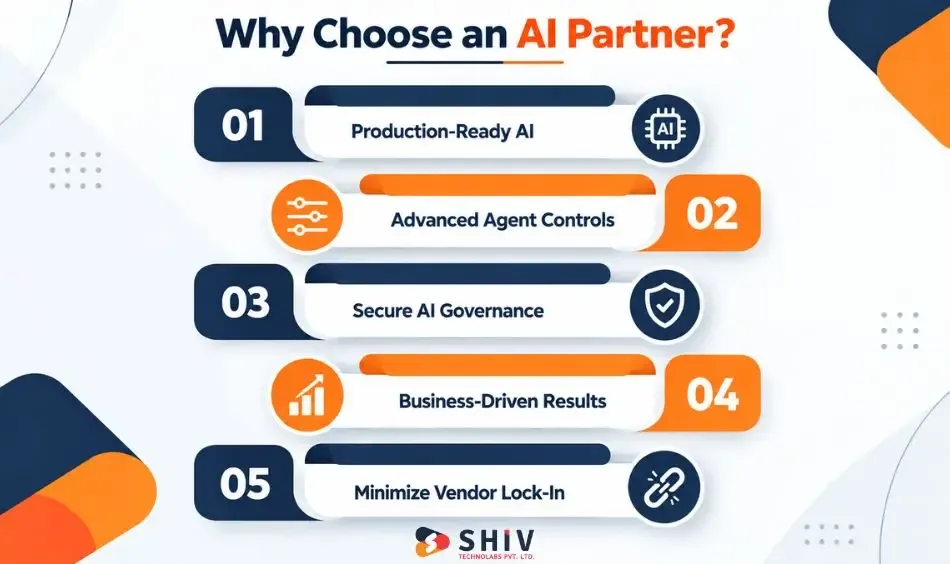
AI vendor evaluation has changed. Businesses are increasingly asking how AI will work inside real processes, what information it can access, how outputs will be tested, and who remains responsible for important decisions. Regulatory requirements also deserve attention. The EU’s AI Omnibus delayed high-risk obligations, so a lot of teams assumed everything moved. Article 50 transparency duties did not move. They apply from 2 August 2026 regardless of whether a system is classified as high-risk. Ask your vendor which of these dates touches your project.
AI Projects Are Moving From Pilots to Production
A proof of concept can test whether an idea is technically possible. Production software must also handle real users, permissions, integrations, latency, costs, failures, and changing data. Ask how the vendor takes an AI feature from prototype through testing, controlled release, monitoring, and ongoing improvement.
AI Agents Require Stronger Action Controls
An AI chatbot may answer a question. An AI agent can potentially retrieve information, call APIs, update records, or trigger workflows. That additional agency makes permission boundaries and human approval more important. OWASP recommends least-privilege access and human approval for high-risk actions when addressing prompt-injection risks. Businesses considering autonomous workflows should assess an AI agent development partner on action controls, tool permissions, fallback behavior, and monitoring.
Security and Governance Are Vendor Selection Criteria
AI governance should not appear for the first time before launch. Data access, privacy, output controls, auditability, human oversight, and accountability should be discussed during discovery and architecture planning.
Business Results Matter More Than an Impressive Demo
A technically impressive feature can still produce little business value. The vendor should connect the project with measurable outcomes such as processing time, support resolution, qualified leads, employee productivity, or task accuracy.
Vendor Lock-In Needs Early Review
Check who owns the source code, prompts, workflows, documentation, embeddings, and custom integrations. Also ask whether another technical team could operate the system if the original vendor relationship ends.
| Old Vendor Question | Better 2026 Question |
| Can you build an AI demo? | Can you show production delivery evidence? |
| Which model will you use? | Why does that model fit our requirements? |
| How quickly can you build it? | How will you test and release it safely? |
| What does development cost? | What will development and operation cost? |
| Can the agent automate this? | Which actions require human approval? |
Consider: AI vendor selection is no longer only a technical procurement decision. Data owners, security teams, business leaders, and legal teams may all have valid requirements.
AI Development Partner Scorecard: 10 Criteria to Compare Vendors
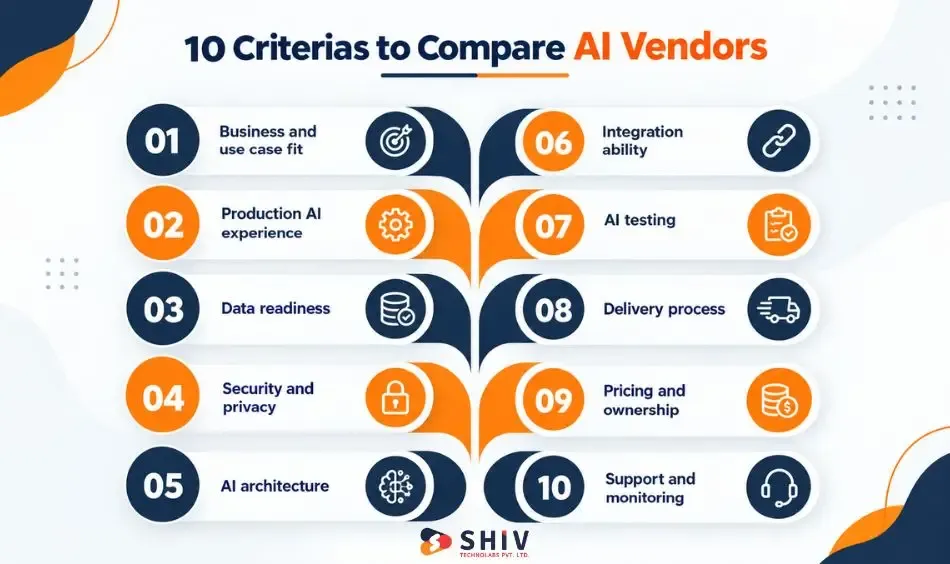
A weighted AI vendor scorecard makes comparisons less subjective. Instead of choosing the vendor with the strongest presentation, procurement teams can score evidence against the requirements that matter to the project.
Score each area from 1 to 5, where 1 means weak evidence, and 5 means strong, verifiable evidence.
| AI Vendor Evaluation Criteria | Weight | What a Strong Vendor Should Show |
| Business and use case fit | 10% | Clear workflow, users, boundaries, KPIs |
| Production AI experience | 15% | Live systems and measurable results |
| Data readiness | 10% | Data audit, quality and access plan |
| Security and privacy | 15% | Access controls, encryption, logs |
| AI architecture | 10% | Reasoned model and architecture choices |
| Integration ability | 10% | APIs, CRM, ERP, SaaS, legacy systems |
| AI testing | 10% | Accuracy, hallucination, and risk testing |
| Delivery process | 5% | Milestones, reviews and documentation |
| Pricing and ownership | 5% | Clear costs, scope and IP terms |
| Support and monitoring | 10% | Monitoring, feedback and maintenance |
| Total | 100% | Evidence-based vendor assessment |
Consider: Score AI vendors from 1 to 5 across business fit, production experience, data, security, architecture, integrations, testing, delivery, ownership, and support. Give higher weights to security and production experience for systems handling sensitive data or business actions.
1. Business Fit and Use Case Understanding
A strong AI development partner starts with the business problem rather than a preferred model. The team should identify users, workflows, data sources, expected outcomes, and important boundaries.
Clear Definition of the Business Problem
The vendor should be able to describe the project without relying on technical terminology. Their explanation should cover the current workflow, existing pain point, affected users, expected improvement, and measurable outcome.
AI Mapping to Real Workflows
AI should fit into an actual process rather than remain an isolated feature. For example, an AI sales assistant may qualify leads before CRM entry instead of operating as a disconnected chatbot.
Measurable Success Criteria
Define success before development starts. Possible KPIs include response accuracy, processing time, task completion, support resolution, qualified leads, employee adoption, or cost savings.
Willingness to Reject Weak AI Use Cases
Not every workflow needs AI. A credible partner should recommend rules, search, standard automation, or conventional software when those options better fit the requirement.
Expert Insight: Ask the vendor to identify one part of your project that should not use AI. Their response can reveal whether they are designing around your requirement or selling AI regardless of fit.
2. Production AI Experience and Delivery Proof
A polished prototype can demonstrate technical skill. It does not prove that the vendor can operate an AI system with live users, real data, permissions, cost limits, and unpredictable inputs.
Live AI Project Evidence
Ask for AI systems that have reached production. Where confidentiality prevents live access, request anonymized examples covering architecture, testing, rollout problems, and measurable results.
Similar Workflow Experience
Industry experience can help, but workflow similarity is often equally important. A vendor experienced with document retrieval, customer support AI, internal assistants, or ERP-connected agents may bring transferable knowledge.
Measurable Case Study Outcomes
Strong case studies should include business results rather than only feature descriptions. Useful evidence includes reduced handling time, higher task completion, better response coverage, or lower manual workload.
Evidence From Failed or Difficult Projects
Ask about a project that did not go as planned. A useful answer should explain the problem, how it was detected, what changed, and what the team learned.
Consider: Production experience becomes more credible when the vendor can explain failures, monitoring, support, and measurable outcomes.
3. Data Readiness and Data Governance
AI quality depends heavily on the information available to the system. Incomplete, duplicated, outdated, or poorly permissioned data can weaken even a technically strong solution.
Data Quality Assessment
The vendor should review the information required by the AI before selecting the architecture. This may include databases, CRM records, ERP data, PDFs, policies, support tickets, APIs, and internal documents.
Role-Based Data Permissions
A connected database is not an access grant. Retrieval and tool access should respect the permissions of the user making the request.
Structured and Unstructured Data Handling
Enterprise systems often require both forms of data. Structured data may come from CRM or ERP systems. Documents, PDFs, emails, manuals, and policies provide unstructured information.
Data Refresh and Version Management
Business information changes after launch. The vendor should explain how content is updated, removed, re-indexed, versioned, and checked for freshness.
Consider: A strong AI partner should assess data quality, sources, user permissions, freshness, sensitive information, and audit requirements before development begins.
4. Security, Privacy, and Compliance Readiness
Security should be part of the AI architecture from the start. Requirements depend on the system, data type, users, integrations, and actions the AI can perform.
Sensitive Data Protection
Ask the vendor to trace one record end-to-end. This review should include AI APIs, application logs, databases, third-party platforms, and backups.
Role-Based Access and Audit Logs
Users should see only information relevant to their authorized role. Audit logs can also help teams review unusual access, outputs, and system actions.
Prompt Injection and Data Leakage Testing
Generative AI systems can face malicious or manipulated inputs. The vendor should test untrusted prompts, connected content, tool access, sensitive information exposure, and unexpected model behavior.
Compliance-Aware Architecture
Relevant requirements may include GDPR, HIPAA, SOC 2, ISO 27001, internal security policies, or AI-specific regulations. The vendor should explain which requirements apply to the proposed use case.
Human Oversight for Sensitive Actions
An AI assistant that drafts text carries different risk from an agent that changes financial or customer records. High-impact actions may require explicit human approval.
Expert Insight: Ask the vendor to draw the complete AI data flow. Then identify where sensitive information enters, travels, gets stored, and can leave the system.
5. AI Architecture and Model Selection
The strongest AI implementation partner should not push one model or architecture for every project. The technical approach should match accuracy requirements, privacy, response time, integration needs, operating cost, and expected usage.
Requirement-Based Model Selection
Ask why a specific model fits your project. The response should compare relevant trade-offs instead of relying on popularity or vendor preference.
RAG, Fine-Tuning, and Agent Architecture
Different AI approaches serve different needs. RAG may support knowledge-grounded answers, fine-tuning may help specialized repeated behavior, and agents may manage multi-step workflows.
Multi-Model and Provider Flexibility
Architecture should make future model changes practical where reasonable. Ask which parts of the application depend directly on OpenAI, Claude, Gemini, Azure AI, AWS Bedrock, Google Vertex AI, or another provider.
Cost, Latency, and Scale Planning
Production AI has ongoing operating costs. Token usage, model calls, retrieval, caching, integrations, tool execution, concurrency, and response time can all affect performance.
| Architecture | Common Fit | Important Check |
| LLM API | AI features and assistants | Cost, privacy, latency |
| RAG | Knowledge-grounded answers | Retrieval, sources, permissions |
| Fine-tuning | Specialized repeated behavior | Training data and maintenance |
| AI agents | Multi-step workflows | Tools, approvals, guardrails |
| Custom model | Specialised requirements | Data, budget, MLOps |
Businesses building AI inside larger digital products should also check the partner’s custom software development services.
Consider: The most powerful model is not automatically the best choice. A smaller model may perform better financially for a narrow, well-defined workflow.
6. Integration With Existing Business Systems
AI becomes more useful when it can work with systems employees already use. These may include CRM, ERP, SaaS platforms, internal databases, support systems, or legacy applications.
API and Middleware Capability
Modern APIs may simplify connectivity, while older systems may require middleware or custom integration layers. Strong custom API development services can become important when AI connects with several systems.
CRM and ERP Connectivity
AI systems may need customer, inventory, sales, finance, or operational data. Experience with ERP and CRM development services can help when AI becomes part of existing workflows.
Permission-Aware System Access
AI integrations should respect existing user permissions. A connected agent should not gain access to data or actions unavailable to the current user.
Safe Failure and Recovery
APIs fail, data becomes unavailable, and third-party systems experience downtime. The architecture should prevent duplicated actions, partial updates, or unsafe fallback behavior.
Expert Insight: Integration experience matters because many AI projects fail outside the model itself. Authentication, permissions, API limits, data mapping, and workflow rules often create the harder production problems.
7. AI Testing, Evaluation, and Risk Controls
AI testing differs from conventional software testing because generated outputs can vary by input and session. A production-ready vendor should have a defined evaluation framework instead of relying on informal testing.
Accuracy and Grounding Evaluation
Teams should create representative test inputs with expected outcomes. This provides a baseline for measuring whether future changes improve or weaken the system.
Hallucination Testing
Generated answers should be checked for unsupported statements. RAG applications should also test retrieval quality, source relevance, and citation behavior.
Adversarial and Edge-Case Testing
Tests should include unusual requests, ambiguous inputs, malicious prompts, missing data, and unauthorized actions. This helps identify weaknesses before live users find them.
Privacy and Permission Testing
AI should be tested with users with different permission levels. The system must not expose information simply because the underlying application can technically access it.
Human Review Controls
Sensitive financial, legal, operational, or customer actions may require approval. Those review points should be defined during architecture and testing.
Consider: AI testing should cover accuracy, grounding, hallucinations, privacy, prompt injection, permissions, edge cases, tool actions, and human review.
8. Delivery Process, Documentation, and Communication
Good AI delivery requires coordination between developers, data owners, users, business leaders, and security teams. The vendor should provide a clear process rather than treating development as a black box.
Discovery and Risk Assessment
Discovery should identify workflows, users, data sources, integrations, risks, boundaries, and success metrics. This creates a clearer foundation for scope and estimates.
Measurable Project Milestones
Every milestone delivers something that runs. For example, a RAG project may validate retrieval quality before adding workflow automation.
Regular Working Demos
Stakeholders should see working features during development. Frequent reviews allow problems to be corrected before they become expensive.
Technical Documentation
Documentation should cover architecture, APIs, data flows, permissions, deployment, prompts, integrations, and operational procedures. Clear documentation also makes future handover easier.
Internal User Training
Users need practical guidance for working with AI systems. Training should cover expected use, limitations, escalation paths, and situations requiring human review.
Consider: Ask to see an anonymized project plan before signing. It can reveal how the vendor manages discovery, testing, reviews, documentation, and release.
9. Pricing, Contract Terms, and IP Ownership
The development quote is only one part of the total AI cost. Model usage, cloud infrastructure, storage, monitoring, support, integrations, and maintenance may create ongoing expenses.
Transparent Project Scope
The proposal should clearly define what is included and excluded. Discovery, data work, integrations, evaluation, deployment, documentation, training, and support should not remain vague.
Clear Pricing Structure
Pricing may be fixed, hourly, milestone-based, phased, or retainer-based. Buyers should compare what each proposal includes rather than comparing headline prices alone.
Source Code and IP Ownership
Confirm ownership of custom code, prompts, workflows, documentation, and other project assets. Third-party software and model licenses should also be documented.
Data Rights and Retention
The contract should explain whether project data can be stored, reused, retained, or shared. Sensitive information may require tighter contractual controls.
SLA and Support Terms
Post-launch responsibilities should be defined clearly. Review support hours, response expectations, maintenance terms, monitoring, and critical issue handling.
Exit and Handover Planning
A future transition should not depend entirely on the original vendor. Confirm documentation, code access, credentials, data exports, deployment ownership, and transition support.
Expert Insight: Ask for the expected monthly operating cost at your projected usage. A low development quote can become expensive when model and infrastructure costs are ignored.
10. Post-Launch Support and AI Monitoring
AI systems require attention after production release. Source information changes, users behave differently, APIs change, costs move, prompts evolve, and model providers may release new versions.
Production Quality Monitoring
Monitoring should reflect the actual use case. Teams may track answer quality, failed tasks, tool errors, response latency, escalations, or user feedback.
Failed Query Analysis
Poor interactions reveal useful improvement opportunities. They may point to missing knowledge, poor retrieval, unclear instructions, broken integrations, or unsupported workflows.
Usage and Cost Tracking
Teams should monitor model calls, token consumption, API costs, infrastructure costs, and other operational spending. Unexpected usage patterns should be investigated quickly.
Business KPI Tracking
Usage alone does not prove value. Performance should be compared with initial KPIs such as time saved, tickets resolved, leads qualified, errors reduced, or tasks completed.
Controlled Improvement Cycles
Prompts, retrieval logic, workflows, model choices, and data sources may need changes after launch. Each update should be tested before wider release.
Expert insight: Post-launch AI support should include output quality, failures, user feedback, model costs, latency, security events, adoption, business KPIs, and controlled system updates.
Which AI Development Partner Risks Should You Avoid?
Nine warning signs separate a credible AI development partner from a risky one. Each one appears in normal sales conversation, usually as a confident answer. The list below shows what vendors say and why each answer signals a problem. Every entry includes the follow-up question that exposes the gap.
| Red flag | What it usually means |
| Demo-only portfolio | No experience with live users, permissions, or failures |
| Guaranteed accuracy | No defined test set or evaluation method |
| Vague data-security answers | Data flow has not been mapped |
| One model for every project | Trade-offs were never compared |
| No adversarial testing | Prompt injection and leakage risks remain untested |
| Unclear IP ownership | Prompts, workflows, and evaluation sets sit in a grey zone |
| Hidden recurring costs | Operating spend was excluded from the quote |
| No monitoring plan | Quality decline will go unnoticed |
| No exit process | Switching partners becomes expensive and slow |
1. Demo-Only Portfolio
Red flag: “Here is a prototype we built last month.”
A demo runs on clean data and a controlled script. Production systems face real users, permission rules, API limits, and unpredictable inputs. A vendor with only demos has never managed a system after launch.
Ask: “Which AI systems have you run in production for six months or longer, and what broke?”
2. Guaranteed Accuracy
Red flag: “Our accuracy is 99 percent.”
No vendor can promise accuracy without naming the test set. Models still produce wrong or uncertain answers on inputs they have not seen. A credible partner explains measurement, human review, and fallback behavior instead of promising perfection.
Ask: “Accurate against which test set, measured how, and what happens when the model is uncertain?”
3. Vague Data-Security Answers
Red flag: “All data is encrypted and secure.”
Encryption alone answers very little. Buyers need to know where data enters, travels, gets processed, and gets stored. That path includes AI provider APIs, application logs, databases, third-party tools, and backups. Retention periods and subprocessor access matter just as much.
Ask: “Draw the full data flow for one request and mark every point where our data leaves our control.”
4. One Model for Every Project
Red flag: “We build everything on the same provider.”
Model choice depends on accuracy needs, privacy limits, latency targets, and operating cost. A vendor with one default answer has not compared those trade-offs. Standardizing on a provider can be a reasonable decision. Refusing to justify that decision is not.
Ask: “Which models did you consider for this workflow, and why did you rule the others out?”
5. No Adversarial Testing
Red flag: “We tested it thoroughly before launch.”
Standard QA checks whether features work as designed. It does not check whether a user can manipulate the system with a crafted prompt. Adversarial testing covers prompt injection, unauthorized tool use, data leakage, and unsafe outputs. Any system that retrieves documents or triggers actions needs this work before release.
Ask: “Show us a prompt injection test case from a past project and what the result was.”
6. Unclear IP Ownership
Red flag: “Ownership is standard, it is all covered.”
Custom code is only part of the asset. Prompts, workflow logic, evaluation sets, retrieval configuration, and documentation carry real value. Contracts that mention only source code leave everything else ambiguous. Third-party licenses and model provider terms need documenting as well.
Ask: “List every project asset by name and state who owns each one after final payment.”
7. Hidden Recurring Costs
Red flag: “The build cost is fixed at this figure.”
Development cost is one line in a longer bill. Model usage, cloud hosting, vector storage, monitoring, and support all continue after launch. Those costs scale with usage rather than staying flat. A low build quote can become the more expensive option within a year.
Ask: “What is the expected monthly operating cost at 1,000, 10,000, and 100,000 requests?”
8. No Monitoring Plan
Red flag: “We will support it after launch.”
Support and monitoring are two different commitments. AI behavior shifts as source data changes, users adapt, and providers release new model versions. Without measurement, quality declines quietly. Teams usually find out when a user complains.
Ask: “Which metrics will you track after launch, at what frequency, and who reviews them?”
9. No Exit Process
Red flag: “We will always be here.”
Vendor relationships end for reasons unrelated to quality. A proper handover includes code, documentation, credentials, deployment access, data exports, and a knowledge transfer session. Without a defined process, the next team spends months rebuilding context.
Ask: “Describe your handover package and how long a full transition takes.”
Expert insight: The nine main AI vendor red flags are demo-only portfolios, guaranteed accuracy claims, vague data-security answers, single-model defaults, missing adversarial testing, unclear IP ownership, hidden recurring costs, absent monitoring plans, and no exit process. Ask every vendor for evidence rather than assurances.
What Questions Should You Ask an AI Development Partner?
Use consistent questions for every shortlisted vendor. This makes the final comparison more evidence-based and supports a fair AI vendor evaluation process.
| Category | Question to Ask |
| Business | What measurable outcome should this project improve? |
| Experience | Which production AI projects can you demonstrate? |
| Data | Which data sources will the system need? |
| Privacy | Where will our data be processed and stored? |
| Architecture | Why are you recommending this AI approach? |
| Integration | Which existing systems need connections? |
| Testing | How will you test hallucinations and unsafe outputs? |
| Security | How do you test prompt injection and unauthorized access? |
| Governance | Which AI actions require human approval? |
| Cost | What recurring model and infrastructure costs should we expect? |
| Ownership | Who owns the code, prompts, workflows, and documentation? |
| Support | How will performance be monitored after launch? |
Consider: Before hiring an AI development partner, ask for production evidence, architecture reasoning, data-handling practices, security testing, integration experience, evaluation methods, total costs, ownership terms, and a post-launch monitoring plan.
How Do You Score and Compare AI Development Vendors?
Give each shortlisted vendor a score from 1 to 5 for every criterion. Multiply that score by the assigned weight to create a weighted comparison. Do not treat the final number as the only decision. A vendor should still meet any mandatory security, legal, technical, or procurement requirements.
| Score | Meaning | Evidence |
| 1 | Weak | Claims are vague or unsupported |
| 2 | Basic | Some evidence but major gaps |
| 3 | Acceptable | Meets standard project requirements |
| 4 | Strong | Clear evidence and mature process |
| 5 | Excellent | Strong production proof and controls |
AI Vendor Comparison Template
| Criteria | Weight | Vendor A | Vendor B | Vendor C |
| Business fit | 10% | |||
| Production experience | 15% | |||
| Data readiness | 10% | |||
| Security and privacy | 15% | |||
| Architecture | 10% | |||
| Integration | 10% | |||
| AI testing | 10% | |||
| Delivery | 5% | |||
| Pricing and ownership | 5% | |||
| Support | 10% | |||
| Total | 100% |
Expert tip: Adjust the weights before reviewing proposals. A customer-facing financial agent, for example, may deserve heavier security and governance weighting than an internal low-risk content assistant.
A weighted scorecard suits custom AI builds that touch company data, connect to existing systems, or influence business decisions. Smaller and lower-risk purchases do not need this level of process. Running a ten-criteria evaluation on a $6,000 integration wastes procurement time and delays useful work.
When You Do Not Need an AI Vendor Scorecard
| Situation | Why the scorecard is unnecessary | Use instead |
| Off-the-shelf AI tools | Architecture and IP terms are fixed by the vendor | Free trial, security review, standard SaaS checklist |
| Single-feature integrations | Scope is narrow and reversible | Fixed scope, timeline, and support terms |
| Projects under roughly $10,000 | Evaluation cost approaches project cost | Short paid discovery with two vendors |
| Internal experiments with no live users | No production risk exists yet | Time-boxed pilot with a defined kill point |
| Existing vendor already delivering | Evidence comes from actual work | Performance review against original KPIs |
Use the full scorecard when any one of these is true. The system reads company data. It triggers business actions such as record updates or transactions. It faces customers directly. It handles regulated or sensitive information. It carries multi-year operating costs.
How Shiv Technolabs Supports AI Development Projects
Shiv Technolabs supports businesses from AI use-case planning through architecture, development, integration, testing, and post-launch work. Our AI development services can support generative AI applications, RAG systems, AI assistants, AI agents, and AI features connected with existing software.
The team can also support AI agent development, API development, and AI connections with ERP, CRM, SaaS, and other business systems. The project scope can include data flows, permissions, AI testing, system integrations, documentation, and production support. Contact us to discuss your AI use case, existing systems, technical requirements, and expected business outcome.
Final Thoughts
Choosing an AI development partner should be an evidence-based business decision. Look beyond polished demos and compare production experience, data readiness, security, AI architecture, integrations, evaluation methods, ownership terms, and post-launch support.
A weighted AI vendor scorecard gives business and technical teams a consistent way to compare vendors. The strongest partner should be able to explain what the AI will do, what it should not do, how success will be measured, how risks will be controlled, and how the system will remain useful after launch.
FAQs About Choosing an AI Development Partner
1. What should I look for in an AI development partner?
Look for production AI experience, data readiness, security practices, integration skills, testing methods, pricing clarity, ownership terms, and post-launch support.
2. How do I evaluate an AI development company?
Use a structured AI vendor scorecard. Compare business fit, production proof, data governance, architecture, integrations, testing, security, delivery process, pricing, and support.
3. What is an AI vendor scorecard?
An AI vendor scorecard is a weighted framework for comparing AI development companies against the same criteria. It helps reduce subjective vendor selection.
4. What questions should I ask an AI development partner?
Ask about production projects, data handling, AI architecture, integrations, hallucination testing, security controls, pricing, IP ownership, support, and measurable project outcomes.
5. Why is production AI experience important?
A prototype does not prove a vendor can manage real users, integrations, permissions, failures, latency, costs, and changing data in a live environment.
6. How important is AI security when choosing a vendor?
Security should be a major selection factor. Review data handling, access controls, audit logs, encryption, prompt injection testing, privacy controls, and human approval rules.
7. What are common AI vendor red flags?
Common red flags include demo-only portfolios, vague security answers, guaranteed perfect accuracy, unclear pricing, weak ownership terms, limited testing, and no monitoring plan.
8. Who should own the AI code, prompts, and workflows?
Get ownership in writing before kickoff. Review source code, prompts, workflow logic, documentation, custom integrations, data rights, and third-party licensing.
9. How should AI development vendors be scored?
Score each vendor from one to five across defined criteria. Apply higher weights to areas carrying greater business, security, or technical risk.
10. Why does post-launch AI monitoring matter?
AI systems can change as data, prompts, APIs, users, and models change. Monitoring helps track accuracy, failures, costs, security events, and business results.
11. Should an AI partner have CRM and ERP integration experience?
Yes, when the project depends on existing business systems. Strong integration experience helps AI access approved data and support real business workflows.
12. What should an AI development contract include?
The contract should cover scope, pricing, recurring costs, IP ownership, data rights, security responsibilities, support terms, SLA conditions, and project handover.