Table of Contents
If you are a startup founder who has used Perplexity and thought, ‘we need something like this but for our industry,’ you are not alone. Building an AI app like Perplexity for a specific vertical is one of the most common product briefs hitting AI development teams right now.
The AI application market is set to cross $220 billion by 2034. The demand for intelligent, real-time search assistants is rising fast, and the window to capture a niche is open.
This guide provides a full cost breakdown, tech stack, core features needed, and a realistic development timeline for an MVP to build an AI app.
Quick Answer:
Building an AI app like Perplexity costs between $50,000 and $250,000, depending on feature scope, tech stack, and your development team’s location. An MVP with core AI search, real-time web retrieval, and a chat interface typically takes 4 to 7 months to build and launch.
What Makes an App Like Perplexity Different From a Standard Chatbot?
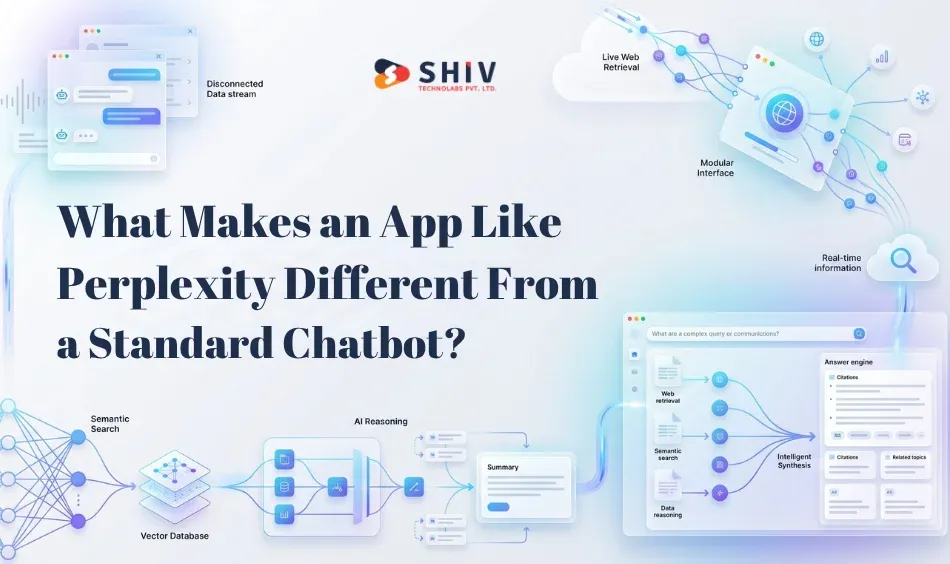
Perplexity is not a chatbot. It is a real-time AI answer engine that retrieves live web data, synthesizes it using a large language model, and delivers cited, conversational responses. That combination of live search plus LLM reasoning is what separates it from tools like ChatGPT in default mode.
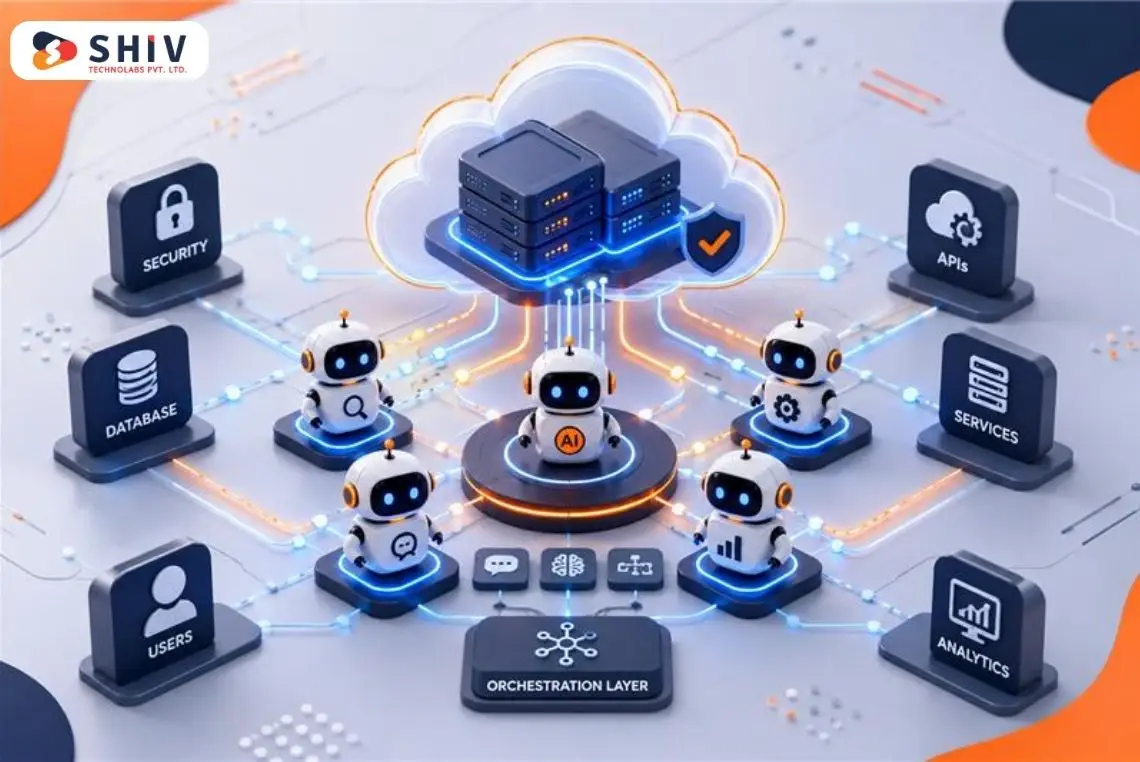
For startup founders, this distinction matters because it shapes your architecture from day one. You are not just integrating an API. You are building a retrieval-augmented generation (RAG) pipeline, a web scraping layer, a ranking and synthesis engine, and a conversational front end.
# Core Capabilities You Need to Replicate
Real-time web retrieval is the backbone. Unlike static LLM responses, a Perplexity-like app queries live sources and returns results with citations. This requires browser automation, scraping infrastructure, and source ranking logic.
Large language model integration sits on top of retrieval. You pass the retrieved content to a model (GPT, Claude, Gemini, or your own fine-tuned model) as context, and the model generates a synthesized answer. Getting the prompt engineering right here is critical for answer quality.
Source citation and transparency are a trust feature, not just a UI detail. Users of AI answer engines expect to see where the information comes from. Building citation rendering into your frontend is non-negotiable.
Conversational memory allows follow-up questions. A user asking “What is Perplexity?” followed by “How does its revenue model work?” should receive contextually connected answers. This requires session-level memory management in your backend.
Personalization and user history keep users coming back. Perplexity’s Pro model uses search history and preferences to improve results. Building this in from the MVP stage gives you a strong retention foundation.
Full Cost Breakdown to Build an AI App Like Perplexity
Cost varies significantly based on whether you are building a focused MVP or a full-featured platform. The ranges below reflect realistic global development rates.
1. Total Estimated Cost Range
Cost varies based on what you want to build first. An MVP gets your product in front of real users fast. A full platform gives you more capability but takes longer and costs more. Use this table to match your budget to the right starting point.
| Build Type | Estimated Total |
|---|---|
| MVP (core AI search, web retrieval, chat UI) | $50,000 to $100,000 |
| Mid-tier product (multi-model, mobile, admin panel) | $100,000 to $175,000 |
| Full-featured platform (custom LLM, fine-tuning, API access) | $175,000 to $250,000+ |
These ranges are starting points, not fixed prices. Your final cost depends on your feature list, the team you work with, and how much of the product you want ready at launch. A scoping call with our team can give you a number specific to your build.
2. UI/UX Design
Design costs for an AI app like Perplexity typically start at $3,000 for a basic template-based setup and can go up to $15,000 for a fully custom chat and search interface. Where you land depends on how differentiated you want the product to look at launch.
| Component | Description | Estimated Cost |
|---|---|---|
| Basic UI | Template-based, minimal customization | $3,000 to $8,000 |
| Custom interface | Interactive chat and search layout | $7,000 to $15,000 |
| Responsive design | Web, tablet, and mobile optimization | $3,200 to $12,000 |
For most MVPs, a budget of $7,000 to $12,000 covers a clean, functional interface that works across web and mobile. You can always invest more in design in version 2 once you have user feedback to guide the decisions.
3. Frontend and App Development
Frontend development is one of the larger cost items in this build, ranging from $8,000 for a web-only app to $40,000 if you want a fully cross-platform mobile experience from day one. The biggest factor is whether you build for the web first or go web and mobile together.
| Component | Description | Estimated Cost |
|---|---|---|
| Web app (React/Next.js) | Primary chat and search interface | $8,000 to $25,000 |
| Mobile app (Flutter) | Cross-platform mobile experience | $15,000 to $40,000 |
| Mobile app (React Native) | Alternative cross-platform approach | $12,000 to $35,000 |
Most startup founders building an MVP start with web only, which keeps frontend costs between $8,000 and $25,000. Adding a mobile app from day one can push this to $40,000 or more, so it is worth confirming where your target users actually spend their time before committing.
4. AI Model and RAG Pipeline Integration
AI integration is where budgets vary most widely, anywhere from $6,100 for a straightforward API setup to $50,000 or more if you want a fine-tuned model trained on domain-specific data. The majority of MVPs sit in the $10,000 to $25,000 range, using managed LLM APIs rather than custom-trained models.
| Component | Description | Estimated Cost |
|---|---|---|
| GPT-4o or Claude API integration | Token management, prompt engineering | $6,100 to $25,000 |
| Multi-model switching | Fallback and routing between models | $8,000 to $20,000 |
| RAG pipeline development | Retrieval-augmented generation setup | $10,000 to $30,000 |
| Fine-tuning on domain data | Custom model training for niche use | $15,000 to $50,000 |
If you are building an MVP, budget $10,000 to $20,000 for solid LLM integration and a working RAG pipeline. Fine-tuning on custom data is a version 2 investment. Get the core retrieval and synthesis working first, then improve accuracy with your own data once you have real queries to learn from.
5. Backend and Infrastructure
Backend development and infrastructure costs range from $12,000 on the lower end to $35,000 or more for a fully scaled cloud setup with auto-scaling and real-time retrieval.
| Component | Description | Estimated Cost |
|---|---|---|
| Scalable cloud backend | AWS or GCP with auto-scaling | $12,000 to $35,000 |
| Real-time web retrieval layer | Search APIs and browser automation | $8,000 to $25,000 |
| User data and session management | Auth, profiles, and history | $4,000 to $12,000 |
| Vector database setup | Pinecone, Weaviate, or Chroma | $3,000 to $10,000 |
A practical MVP backend budget sits between $20,000 and $35,000, covering cloud setup, retrieval, and user management.
6. Third-party Integrations
Integration costs range from $1,000 for a basic payment gateway to $15,000 for complex custom API connections into domain-specific data sources.
| Component | Description | Estimated Cost |
|---|---|---|
| Search API access (Bing, Brave) | Live web data retrieval | $2,000 to $6,000 |
| Payment gateway | Subscription or usage billing | $1,000 to $3,000 |
| CRM integration | Sales and support connectivity | $2,000 to $5,000 |
| Custom API connections | Domain-specific data sources | $3,000 to $15,000 |
Start with only the integrations your MVP genuinely needs. A search API and payment gateway cover the basics and keep the cost under $10,000.
7. Admin Dashboard and Analytics
Admin and analytics development ranges from $4,000 for basic reporting to $22,000 for a full admin panel with user management, query logs, and a public API for third-party developers.
| Component | Description | Estimated Cost |
|---|---|---|
| Admin panel | User management, query logs, and moderation | $7,000 to $18,000 |
| Public API for third-party developers | Documented endpoints with rate limiting | $8,000 to $22,000 |
| Analytics and reporting | Usage tracking, query analysis, retention metrics | $4,000 to $12,000 |
8. Testing and Security
Testing and QA solutions typically account for $8,000 to $20,000 for QA and $4,000 to $18,000 for security implementation.
| Component | Description | Estimated Cost |
|---|---|---|
| QA and automated testing | Functional, load, and regression testing | $8,000 to $20,000 |
| Security implementation | Encryption, GDPR, SOC2 readiness | $4,000 to $18,000 |
| Performance optimization | Latency reduction, caching strategy | $3,000 to $10,000 |
How Long Does It Take to Build an App Like Perplexity?
The ranges below assume a dedicated development team working in agile sprints. A smaller team or a more complex feature set will push timelines toward the higher end.
| Phase | Duration |
|---|---|
| Discovery and architecture planning | 2 to 3 weeks |
| UI/UX design | 3 to 5 weeks |
| Backend and RAG pipeline development | 6 to 10 weeks |
| Frontend development | 4 to 8 weeks |
| AI integration and prompt engineering | 4 to 6 weeks |
| QA, security, and performance testing | 3 to 5 weeks |
| Deployment and launch | 1 to 2 weeks |
MVP timeline: 4 to 7 months. A full-featured product with mobile apps, custom LLM fine-tuning, and a public API typically takes 9 to 14 months.
AI-assisted development tooling (GitHub Copilot, Cursor) can reduce backend and frontend timelines by 20 to 30% when used by experienced teams.
What Tech Stack Powers an App Like Perplexity?
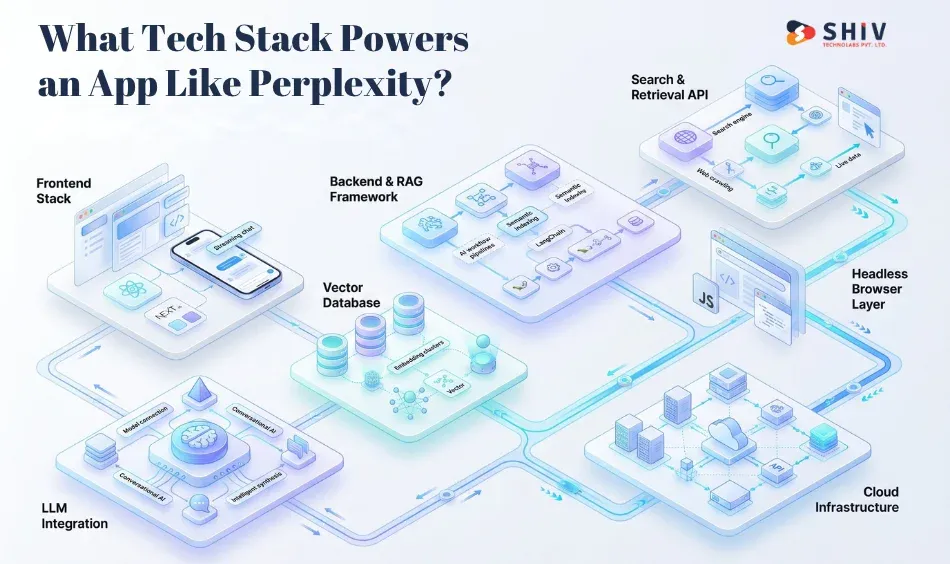
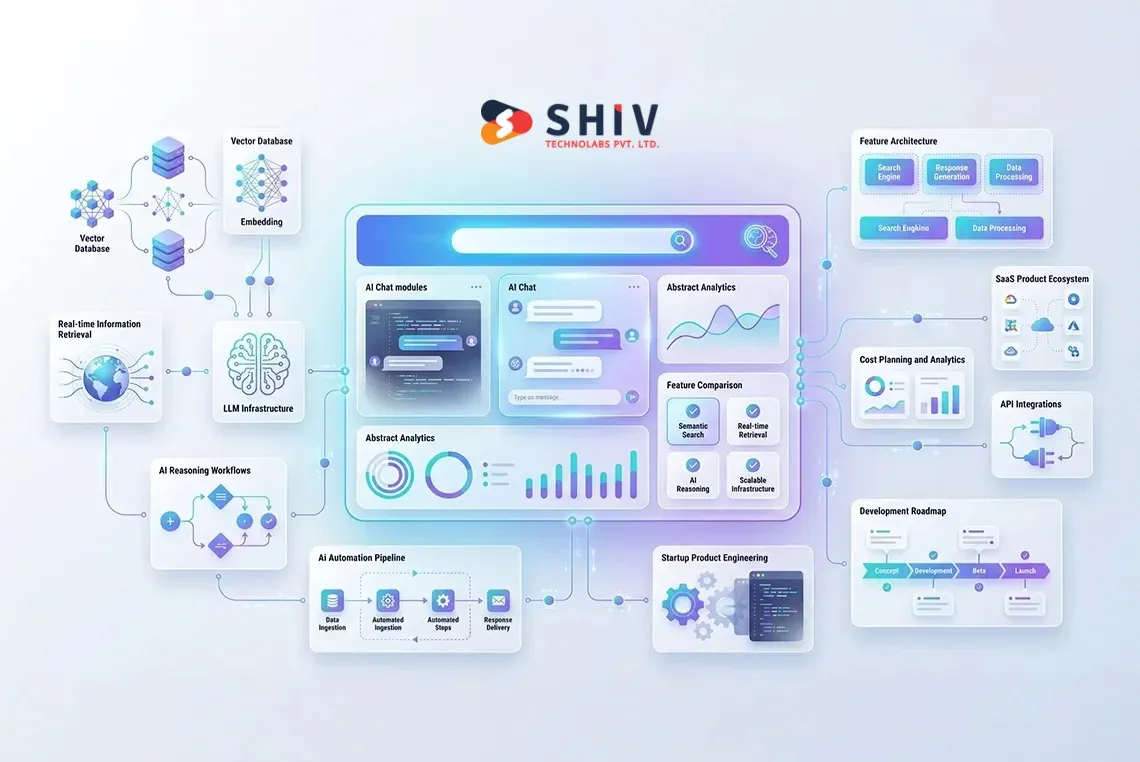
Choosing the right tech stack early saves months of rework later. A Perplexity-like AI app needs a frontend for real-time conversations, a backend for orchestration, a retrieval pipeline for live data, and AI models that can generate accurate responses with citations.
1. Frontend Stack
React or Next.js is commonly used for the web app interface. For mobile apps, React Native or Flutter works well for cross-platform development. Your frontend should support streaming responses so users can see answers appear in real time instead of waiting for a full response to load.
2. Backend and RAG Framework
Python with FastAPI or Node.js with Express is commonly used for the backend. Python is usually preferred for AI-heavy applications because it integrates smoothly with modern AI frameworks.
LlamaIndex and LangChain remain the two leading RAG frameworks in 2026. LlamaIndex is better for retrieval, indexing, and semantic search, while LangGraph works well for multi-step AI workflows and agent logic. Many production AI apps use both together.
3. Vector Database
Pinecone, Qdrant, Weaviate, and Chroma are still the main vector database choices in 2026.
- Pinecone is reliable and easy to manage for production apps.
- Qdrant offers a more cost-effective setup.
- Weaviate is useful for hybrid keyword and vector search.
- Chroma is mostly used for prototyping and smaller projects.
4. Web Search and Retrieval API
With the Bing Search API retired, Tavily, Brave Search API, SerpAPI, and Firecrawl have become the leading choices for AI search apps.
- Tavily is popular for AI-native search workflows.
- Brave Search API focuses on privacy.
- SerpAPI supports multiple search engines.
- Firecrawl works well for full-page content extraction in RAG pipelines.
5. Headless Browser Layer
Playwright is the preferred headless browser tool for AI apps in 2026. It handles JavaScript-heavy websites more reliably than Puppeteer and is widely used for scraping and browser automation.
6. LLM Integration
GPT-5.5 and GPT-5.5 Instant from OpenAI are among the latest production-ready AI models in 2026. Claude 4.6 is strong for coding and long-form answers, while Gemini 3.1 Pro supports very large context windows.
For lower API costs at scale, many teams fine-tune open-source models like Llama 4 or Mistral on domain-specific data.
7. Cloud Infrastructure
AWS and Google Cloud remain the most common infrastructure choices for AI apps. Managed AI APIs are the best starting point for MVPs because they reduce infrastructure complexity. Once usage grows, teams often move parts of the stack to self-hosted infrastructure for better cost control.
Also Read: Custom LLM Development: OpenAI API vs. Building Your Own Private Model
How to Choose the Right Development Partner for This Build?
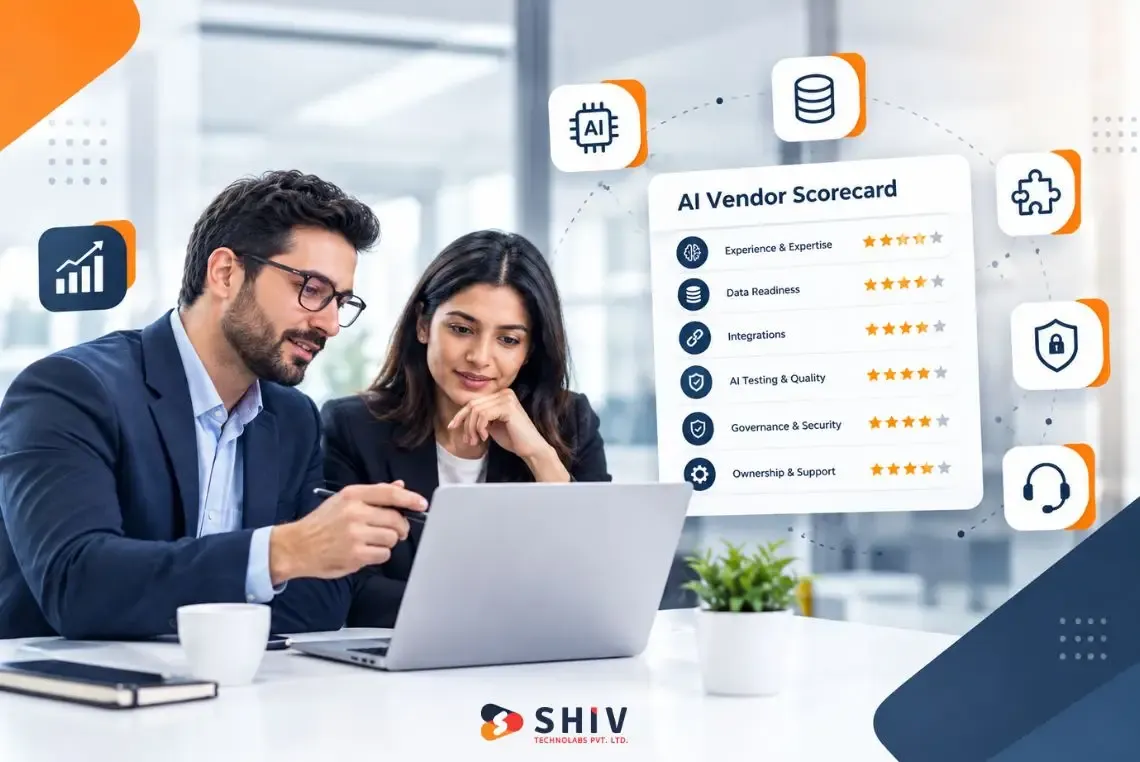
Building a Perplexity-like app is not a standard web project. It requires direct experience in RAG pipelines, LLM API integration, real-time data retrieval, and vector database management. Most general-purpose app development agencies will underestimate this complexity and learn on your budget.
1. Demonstrated AI product portfolio
Ask to see live AI applications the team has built, not just UI mockups or case study PDFs. Ask specifically whether they have built RAG-based applications and whether they have worked with LangChain, LlamaIndex, or similar frameworks. A team that has never touched retrieval-augmented generation will treat your project as a learning exercise.
2. Full-stack AI development capability
You want a single team that handles design, frontend, backend, ML integration, cloud infrastructure, and QA together. Fragmented development across multiple vendors multiplies coordination overhead and creates integration failures at the seams. This is especially costly in AI projects where the RAG pipeline, the frontend streaming, and the backend session management all need to work in sync.
3. Startup-specific development track record
Enterprise development timelines do not fit startup budgets or market windows. Look for teams that have built and shipped MVPs within 4 to 6 months, who work in agile sprints, and who can advise on what to cut from scope to hit your launch date without breaking the core experience.
Build Your AI App With Shiv Technolabs
At Shiv Technolabs, we have delivered AI-powered app builds for startup founders across the US, UK, Canada, and Australia. Our team provides premier AI development services. We work with RAG architectures, OpenAI as well as Claude API integrations, vector database setups, and real-time web retrieval pipelines.
We follow an MVP-first approach, so you get a working product in front of real users quickly. Ready to discuss your build? Share your requirements, and our team will send you a detailed project breakdown within 48 hours. Contact Shiv Technolabs today!
Conclusion
Building an AI app like Perplexity is possible for IT startup founders with the right team and a clear plan. What separates successful launches from abandoned projects is planning the architecture correctly from day one, scoping the MVP tightly, and working with a team that has done this before.
The startup founders who move in the next 12 months will be the ones defining their niches. General-purpose AI search is already competitive. Vertical-specific answer engines in legal, medical, financial, and eCommerce research are still wide open.
Frequently Asked Questions
How much does it cost to build an AI app like Perplexity?
An MVP typically costs between $50,000 and $100,000. A full-featured product with multi-model support, mobile apps, and a public API ranges from $150,000 to $250,000 or more, depending on team location and feature scope.
How long does it take to build a Perplexity-like AI app?
An MVP takes 4 to 7 months. A full product with advanced features, fine-tuned models, and mobile apps takes 9 to 14 months. AI-assisted development can compress these timelines by 20 to 30 percent with an experienced team.
What is the best tech stack for building an AI search app like Perplexity?
Python with FastAPI for the backend, React or Next.js for the frontend, LangChain or LlamaIndex for the RAG pipeline, Pinecone or Weaviate for vector storage, and GPT-4o or Claude 3 for LLM integration is the most proven production combination right now.
Can I build an AI app like Perplexity without training my own model?
Yes. Most production apps use LLM APIs from OpenAI, Anthropic, or Google rather than training models from scratch. You only need custom model training if your domain has highly specialized knowledge that existing models handle poorly.
What is the difference between a Perplexity-like app and a standard chatbot?
A standard chatbot uses a static LLM with no live data access and answers based on training data alone. A Perplexity-like app retrieves real-time web results, passes them as context to the LLM, and generates cited answers. The retrieval layer is what makes it an answer engine rather than a chatbot.
What is RAG, and why does it matter for building apps like Perplexity?
RAG stands for retrieval-augmented generation. It is the core technique that allows your app to fetch live or domain-specific data and pass it to the LLM as context. This produces accurate, current answers instead of relying solely on the model’s training data, which has a cutoff date.
Can I build a niche version of Perplexity for a specific industry?
Absolutely. Niche focus is a strong competitive advantage. Legal research AI, medical literature search, financial data assistants, and e-commerce product research engines are all viable Perplexity-inspired products. Vertical focus lets you fine-tune on domain data and build a more accurate product than any general-purpose tool can offer.
Does Shiv Technolabs build AI apps like Perplexity?
Yes. Shiv Technolabs builds custom AI applications, including RAG-based answer engines, LLM-integrated products, and real-time AI search tools for startup founders and growing product companies across the US, UK, Canada, and Australia.