Table of Contents
When your AI bill quietly grows into one of your largest operating expenses, “just using APIs” stops being a simple choice.
Custom LLM development services are no longer a future consideration, they emerge when scale exposes the limits of third-party APIs. What begins as a low-cost experiment can escalate rapidly as usage reaches billions of tokens per month, turning variable spend into a persistent financial burden.
In regulated industries, the shift happens even sooner. Here, cost is secondary to control. Data sovereignty, compliance mandates, and ownership of infrastructure push enterprises toward building and managing their own models.
The choice between a third-party API and a private model depends on cost, control, and long-term scalability. Businesses already investing in AI development services need to evaluate this as a business architecture decision, not just a technical one.
This blog works through both options in detail, covering real 2026 cost numbers, architecture considerations, compliance implications, and a practical decision framework to help technology leaders and business owners make an informed choice.
OpenAI API or Self-Hosted LLM: Which One Should You Choose?
If you need a fast decision, choose the OpenAI API for speed, easy setup, and advanced model access. Choose a self-hosted LLM when your business needs stronger data control, predictable long-term cost, custom model behavior, or strict compliance support.
| Decision Factor | OpenAI API | Self-Hosted LLM |
|---|---|---|
| Best fit | Fast AI product launch, testing, and internal tools | Long-term AI systems with strict control needs |
| Setup effort | Low, because the model is ready to connect through API | High, because hosting, GPUs, scaling, and monitoring are required |
| Team need | Works well without an in-house ML team | Needs ML, DevOps, or infrastructure support |
| Cost fit | Better when usage is still manageable | Better when usage is high and predictable |
| Data control | Suitable when external API processing is acceptable | Better for regulated or sensitive data workflows |
| Model control | Limited control over model version and behavior | Full control over model choice, tuning, versioning, and updates |
| Time to launch | Faster | Slower |
| Simple decision | Choose it when speed matters most | Choose it when control matters most |
1. OpenAI API vs Self-Hosted LLM Cost in 2026
Cost is where most businesses start the comparison, and it is where the most confusion exists. Both options have costs that are easy to underestimate.
# 1.1 API Cost Breakdown
The OpenAI API charges per million tokens for both input and output. In 2026, pricing is roughly: GPT-4o at ~$5 per million input tokens and ~$15 per million output tokens, while GPT-4o mini runs closer to ~$0.15 input and ~$0.60 output.
These numbers look small at first. A single user sending 1,000 tokens and receiving 500 tokens costs a fraction of a cent. The challenge appears at scale. A system with 5,000 active users, each making 10 queries per day at 1,500 tokens per interaction, generates about 75 million tokens daily. Even with GPT-4o mini, this translates to roughly $11,000 to $15,000 per month.
The bigger issue is how usage grows. Token consumption rarely scales linearly. As products add more AI features, prompts become longer and responses more detailed. A system using 100 million tokens per month can grow to billions within months, even without major product changes.
# 1.2 Self-Hosted LLM Cost Breakdown
Self-hosted LLM costs fall into two primary buckets: infrastructure and engineering.
Infrastructure (GPU and Cloud): Running a capable open-source model requires significant GPU compute. A model like Llama 3 70B or Mistral 8x7B needs at least 4 to 8 high-memory GPUs to serve production traffic with acceptable latency. On AWS, a p4d.24xlarge instance with 8 A100 GPUs costs roughly $32 per hour on-demand, or approximately $9,000 per month at continuous use. Reserved 1-year instances reduce this to $4,500 to $6,000 per month. Smaller models like Mistral 7B or Llama 3 8B can run on a single A10G GPU at $1.50 to $3 per hour, making them far more accessible for businesses starting their self-hosting journey.
Storage, networking, load balancers, and monitoring infrastructure add 15 to 25 percent on top of compute costs in most cloud deployments.
Engineering and Operations: This is where the self-hosted cost model diverges most sharply from the API. Running a private LLM in production is not a set-and-forget operation. It requires an inference stack, typically vLLM, TGI, or NVIDIA Triton, autoscaling configuration, latency monitoring, model version management, and ongoing debugging. This is also where the Private AI vs Public AI decision becomes practical, because control brings infrastructure responsibility. A production-grade deployment realistically needs at least one senior ML engineer and one platform or DevOps engineer dedicated to maintaining it. At US market rates, that is $250,000 to $400,000 per year in engineering salaries before overhead.
# 1.3 Hidden Costs of Self-Hosting
Beyond compute and engineering, three hidden cost categories catch most businesses off guard.
Underutilized GPUs: GPU instances are rented or purchased at fixed capacity. At night, on weekends, or during low-traffic periods, your GPUs sit partially or fully idle while still accruing cost. Unless you build sophisticated autoscaling that spins instances down during low demand and back up quickly enough not to affect user experience, you pay for capacity you are not using. This problem is less significant for high-traffic products but significant for internal tools or moderate-usage deployments.
Scaling Complexity: Traffic spikes do not give advance notice. If your product gets a surge in usage, scaling a self-hosted model requires either pre-provisioned buffer capacity (expensive) or fast autoscaling logic (technically complex). The OpenAI API scales automatically without any configuration on your end. Replicating that experience on your own infrastructure takes real engineering investment.
Maintenance Overhead: Models need updates. Your inference software needs patches. Security configurations need auditing. GPU drivers and CUDA versions need managing. None of this is dramatic individually, but collectively it represents a continuous engineering tax that grows as your infrastructure becomes more complex.
# 1.4 How LLM Costs Change as Your Usage Scales
The table below gives estimated cost ranges across usage levels for 2026. These figures assume standard cloud pricing, a moderately sized model for self-hosting, and fully loaded engineering costs amortized monthly.
| Monthly Token Volume | OpenAI API (GPT-4o) | OpenAI API (GPT-4o mini) | Self-Hosted LLM (Infra Only) | Self-Hosted LLM (Fully Loaded) |
|---|---|---|---|---|
| 10M tokens | $75 – $150 | $8 – $15 | $1,500 – $3,000 | $23,000 – $36,000 |
| 100M tokens | $750 – $1,500 | $80 – $150 | $1,500 – $3,500 | $23,000 – $37,000 |
| 1B tokens | $7,500 – $15,000 | $750 – $900 | $3,000 – $7,000 | $25,000 – $40,000 |
| 5B tokens | $37,500 – $75,000 | $3,750 – $4,500 | $8,000 – $18,000 | $30,000 – $50,000 |
| 10B tokens | $75,000 – $150,000 | $7,500 – $9,000 | $12,000 – $25,000 | $35,000 – $57,000 |
The fully loaded column includes an estimated $22,000 to $33,000 per month in engineering salaries (2 engineers at US market rates). This makes the self-hosted economics look unfavorable at low volumes but increasingly attractive at 5 billion tokens and above, especially if your team was already planning to hire ML engineering capacity for other work.
2. Is It Cheaper to Use the OpenAI API or Host Your Own LLM?
The answer depends on usage volume, and the crossover point is higher than most expect.
Below ~500 million tokens per month, the OpenAI API is usually cheaper. Infrastructure savings from self-hosting do not justify engineering overhead at this stage. GPT-4o mini is cost-effective enough that many products never reach a point where self-hosting makes sense.
The shift begins around 1 to 2 billion tokens per month for GPT-4o, or 5 to 10 billion tokens for GPT-4o mini. At this scale, API costs grow enough that self-hosting becomes more cost-efficient.
Other factors matter as well. Existing ML teams reduce setup cost. Domain-specific use cases benefit from fine-tuning. Regulated industries often prioritize data control over cost.
At a simple level: API works best at lower scale. Self-hosting becomes more practical at higher scale or when control and compliance matter more.
# 3. Proprietary vs Open-Source LLMs for Business
Businesses evaluating self-hosted AI must choose between proprietary models and open-source models.
Proprietary models like GPT-4o, Claude 3.7, and Gemini 1.5 Pro offer top-tier performance with minimal setup. They work best when speed, reliability, and advanced capabilities matter.
Open-source models like Llama 3, Mistral, and Falcon provide full control, no per-token cost, and better flexibility for domain-specific use cases. The performance gap has reduced significantly, especially with fine-tuning.
Open-Source vs Proprietary LLMs: Side-by-Side Comparison
| Factor | Proprietary LLMs (API) | Open-Source LLMs (Self-Hosted) |
|---|---|---|
| Setup time | Hours | Weeks to months |
| Upfront cost | Low (pay per use) | High (infra + engineering) |
| Cost at scale | Increases with usage | Becomes more stable |
| Data privacy | Data processed externally | Full internal control |
| Customization | Limited | Full control (fine-tuning) |
| Vendor dependency | High | None |
| Performance | Best available | Close, depends on tuning |
| Compliance | Depends on provider | Strong (full control) |
| Maintenance | None | Ongoing effort |
If your team needs model planning, tuning, and enterprise AI setup, Shiv Technolabs’ generative AI development services can support the complete build cycle.
# 4. Building a Private LLM for Enterprise
The term “private LLM” is often used loosely, but in an enterprise context, it has a specific meaning.
A private LLM runs entirely on infrastructure your organization controls. Model weights are stored within your environment, inference happens inside your network, and no data is sent to external providers. You control model behavior, updates, and access.
This is different from using OpenAI Enterprise, where data is still processed through external infrastructure under agreement.
A private LLM means full ownership, control, and isolation of your AI system.
# Typical Architecture Components
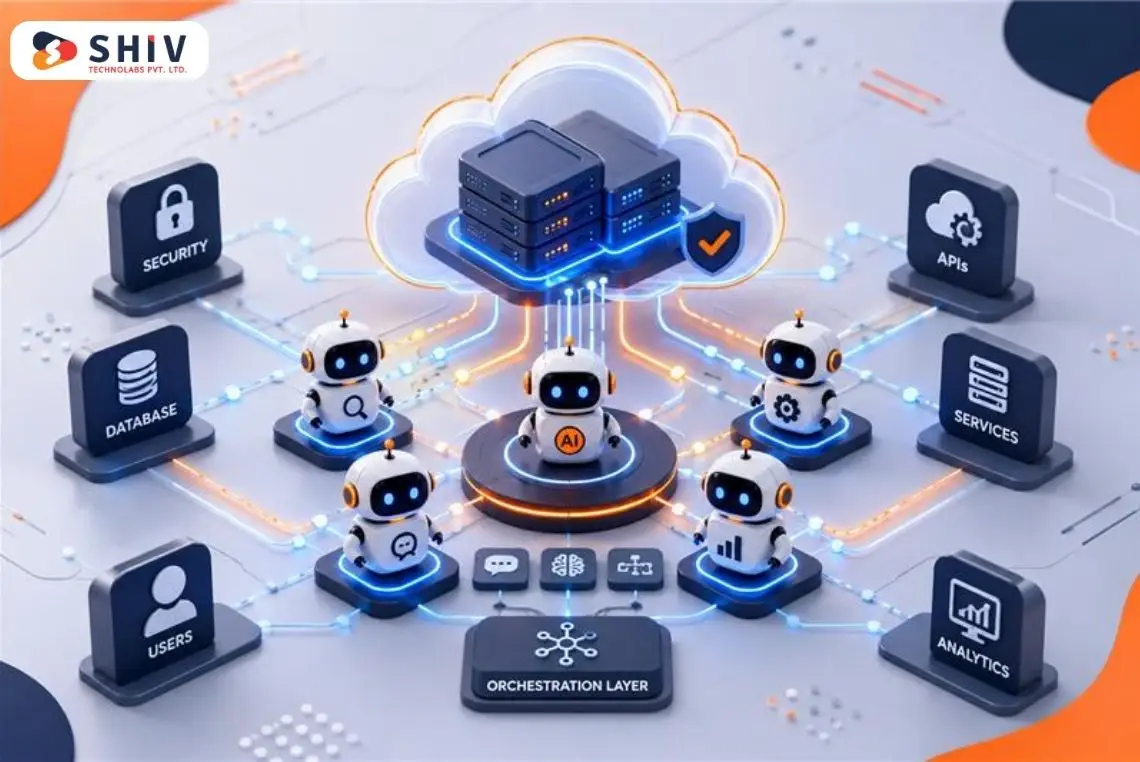
A production-grade private LLM deployment for enterprise typically includes the following components working together.
Base Model: An open-source model appropriate to the task, such as Llama 3 8B for lighter workloads or Llama 3 70B and Mixtral 8x7B for more capable deployments. The base model is downloaded from Hugging Face or a similar registry and stored in your environment.
Fine-Tuning Layer: If your use case requires domain-specific performance, the base model is fine-tuned on your proprietary data using techniques like LoRA (Low-Rank Adaptation) or full fine-tuning depending on budget and requirements. This step is what makes the model understand your terminology, document formats, and decision logic.
Inference Server: Tools like vLLM, TGI (Text Generation Inference by Hugging Face), or NVIDIA Triton serve the model at production scale. These handle batching, memory management, and throughput optimization to make inference fast and cost-efficient.
Vector Database (for RAG): If your deployment uses retrieval-augmented generation, a vector database like Pinecone, Weaviate, Qdrant, or pgvector stores embeddings of your internal documents for fast semantic retrieval.
API Gateway: An internal API layer that your applications call, handling authentication, rate limiting, logging, and routing between model versions.
Monitoring and Observability: Tools for tracking latency, throughput, error rates, and response quality over time. This layer is critical for maintaining model reliability in production.
Security and Access Control: Role-based access to the inference API, encryption at rest and in transit, audit logging for all requests and responses, and integration with your identity provider.
5. RAG vs Fine-Tuning for Enterprise AI
When businesses want AI to work with internal data, two approaches are used: RAG and fine-tuning. Both solve different problems, and choosing the right one depends on how your data behaves and what your system needs to deliver.
# RAG: Best for Dynamic Data
RAG retrieves relevant information from your documents at runtime and uses it to generate responses. It works well when your data changes frequently and needs to stay current without retraining.
It is commonly used for knowledge bases, customer support systems, and compliance tools where responses must reflect the latest information. The limitation is that output quality depends on retrieval accuracy. If the wrong data is fetched, the response can still sound correct but be wrong.
# Fine-Tuning: Best for Structured Behavior
Fine-tuning trains the model on your data so it can follow specific formats, workflows, or domain language. It is useful when consistency matters more than real-time updates.
Typical use cases include structured outputs, classification systems, and domain-specific tasks. It is also more efficient at scale since the model does not rely on external retrieval for every request. The tradeoff is the need for quality training data and periodic retraining.
# What Works in Practice
Most enterprise systems combine both approaches. Fine-tuning handles behavior and consistency, while RAG keeps the model updated with current data.
This hybrid setup delivers better accuracy, control, and scalability for production AI systems.
Many enterprise teams start with consulting before building. Our post on generative AI consulting explains how idea validation, data planning, and model delivery work together.
6. On-Premise LLM Deployment for Data Privacy
On-premise deployment means running your LLM on physical servers in a data center that your organization controls, rather than on cloud infrastructure. It is the most privacy-preserving option available because data never leaves your physical premises, not even to your cloud provider. This approach is often part of a broader generative AI architecture strategy where data flow, model access, and infrastructure are fully controlled within the organization.
When On-Premise LLM Deployment Makes Sense
On-premise deployment is the right choice when data cannot leave your environment.
This applies to organizations with strict data sovereignty or compliance requirements, such as government agencies, healthcare providers, financial institutions, and legal firms handling sensitive data. In these cases, running AI on external infrastructure is not an option.
It also works well for companies that already operate on-premise systems. If your team manages databases, applications, and security internally, adding GPU infrastructure is an extension of existing capabilities.
For large and predictable workloads, on-premise can also be cost-efficient over time. Once infrastructure is set up and amortized, long-term inference costs can be lower than cloud-based alternatives.
When On-Premise LLM Deployment Does Not Make Sense
On-premise is not suitable for most businesses.
The upfront investment is high, often ranging from $500,000 to several million dollars for infrastructure, networking, cooling, and power. It also requires specialized expertise to manage GPU hardware and maintain system reliability.
If your main concern is data privacy but not strict infrastructure control, a private cloud setup on platforms like Amazon Web Services, Microsoft Azure, or Google Cloud Platform offers a more practical alternative. It provides strong data isolation with significantly lower operational overhead.
7. HIPAA Compliant AI Development Considerations
Healthcare organizations and their technology partners face specific requirements when building AI systems that process protected health information (PHI). HIPAA compliance for AI is not a product you can purchase; it is an architectural and operational discipline that runs through every layer of your system.
# Data Security
Any AI system that processes PHI must encrypt that data both at rest and in transit using current standards (AES-256 for storage, TLS 1.2 or higher for transmission). The model itself, if fine-tuned on PHI, must be stored in an encrypted environment with restricted access. Your vector database, if used for RAG, must apply the same encryption standards to all stored embeddings and document chunks.
Data minimization is also a HIPAA principle that applies directly to LLM design. Your system should only process the PHI necessary for the specific task. Prompts should be designed to avoid including unnecessary patient identifiers, and output filters should prevent the model from surfacing PHI it was not asked to retrieve.
# Audit Requirements
HIPAA requires that covered entities and business associates maintain audit logs of who accessed PHI, when, and for what purpose. For an AI system, this means logging every inference request with a user identifier, timestamp, and enough metadata to reconstruct the context of the request. Logs must be retained for a minimum of 6 years and must be protected against unauthorized modification.
Your AI platform should also include alerting for unusual access patterns, such as a user querying PHI at volumes far outside their normal behavior, which could indicate a security incident.
# Access Control
PHI-processing AI systems must implement role-based access controls so that only authorized users can submit queries that involve patient data. This means integrating your AI inference API with your organization’s identity management system and enforcing access policies at the API gateway level, not just at the application layer.
Business Associate Agreements (BAAs) are also required for any vendor whose systems touch PHI. If you are using a third-party API to process PHI, that vendor must sign a BAA. This is one reason many healthcare organizations choose to build private LLM deployments entirely within their own infrastructure: it eliminates the BAA complexity with an external model provider.
8. How to Build a Private LLM With Company Data

Building a private LLM is a structured process. The outcome depends on how clearly you define the problem, prepare data, and choose the right architecture.
# Start With a Clearly Defined Use Case
Begin with a specific outcome. A vague goal leads to poor architecture decisions. Define inputs, outputs, expected accuracy, and usage volume upfront. This clarity drives every decision that follows.
# Get Your Data Ready for Training or Retrieval
Data preparation takes the most effort. For fine-tuning, data must be cleaned and structured into input-output pairs. For RAG, documents must be properly chunked, embedded, and indexed. Retrieval quality depends heavily on this step.
# Decide Between RAG, Fine-Tuning, or Hybrid
Choose the approach based on your use case. RAG works for dynamic data. Fine-tuning works for structured behavior. Most systems use a hybrid approach.
Also finalize your base model, deployment setup, and inference framework at this stage.
# Build Security and Access Control From Day One
Security is part of the build, not a final step. Control access to the model, encrypt data, and maintain audit logs. For regulated environments, align with standards like HIPAA, SOC 2, or GDPR before going live.
9. When to Switch From OpenAI API to a Custom Model
The decision to move from an API to a private model is rarely driven by a single factor. It usually happens when several signals appear at the same time.
# Key Signals That It Is Time to Switch
Rising API costs: When your monthly API bill consistently exceeds $10,000 to $20,000 and your usage is growing, the economics of self-hosting start to improve relative to continued API spend. At $50,000 per month or above, the case for a private model is usually compelling on cost grounds alone.
Data sensitivity concerns: If your business or legal team has raised questions about sending specific categories of data to an external model, or if a compliance audit has identified AI as a data handling risk, the switch from API to private model is often a compliance requirement rather than an optimization.
Domain-specific performance gaps: If your use case requires consistent, high-quality performance on specialized tasks and you find yourself investing significant engineering effort in prompt engineering to compensate for the general model’s limitations, fine-tuning a private model on your data may close that gap more reliably than continued prompt optimization.
Vendor dependency risk: If your product has built core features on a specific API, a pricing change, a model deprecation, or a policy update from the provider can disrupt your product roadmap. Businesses at this stage often switch to avoid that single point of external control.
# When Not to Switch
Not every business that is unhappy with API costs should switch to self-hosting. If your team does not have ML engineering expertise, the operational burden of self-hosting may cost more in staff time and quality issues than it saves in API bills. If your usage is below 500 million tokens per month and your data is not sensitive, the API is almost certainly the better option for the next 12 to 24 months. For early-stage teams working with limited resources, startup development services can help structure AI adoption without committing to heavy infrastructure too soon. And if your product is still iterating rapidly, locking into a custom model too early can slow down your ability to experiment with new capabilities.
The right trigger for switching is a combination of scale, data requirements, and organizational readiness, not just a rising API bill.
10. Total Cost of Ownership (TCO) for a Private LLM
Understanding the full TCO of a private LLM requires accounting for every cost layer over a meaningful time horizon, typically 24 to 36 months.
# Cost Components
Compute infrastructure: GPU servers or cloud instances for inference, training, and storage. This is the most variable cost and depends heavily on model size, throughput requirements, and whether you choose cloud or on-premise. Expect $2,000 to $20,000 per month for cloud GPU infrastructure depending on scale.
Engineering salaries: The largest cost component for most organizations. A minimum viable private LLM team requires at least one ML engineer and one platform engineer. At US market rates, budget $250,000 to $400,000 annually.
Data preparation: One-time but significant. Depending on the volume and quality of your source data, budget $30,000 to $150,000 for the initial data preparation phase.
Fine-tuning compute: Each training run costs $500 to $5,000 depending on model size, dataset size, and GPU type. Budget for several iteration cycles during development plus periodic retraining.
Security and compliance setup: Particularly for regulated industries, initial security architecture and compliance documentation work runs $15,000 to $50,000 and ongoing audit preparation adds cost annually.
Tooling and software: MLflow or similar experiment tracking, monitoring tools, vector database licenses or hosting, and inference framework support. Budget $500 to $3,000 per month.
# TCO Table: 24-Month Projection
| Cost Component | Month 1–3 (Setup) | Month 4–24 (Operations) | 24-Month Total (Estimate) |
|---|---|---|---|
| Compute infrastructure | $5,000 – $20,000 | $3,000 – $15,000/mo | $68,000 – $335,000 |
| Engineering salaries (2 FTEs) | $60,000 – $100,000 | $20,000 – $35,000/mo | $480,000 – $830,000 |
| Data preparation | $30,000 – $150,000 | $5,000 – $20,000/mo | $135,000 – $570,000 |
| Fine-tuning compute | $2,000 – $10,000 | $500 – $3,000/mo | $12,500 – $73,000 |
| Security and compliance | $15,000 – $50,000 | $1,000 – $3,000/mo | $36,000 – $113,000 |
| Tooling and software | $1,000 – $3,000 | $500 – $3,000/mo | $11,500 – $66,000 |
| Total | $113,000 – $333,000 | $743,000 – $1,987,000 |
These ranges are wide because they cover a broad range of business sizes and deployment scales. A smaller business running a 7B parameter model with one part-time engineer sits at the lower end. A large enterprise running a 70B parameter model with a dedicated team in a regulated industry sits at the higher end. The table is most useful as a framework for building your own projection with your specific numbers.
11. Decision Matrix: API vs Private vs Hybrid
The table below maps common business situations to the recommended architecture path based on the factors covered in this blog.
| Business Situation | Recommended Path | Primary Reason |
|---|---|---|
| Early-stage startup, under 100M tokens/month | OpenAI API | Speed to market, low overhead |
| Internal tools, non-sensitive data, moderate usage | OpenAI API or GPT-4o mini | Cost-effective, no infrastructure needed |
| Internal knowledge base or document Q&A | API + RAG layer | Grounded responses without retraining |
| Healthcare, legal, or financial data processing | Private LLM, private cloud or on-premise | HIPAA and data sovereignty requirements |
| Customer-facing AI product, 1B+ tokens/month | Private LLM, fine-tuned | Cost at scale, domain performance |
| Proprietary domain with unique terminology or formats | Fine-tuned private model + RAG | Domain accuracy, data control |
| Product requiring vendor independence | Open-source self-hosted model | No external dependency |
| Mix of sensitive and non-sensitive workloads | Hybrid, private + API | Cost and control balance |
| Regulated enterprise with existing ML team | Sovereign AI infrastructure | Full control, compliance, scale |
Most businesses will move through more than one row in this table as they grow. Starting on the API and planning the transition to a private or hybrid model is a sensible progression for most organizations.
Need Help With Custom LLM Development Services?
Shiv Technolabs works with businesses that have outgrown the OpenAI API or are building AI products that require private, compliant, and domain-specific model infrastructure. Whether you need help evaluating the right architecture for your situation, building a fine-tuned private model on your proprietary data, or standing up sovereign AI infrastructure for a regulated industry, our team has the technical experience to plan and execute it properly.
From data preparation and RAG pipeline architecture to HIPAA-compliant on-premise LLM deployment and full custom AI model development, we provide end-to-end services that align with your business goals, data requirements, and long-term budget.
Conclusion
Custom LLM development is not the right fit for every business, and the OpenAI API is not a long-term solution for all use cases. The decision depends on usage volume, data sensitivity, performance needs, and your ability to manage ML infrastructure.
At lower scale, the API offers speed and cost efficiency. As usage grows or compliance becomes critical, a private LLM becomes more practical.
The key is to decide based on real usage and total cost of ownership, not assumptions or short-term cost spikes.
Businesses that start with the API, measure usage, and plan the transition carefully tend to get better long-term outcomes. This is where custom LLM development services help—by turning a complex shift into a structured, scalable implementation.
Frequently Asked Questions
1. Is it cheaper to use the OpenAI API or host my own LLM?
At usage below 500 million tokens per month, the OpenAI API is typically cheaper when you account for all self-hosting costs, including engineering salaries, infrastructure, and data preparation. The economics shift at 1 to 5 billion tokens per month depending on the model tier and your engineering overhead. A total cost of ownership analysis over 24 months is the most reliable way to compare the two for your specific situation.
2. How do I build a private LLM with my company data?
Start by defining the specific use case and the quality threshold you need to meet. Then prepare your data through cleaning, formatting, and either RAG indexing or fine-tuning dataset creation. Choose a base open-source model appropriate to your compute budget and context window requirements. Set up your inference infrastructure, add security and access controls, and run evaluation cycles before going to production. The process typically takes 3 to 6 months for a first deployment.
3. When should I switch from the OpenAI API to a custom model?
The main signals are a monthly API bill consistently above $10,000 to $20,000 and growing, data sensitivity concerns that make external API use a compliance risk, persistent performance gaps on domain-specific tasks that prompt engineering has not resolved, and vendor dependency risk becoming a strategic concern for your product. If none of these apply, staying on the API is often the more rational choice.
4. What are the hidden costs of self-hosting an LLM?
The costs that most estimates miss are GPU idle time during low-traffic periods, the engineering overhead of autoscaling and reliability management, ongoing data preparation as your knowledge base evolves, security and compliance configuration for regulated environments, and latency optimization work to match API-level response times. These costs can add $200,000 to $400,000 annually on top of raw compute expenses.
5. What is the total cost of ownership for a private LLM?
Over 24 months, a realistic TCO for a private LLM deployment ranges from $750,000 to $2,000,000 for a mid-to-large enterprise, depending on model size, usage volume, team size, and compliance requirements. This includes infrastructure, engineering salaries, data preparation, fine-tuning compute, security setup, and tooling. Smaller deployments with a part-time team and a smaller model can come in under $300,000 over the same period.
6. What is the difference between RAG and fine-tuning for enterprise AI?
RAG connects a base model to an external knowledge base at inference time, so the model retrieves relevant content from your documents on each query. It is better for use cases where information changes frequently and you need the model to cite specific sources. Fine-tuning modifies the model’s weights by training it on your data, so it internalizes domain knowledge, output formats, and reasoning patterns. Fine-tuning is better for consistent output structure, domain-specific classification, and high-throughput workloads where retrieval latency is a concern.
7. What does HIPAA-compliant AI development require?
HIPAA-compliant AI requires encryption of PHI at rest and in transit, role-based access controls integrated with your identity management system, audit logging of all inference requests involving patient data, data minimization in prompt design, and Business Associate Agreements with any vendor whose infrastructure touches PHI. For most healthcare organizations, this means building on private LLM infrastructure where data does not leave their environment, rather than routing PHI through external model APIs.
8. What open-source LLMs are best for enterprise use in 2026?
The most widely used open-source models for enterprise deployments in 2026 are Meta’s Llama 3 series (8B and 70B), Mistral AI’s Mistral 7B and Mixtral 8x7B, and Falcon from the Technology Innovation Institute. Model choice depends on your compute budget, context window requirements, and the specific task. Llama 3 70B is a strong general-purpose choice for high-quality output. Mistral 7B is the most cost-efficient option for high-throughput workloads where a smaller model is acceptable.
9. Can I use both the OpenAI API and a private model at the same time?
Yes, and many enterprise AI architectures do exactly this. A hybrid approach routes different workloads to the most appropriate model: non-sensitive, lower-volume, or frontier-capability tasks go to the API, while high-volume, sensitive, or domain-specific tasks go to the private model. This gives you the cost and compliance benefits of self-hosting where they matter most while keeping the flexibility of the API for tasks where it performs better or is more cost-efficient.
10. How long does it take to build and deploy a private LLM?
A realistic timeline for a first private LLM deployment is 3 to 6 months from project kickoff to production. Data preparation typically takes 6 to 16 weeks depending on data volume and quality. Fine-tuning and evaluation cycles add 4 to 8 weeks. Infrastructure setup and security configuration run in parallel and add 4 to 8 weeks. Businesses that engage an experienced custom AI model development company typically move faster because they avoid the learning curve on tooling, architecture, and data preparation workflows.