Table of Contents
Every business building a mobile app faces the same early decision. Hire an in-house team to manage the full build, or bring in a specialized partner instead. Outsourcing mobile app development lets a company launch a quality app without carrying the cost and time of hiring engineers, designers, and testers from the ground up.
The mobile app development outsourcing market was valued at nearly $1.4 billion in 2026 and is on track to surpass $3.5 billion by 2035, growing at roughly 11% annually. That growth reflects a simple reality. Most founders and product teams do not have the months it takes to build an internal engineering team before writing a single line of code.
This gap between ambition and available resources is exactly why outsourcing has become a standard part of how modern apps get built, not a fallback option.
Quick Answer
Outsourcing mobile app development means hiring an external team to design, build, test, and launch your app instead of building an in-house department. It lowers hiring costs, speeds up delivery through teams that are ready to start immediately, and gives you access to specialized iOS, Android, and cross-platform talent without long-term overhead.
Why Do Businesses Choose to Outsource Mobile App Development?
Outsourcing is rarely a shortcut. It is a planned move that startups and established companies both use to get a working app to market with less internal efforts.
1. Talent Availability
Hiring skilled mobile developers close to home is slow and expensive in most markets. Outsourcing opens access to a wider pool of trained developers, designers, testers, and system architects through dedicated developer teams worldwide. You get a full working team without sourcing each specialist yourself.
2. Budget Control
In-house hiring adds cost layers quickly, including salaries, equipment, licenses, and office space. With outsourcing, you agree on a project budget upfront and pay for delivered work. There are no unexpected charges during the project.
3. Faster Time to Market
Speed matters when you need to launch faster than a competitor or before your funding runs low. Outsourced teams already run on tested workflows and tools, and a product development company can manage short sprints with frequent releases. That structure gets an app live faster than assembling a team from scratch.
4. Flexibility to Scale Up or Down
You can add developers mid-project when the scope grows, then scale back after launch. There is no hiring or termination process attached to either move. You pay based on how fast you need to go.
How Much Can You Actually Save by Outsourcing?
Outsourcing lowers costs without reducing the quality of work. It eliminates the waste associated with building and running an in-house department. The table below compares in-house and outsourced costs across a typical 12-month build, similar to how businesses review mobile app development costs before choosing a delivery model.
| Expense Category | In-House Team | Outsourced Team |
|---|---|---|
| Developer compensation | $107,000 to $158,000 per year per developer in the US | $15 to $70 per hour depending on region and seniority |
| Infrastructure | Office space, hardware, software licenses | Included in the vendor fee |
| Hiring time and cost | 1 to 3 months plus recruiter fees | Team ready to start within days |
| Scaling flexibility | Slow, tied to hiring and notice periods | Scale up or down within a project cycle |
| Simple app 12 month build | $250,000 and up | $10,000 to $60,000 |
| Medium complexity app | $350,000 and up | $40,000 to $150,000 |
| Enterprise-grade app | $600,000 and up | $150,000 to $400,000 or more |
A few things drive the range on the outsourced side. Project complexity, the country your team is based in, the technology stack, and how many features are in scope all move the number. A simple MVP development project with one main user journey keeps the cost lower end. A multi-platform app with payments, real-time data, and complex integrations moves toward the high end.
Fixed infrastructure costs disappear too. The outsourcing partner covers its own office space, tooling, and HR overhead, and that cost sits inside the quoted rate instead of showing up as a separate line item on your books.
Does Outsourcing Help You Launch Your App Faster?
Getting to market quickly matters most when you need to test an idea before funds run low or when a competitor is moving on the same opportunity. Outsourcing removes delay at nearly every stage of the build.
1. Ready-to-Work Teams Skip the Hiring Wait
There is no job posting, interview cycle, or notice period to wait out. A vetted team can start scoping your project within days of signing a contract.
2. Pre-tested Tech Stacks and Frameworks
Outsourced teams have already solved setup problems on past projects, especially when using proven options like cross-platform app development for faster multi-device delivery. They bring frameworks and tools that are proven, so nobody spends the first few weeks figuring out what will work.
3. Parallel Work Across Design, Development, and QA
Design, development, and testing can run at the same time instead of one after another. That overlap alone can cut weeks off a typical build.
4. Time Zone Coverage Keeps the Project Moving
When your local team logs off, an outsourced team in a different time zone can keep working. A US company can send feedback at night and find an updated build waiting the next morning. The project advances every single day instead of pausing overnight.
What Outsourcing Models Should You Choose From?
The right engagement model depends on your budget, your timeline, and how much day-to-day control you want over the build.
1. Dedicated Team
A dedicated development team works like an extension of your own company for the length of the project. You get full visibility into daily progress and direct communication with developers. This model suits large builds or apps that will keep evolving well past launch.
2. Fixed Price
A fixed price engagement locks in cost and scope before work begins. Both sides agree on deliverables, and the price does not move once the contract is signed. This works best for smaller apps with a clear, unchanging feature list.
3. Time and Material
A staff augmentation model can also fit time and material projects because you pay for the skills and hours required. Features can shift as you learn from user feedback. This model fits MVPs and products where requirements are still taking shape.
What Challenges Come with Outsourcing, and How Do You Manage Them?
Outsourcing carries real risks, but none of them are unmanageable with the right process in place.
1. Communication Gaps
Different languages or working styles can slow decisions down. Set up daily standups and keep written notes in a shared tool like Slack so nothing gets lost between calls.
2. Time Zone Co-ordination
A large time difference makes live conversations harder to schedule. Fix 2 to 3 hours of daily overlap and rely on shared calendars plus async updates for everything else.
3. Data Security
Sharing code and user data with an outside team raises fair questions. Put a signed NDA, access controls, and a clear data handling clause in the contract before work starts.
4. Quality Control
Outsourcing the work does not mean you stop managing the project. Set weekly milestones, review builds against those goals, and test releases yourself before they ship.
When Is the Right Time to Outsource Mobile App Development?
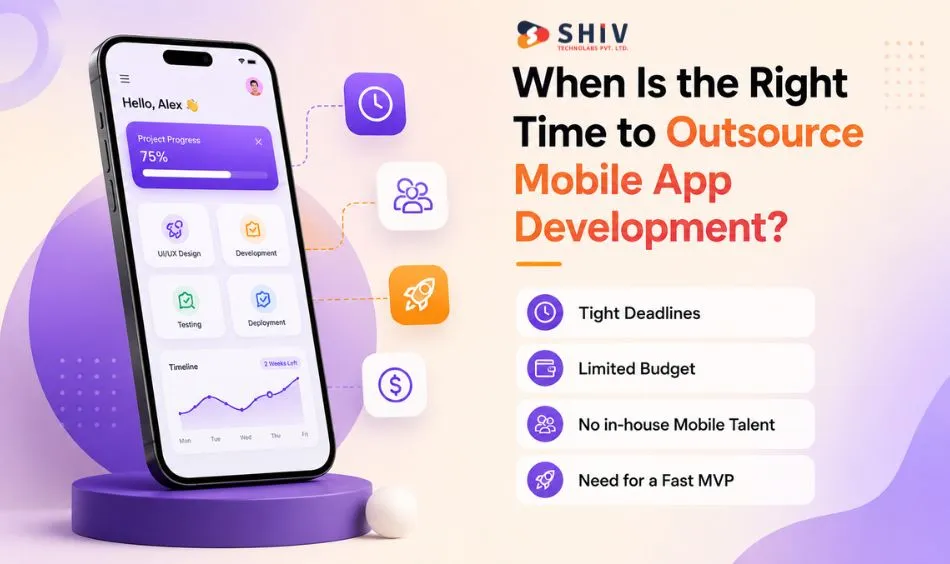
Outsourcing is not reserved for large enterprises. It works for any team that needs a working app without carrying full in-house overhead.
1. Tight Deadlines
If you need a working app in a few weeks, building and training an internal team will not fit the timeline.
2. Limited Budget
If you are working with a fixed budget such as $50,000, hiring locally will likely not stretch that far across a full build.
3. No in-house Mobile Talent
If your team has no dedicated mobile developers or designers, startup development services can fill the gap without building a full in-house tech team.
4. Need for a Fast MVP
If you want to test an idea in the market and refine it based on real feedback, outsourcing gets a testable version live without months of setup.
Ready to Turn Your App Idea Into a Working Product?
Shiv Technolabs builds iOS, Android, and cross-platform apps for startups and growing businesses that need to move fast without cutting corners on quality.
- Developers ready to start scoping within days
- Fixed, hourly, or milestone-based pricing to match your budget
- Delivery teams supporting clients across 30-plus countries
- Support that continues past launch, not just through handoff
Contact Shiv Technolabs today!
Conclusion
Outsourcing mobile app development does more than lower your budget. It shortens the path from idea to launch and removes the overhead of running an in-house team you may not need long-term.
Whether you are building a first MVP, entering a new market, or scaling an existing product, the right outsourcing partner gives you a working app without the cost of building a department around it.
FAQs
What does outsourcing mobile app development actually involve?
It means hiring an external company or freelance team to design, build, test, and launch your app instead of managing that work with in-house staff.
Is outsourcing cheaper than hiring an in-house team?
In most cases, yes. You avoid salaries, benefits, office space, and recruiting costs, and you only pay for the work defined in your project scope.
Which countries are best for outsourcing mobile app development?
India, Vietnam, and parts of Eastern Europe are common choices because they combine strong technical talent with lower hourly rates than Western markets.
How long does an outsourced mobile app take to build?
A simple MVP can take 2 to 4 months. A medium complexity app usually takes 4 to 7 months, and enterprise-grade builds can run 8 months or longer.
What is the difference between a dedicated team and a fixed price model?
A dedicated team works as an extension of your company on an ongoing basis. A fixed price model locks in scope and cost before work starts and suits smaller, well-defined projects.
How do I protect my data when outsourcing app development?
Use a signed NDA, restrict access to only what each team member needs, and put data handling terms directly into the contract before the project begins.
Can outsourcing work for a small startup with a limited budget?
Yes. Fixed price and time and materials models both let small teams get a working app built without the overhead of full-time hires.