Table of Contents
Most modern businesses rely on multiple digital tools to run daily operations. A CRM stores customer information, an accounting system manages billing and invoices, and marketing platforms handle campaigns and communication. The challenge begins when these systems work in isolation, which is why custom software development solutions are often required to unify them. Teams often end up transferring data manually between tools, which slows down operations and increases the chances of errors and duplicate records.
This is where API connections make a real difference. By allowing different software systems to share data automatically, they reduce repetitive manual work and help information stay consistent across platforms. In this blog on API integration benefits for your business, we will look at the top reasons why connecting your tools matters, how it improves day-to-day workflows, and why it has become an important part of building efficient and scalable digital systems.
Quick Answer
API integration connects two or more software systems through their application programming interfaces, letting them exchange data and trigger actions automatically. The main benefits are workflow automation, real-time data access, lower operating costs, easier scaling, and stronger decision-making across the business.
What Is API Integration?
API integration connects separate applications and systems through their APIs so they can exchange data and trigger actions without manual input, often implemented as part of enterprise software development services. An API acts as a messenger between two pieces of software, passing requests and responses back and forth.
At its core, API integration builds a bridge between systems that were never designed to talk to each other directly. An online store can connect to a payment gateway to process orders, or a CRM can sync customer records with an email platform automatically. For more advanced requirements, businesses often rely on custom API development services to build secure and scalable integrations between systems.
# Key components of API integration
A few key components make this connection possible, with each one playing a specific role in keeping data moving accurately and reliably.
- APIs: The endpoints that expose data and functions for other systems to call.
- Middleware: Software that sits between two applications and manages how they communicate.
- Connectors: Prebuilt links between specific platforms that remove the need for custom code.
- Documentation: The reference material developers use to call an API correctly and handle errors.
How Does API Integration Work?
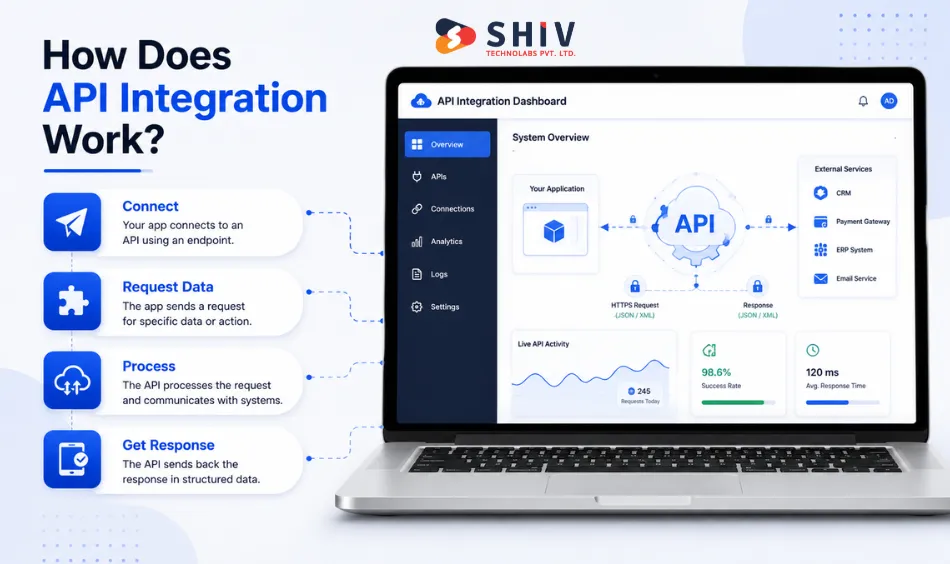
Every integration follows the same basic pattern, regardless of which two systems are involved. Understanding this flow makes it easier to spot where something might break.
- Request: One application sends a request to another application’s API, asking for data or asking it to act.
- Processing: The receiving system handles the request, which might mean querying a database or running a calculation.
- Response: The receiving system sends back the result, whether that is requested data or a confirmation.
- Action: The original application uses that response to update a record, display information, or start another process.
Why Does API Integration Matter for Modern Business?
Connected systems do more than save time. They change how a business operates day to day and how quickly it can adapt when conditions shift.
1. It Improves Everyday Business Processes
Connecting a CRM to an email platform can update customer records and trigger a campaign automatically, removing a task someone used to do by hand every day.
2. It Keeps Data Current Across Teams
Real-time data exchange matters most in finance and healthcare, where outdated information can lead to a bad decision or a missed compliance deadline.
3. It Supports Faster Innovation
A retail business can add a new payment option or a chatbot through an API without rebuilding its existing eCommerce platform from scratch.
4. It Scales With The Business
New functionality can be added in a plug-and-play manner as a company grows, instead of requiring a full rebuild of the IT infrastructure.
Top 10 Key Benefits of API Integration for Your Business
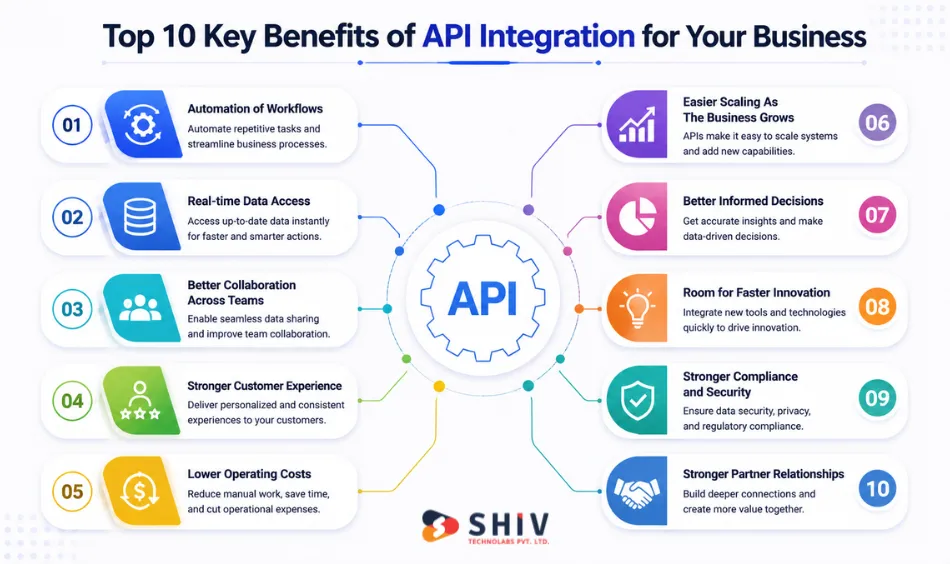
API integration benefits extend across operations, customer experience, and long-term planning. Here are the ten that matter most for a growing business.
1. Automation of Workflows
Connecting applications lets data move between them without a person re-entering it, which is a key part of business process automation solutions. A web form can feed a CRM directly, removing one more manual step from the sales process.
Staff spend less time on repetitive entry and more time on work that actually requires judgment. Fewer manual steps also means fewer typos and mismatched records.
2. Real-time Data Access
An online store connected to inventory software can show accurate stock counts the moment they change through ERP and CRM integration services.
Real-time access to data also supports better forecasting. Teams can adjust pricing or reorder stock based on current demand, inventory levels, and sales activity instead of relying on last week’s numbers.
3. Better Collaboration Across Teams
When systems share data, employees stop switching between five different tools to find one answer. A support ticket and a sales record can sit on the same screen.
Shared, consistent data keeps teams working from the same facts. A sales rep can see a customer’s recent support history before a call, which makes the conversation more useful.
4. Stronger Customer Experience
Combining customer data from a CRM and a marketing platform allows a business to send messages based on actual behavior instead of broad, untargeted campaigns.
A business that understands a customer’s history can offer the right product at the right time, which builds the kind of loyalty that keeps people coming back.
5. Lower Operating Costs
Automating data transfer cuts down on the staff hours spent on manual entry and on the cost of fixing the errors that manual entry tends to produce.
Integration can also extend the life of systems already in place, since adding a connection is usually cheaper than replacing software outright.
6. Easier Scaling As The Business Grows
New tools can be added through an API connection without disrupting what already works, which matters when a company is expanding into new regions or product lines.
This modular approach means growth does not require a ground-up rebuild of the technology stack every time the business adds a new service.
7. Better Informed Decisions
Pulling data from sales, support, and finance into one place gives leadership a clearer picture than checking each system separately ever could.
Combined data reveals patterns a single source would miss, such as how a marketing campaign affected actual sales figures over the following weeks.
8. Room for Faster Innovation
New technology, such as an AI-driven analytics tool, can be added through an API without disturbing existing systems using AI development services.
Teams can test new tools with less risk, since a connection can be removed if it does not work out, unlike a full platform migration.
9. Stronger Compliance and Security
Standardized API connections make it easier to apply consistent security rules and to produce the reporting that regulators expect, particularly in finance and healthcare.
Fewer manual handoffs of sensitive data also means fewer places where that data could be exposed or mishandled.
10. Stronger Partner Relationships
Connecting an order management system to a supplier’s inventory feed gives both sides visibility into stock levels and order status in real time.
That transparency tends to strengthen supply chain relationships and can open the door to closer collaboration down the line.
Why Work with Shiv Technolabs on Your API Integration?
Connecting two systems sounds simple until authentication fails, data formats do not match, or an error case breaks the entire workflow. Shiv Technolabs has handled these problems across CRM, payment, and inventory integrations for clients in eCommerce, healthcare, and finance.
Our team maps out the data flow before writing a single line of code, so the integration matches how your business actually works instead of forcing your team to adapt to the tool. That includes custom API development, third-party connectors, and full backend integrations for mobile apps built on React Native and other frameworks.
# Ready to Connect Your Systems?
Talk to our team about which integrations would save your business the most time. Get in touch with Shiv Technolabs today to scope your API integration project and get a realistic cost and timeline estimate.
Conclusion
API integration benefits a business in ways that compound over time. Automated workflows, real-time data, and lower costs add up to a company that runs leaner and adapts faster than one stuck moving data by hand.
Businesses that treat integration as a core part of their technology strategy, not an afterthought, tend to scale with fewer growing pains.
FAQs
What is API integration in simple terms?
It is the process of connecting two or more software systems so they can share data and trigger actions automatically, without someone moving information by hand.
How much does API integration cost?
Costs vary widely based on complexity. A simple connection between two well-documented APIs might run a few thousand dollars, while a custom integration across multiple legacy systems can run significantly higher. Most projects fall in a 3 to 12 week timeline depending on scope.
Is API integration safe for sensitive data?
Yes, when it is built with proper authentication, encryption, and access controls. Standardized connections often improve security compared to manual data transfers.
Which businesses benefit most from API integration?
Any business running more than two or three disconnected tools tends to see a fast return, especially in eCommerce, healthcare, finance, and logistics.
Can small businesses use API integration too?
Yes. Many platforms offer prebuilt connectors that make integration affordable even for small teams, without requiring custom development.
What is the difference between an API and API integration?
An API is the interface a piece of software exposes for others to use. API integration is the actual work of connecting two systems through their APIs so they function together.
Do I need a developer to set up API integration?
Simple connections can sometimes be handled through no-code tools, but most business-critical integrations benefit from a developer who can handle error handling, data mapping, and security correctly.