![How Much Does Pharmacy Billing Software Cost Here’s the Breakdown [2025]](https://shivlab.com/wp-content/uploads/2025/10/How-Much-Does-Pharmacy-Billing-Software-Cost-Heres-the-Breakdown-2025.webp)
Table of Contents
When pharmacies plan custom billing software, the cost depends on how the business operates. A single-store setup with basic billing stays in the lower range.
Multi-store systems with prescriptions, reporting, and integrations cost more. That’s why custom pharmacy billing software in 2026 usually ranges from $5,000 to $250,000+. It depends on how simple or advanced your setup needs to be.
Many pharmacies begin with ready-made tools. But as operations expand, challenges appear, including limited control over workflows, difficulty connecting systems, and gaps in reporting. At that stage, businesses start considering custom software development solutions designed around their exact process.
In this guide, you will see:
- How much does custom pharmacy billing software development cost
- What factors influence the final price
- Cost breakdown by system type
- When building a custom solution makes sense
This will help you estimate your investment with clarity and plan your next step based on real business needs.

Custom Pharmacy Billing Software Cost at a Glance
Custom pharmacy billing software cost depends on how complex your system needs to be and how your pharmacy operates. Below is a quick breakdown based on typical business scenarios.
| System Type | Best For | Cost Range |
|---|---|---|
| Basic custom system | Single pharmacy with standard billing | $5,000 – $30,000 |
| Multi-store system | Growing pharmacy chains | $30,000 – $50,000 |
| Advanced platform | Large operations with integrations and reporting | $50,000 – $100,000 |
| Enterprise system | Hospitals and pharmacy networks | $100,000 – $250,000+ |
What You’re Actually Paying for – At Each Level
Basic system
- Billing and invoicing
- Basic inventory tracking
- Simple reports
Multi-store system
- Multiple pharmacy locations
- User roles and permissions
- Centralized data
Advanced platform
- Integrations with ERP or accounting systems
- Detailed reporting dashboards
- Automation for stock and billing
Enterprise system
- Large-scale data handling
- Custom workflows for prescriptions and claims
- System integrations across departments
The right cost range depends on your current setup and how complex your operations are. Most growing pharmacy businesses move beyond basic systems once they need better control, reporting, and system connections.
Also Read: Types of Pharmaceutical App Development
What Drives the Cost of Custom Pharmacy Billing Software Development
The cost of custom pharmacy billing software is not fixed. It varies based on your pharmacy operations, the number of systems involved, and the complexity of your workflows. Below are the key factors that directly impact pricing.
| Factor | What It Includes | Impact on Cost |
|---|---|---|
| Billing Workflow Complexity | Sales and invoices, prescription handling, insurance claims, recurring billing, partial payments, returns | More billing steps increase development effort and system logic complexity |
| Number of Stores & Users | Single vs multi-store setup, centralized database, role-based access, real-time sync | More locations and users increase architecture complexity and development scope |
| Integrations with Other Systems | ERP systems, accounting tools, payment gateways, and insurance providers | Each integration adds development time, testing effort, and ongoing maintenance |
| Compliance & Data Handling | Access control, audit logs, data storage rules, encryption standards | Compliance needs affect backend design, security layers, and infrastructure cost |
| Reporting & Analytics | Daily sales, inventory reports, multi-store performance, financial summaries, demand trends | Advanced reporting requires more backend processing and dashboard development |
| System Design & User Experience | Custom UI, dashboards, workflows, mobile responsiveness, and staff usability | Better design and usability increase the design and development effort |
| Hosting & Infrastructure | Cloud setup, servers, database configuration, backups, uptime planning | Larger systems need stronger infrastructure, increasing setup and running costs |
How Much Does it Cost to Build a Custom Pharmacy Billing Software?
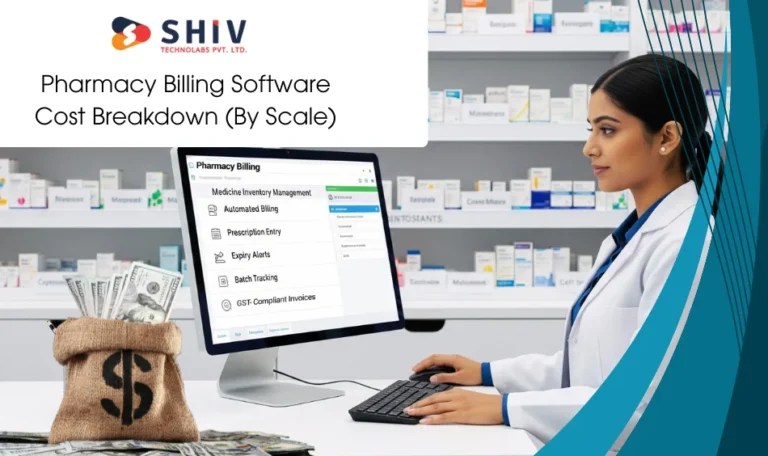
Custom pharmacy billing software development cost depends on feature depth, number of locations, integrations, reporting needs, and compliance work.
In pharmacy systems, the main cost drivers usually include inventory management, prescription management, financial management, analytics and reporting, multi-location support, expiry control, re-order management, and payer or insurance validation workflows.
Average software development rates in top-tier countries
The table below uses average developer hourly rates published in a 2025 cross-country comparison by Upstack Studio:
| Top-tier country | Average hourly software development rate (USD) |
|---|---|
| United Kingdom | $96.75 |
| Canada | $94.67 |
| Australia | $93.25 |
| United States | $87.88 |
| Germany | $79.56 |
Data Source: Upstack Studio
These are average market rates, not fixed quotes. A local senior healthcare software team, a specialist agency, or a regulated-data project can price above these numbers, while blended teams can price lower.
Custom pharmacy billing software cost varies based on business needs. The below-mentioned scenarios shows how pricing changes from basic systems to advanced and enterprise platforms.
Cost summary by scenario
This summary table helps answer questions, and readers can compare the main build levels in one place.
| Top-tier country | Average hourly software development rate (USD) |
|---|---|
| United Kingdom | $96.75 |
| Canada | $94.67 |
| Australia | $93.25 |
| United States | $87.88 |
| Germany | $79.56 |
Scenario 1: Single-store billing MVP
This scenario fits a pharmacy that needs core billing, invoices, product catalog, basic stock updates, tax setup, and simple reports. It does not assume advanced payer logic, multi-branch sync, or heavy workflow automation. That is why it costs the least.
| Country | Estimated cost (350 hours) |
|---|---|
| United States | $30,758 |
| United Kingdom | $33,862 |
| Canada | $33,134 |
| Australia | $32,638 |
| Germany | $27,846 |
This level is usually the starting point when a pharmacy wants ownership of workflows but does not yet need insurance validation, branch-wide controls, or deep reporting. For top-tier markets, this is often the lowest realistic range for a custom pharmacy billing product that still includes clean architecture, testing, and launch readiness.
Scenario 2: Single-store pharmacy system with inventory, expiry control, and e-prescription support
This version adds more pharmacy-specific logic: inventory management, expiry control, stock re-order logic, and e-prescription-related workflows. Those features are repeatedly listed as core functions in pharmacy system references, and they move the project past a plain billing app.
| Country | Estimated cost (650 hours) |
|---|---|
| United States | $57,122 |
| United Kingdom | $62,888 |
| Canada | $61,536 |
| Australia | $60,612 |
| Germany | $51,714 |
For many independent pharmacies, this is the first range that feels like real pharmacy software, not just a billing dashboard. It covers the parts of the workflow that directly affect inventory accuracy, refill handling, and day-to-day staff use.
Scenario 3: Custom platform for a 3-5 store pharmacy chain
A small chain usually needs shared branch data, user roles, branch-level stock visibility, centralized reporting, and stronger admin controls. Multi-location support appears in current pharmacy software discussions because manual stock and billing processes become harder to manage as pharmacies grow.
| Country | Estimated cost (1,100 hours) |
|---|---|
| United States | $96,668 |
| United Kingdom | $106,425 |
| Canada | $104,137 |
| Australia | $102,575 |
| Germany | $87,516 |
This is where custom software starts to make stronger business sense for chains. The price rises because the system has to handle branch-aware inventory, permission logic, cross-store reporting, and tighter operational control instead of just store-level billing.
Scenario 4: Multi-location chain platform with accounting, ERP, or payer integrations
This scenario is for a pharmacy group that needs 10+ locations, stronger reporting, billing validation, outside integrations, and a more mature data layer.
| Country | Estimated cost (1,800 hours) |
|---|---|
| United States | $158,184 |
| United Kingdom | $174,150 |
| Canada | $170,406 |
| Australia | $167,850 |
| Germany | $143,208 |
This is often the range where buyers stop comparing only “software features” and start thinking in terms of systems architecture, data flow, reporting quality, and operating cost over time. Once integration work enters the project, both delivery risk and test effort rise.
Scenario 5: Enterprise or hospital-linked pharmacy billing platform
This is the highest-cost scenario in this section. It assumes a platform with custom workflows, large data volume, advanced reporting, multiple integration points, audit logs, stronger access controls, and more formal security work.
| Country | Estimated cost (2,800 hours) |
|---|---|
| United States | $246,064 |
| United Kingdom | $270,900 |
| Canada | $265,076 |
| Australia | $261,100 |
| Germany | $222,768 |
This is the range for organizations that need more than a pharmacy front-end. They are usually paying for software depth, cleaner internal controls, broader data handling, and longer testing cycles, not just more screens.


What is the Difference Between Off-the-Shelf vs Custom Pharmacy Billing Software
Choosing between off-the-shelf software and a custom-built system depends on how your pharmacy operates and how much control you need over workflows and data.
| Factor | Off-the-Shelf Pharmacy Billing Software | Custom Pharmacy Billing Software |
|---|---|---|
| Setup Time | Fast, ready to use | Moderate, built from scratch |
| Flexibility | Limited to predefined features | High, built around your workflow |
| Integrations | Restricted or predefined | Fully configurable |
| Ownership | Controlled by the vendor | Fully owned by your business |
| Cost Structure | Subscription-based | One-time + maintenance |
| Scalability | Limited as the business grows | Built to scale with operations |
| Reporting | Standard reports | Custom dashboards and insights |
| Workflow Fit | You adjust to the software | Software matches your workflow |
| Multi-Store Support | Limited or restricted | Built for centralized multi-store control |
| Best Fit | Simple, single-store setups | Growing and complex pharmacy systems |
Which One Should You Choose?
- Choose off-the-shelf software if your needs are simple and you want a quick setup
- Choose custom software if your workflows are complex or you plan to scale
As your pharmacy grows, many businesses move from ready-made tools to custom systems to gain better control, reporting, and system connectivity.
Dig Deeper: Build vs Buy Software — Make the Right Choice
Build Your Pharmacy Billing Software with Shiv Technolabs
Shiv Technolabs builds custom pharmacy billing systems that match your workflow, scale, and integration needs. Instead of adjusting your operations to fit a tool, you get a system designed around how your pharmacy actually runs.
What you get
- Billing and inventory aligned with your process
- Multi-store control with centralized data
- Integrations with ERP, accounting, and external systems
- Reporting built for real business decisions
- AI-based features like demand insights and stock planning
Start with a clear estimate based on your requirements and plan your system with the right scope from day one.
Conclusion
Custom pharmacy billing software development cost in 2026 depends on how your business operates, not just the number of features you want. A simple system for a single pharmacy requires a smaller investment, while multi-location platforms with integrations and advanced workflows need a higher budget.
The key is to align your system with your actual operations. Instead of building everything at once, many businesses start with core features and expand over time as their needs grow. This approach keeps the initial investment controlled while still allowing the system to scale.
Before starting development, it is important to clearly define your requirements, expected growth, and system dependencies. A well-planned system reduces unnecessary costs and helps you build software that supports your business in the long run.
If you are planning to build custom pharmacy billing software, focus on clarity first. The better you define your needs, the more accurate your cost and timeline will be.
FAQs
How much does custom pharmacy billing software development cost in 2026?
Custom pharmacy billing software typically costs between $5,000 and $250,000+. The final cost depends on system complexity, number of locations, integrations, and reporting needs.
How long does it take to build pharmacy billing software?
A basic system can take 4 to 8 weeks, while advanced or enterprise platforms may take 3 to 8 months, depending on features and integrations.
Is custom pharmacy billing software better than ready-made tools?
Custom software is a better fit when your business has specific workflows, multiple locations, or integration needs that standard tools cannot handle. Ready-made tools work well for single-store pharmacies with simple billing and minimal customization needs.
Can pharmacy billing software be built in phases?
Yes, many businesses start with core features like billing and inventory and expand later with integrations, reporting, and advanced workflows as their operations grow.
What features are essential in pharmacy billing software?
Core features usually include billing, inventory tracking, user roles, and basic reporting, while advanced systems include integrations, automation, and multi-store management.
How do I get an accurate cost estimate?
You can get an accurate estimate by clearly defining the number of locations, required features, integrations, and expected scale before starting development.
Does integration with EHR or insurance systems increase cost?
Yes. These integrations need secure data exchange, custom APIs, and complex workflows like claims, which increase development and testing effort.
Is it better to build custom pharmacy billing software or use SaaS solutions?
SaaS works for simple setups. Custom software is better for multi-store, complex workflows, and integration-heavy systems.
What is the ROI of investing in custom pharmacy billing software?
It reduces errors, saves staff time, improves inventory control, and gives better reports, which lowers costs and supports growth.
Why is healthcare and pharmacy software more expensive to develop?
It requires strong security, compliance, accurate data handling, and complex workflows like prescriptions, insurance processing, and much more.