Table of Contents
Many agencies lose mobile app projects not because they lack clients, but because their team is already full. A client may ask for an app, set a fixed deadline, and expect quick movement. When the agency cannot take it on, the project often goes to another company.
This is where white label mobile app development for agencies becomes useful. It helps agencies accept more app projects, deliver them under their own brand, and avoid the cost of hiring a full in-house mobile team.
In this guide, we will cover how white label mobile app development works, which app projects fit this model, how agencies can price these projects, and what they should check before choosing a white label mobile app partner.
Quick Answer
White label mobile app development for agencies means partnering with a development company that builds mobile apps behind the scenes while you manage the client and brand the final product as your own. Agencies use it to take on more projects, offer mobile as a new service line, and grow revenue without adding developers to their payroll.
Why Are Agencies Turning Down App Projects They Should Be Winning?
The demand for mobile apps among small and mid-size businesses has grown faster than most agency teams can keep up with. Clients in retail, healthcare, hospitality, and on-demand services all want mobile-first products. Saying no to those projects is not a strategy; it is a slow revenue leak that compounds over time.
1. In-house Teams Hit a Ceiling Fast
A team of 3-5 developers can only run so many parallel projects before quality slips. When a complex mobile app lands in the pipeline alongside two ongoing web builds, something gives way. Deadlines stretch, revisions pile up, and the client experience suffers. Agencies that rely entirely on in-house capacity spend more time managing overload than actually growing their business. The ceiling is not a talent problem. It is a model problem.
2. Hiring New Developers Costs More Than Most Projects Justify
The average cost of hiring a mid-level mobile app developer in the US sits between $90,000 and $130,000 per year, excluding benefits, onboarding time, and the three to six months it takes before a new hire is fully productive. Taking on one or two additional app projects per quarter does not justify that commitment. White label development solves capacity on a project-by-project basis. You pay only for what you use, and you stop paying when the project ends.
3. Clients Expect Delivery Timelines That Match The Competition
A client asking for a mobile app in April is not waiting until October for it. If your agency cannot quote a competitive timeline, another agency will. White label development partners who specialize in mobile give agencies the ability to deliver on timelines that match what clients expect, not timelines that reflect how stretched your internal team currently is.
What Does White Label Mobile App Development For Agencies Actually Mean?
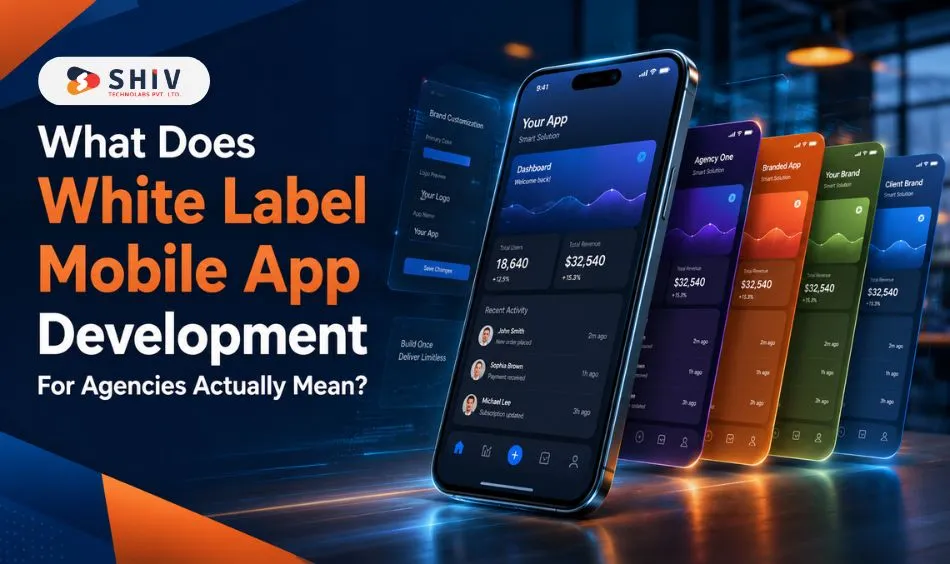
At its core, white label mobile app development means a specialized development company builds the app, and your agency delivers it under your own brand. The client sees your agency’s name on everything: proposals, progress updates, design files, final delivery. The development partner stays invisible throughout.
1. You Manage the Client Relationship, the Partner Builds the Product
Your agency owns the scope conversation, the design direction, the timeline commitments, and the client relationship. The white label development service providers handle engineering, QA, and technical delivery. Communication between your agency and the development team typically runs through a dedicated project manager using tools you already use, like Slack or email. Nothing the partner produces goes directly to the client.
2. How the Handoff Works in Practice
Once your agency closes a client and defines the project scope, you share the brief with the white label partner. Both sides agree on timelines, milestones, and delivery format. The partner builds while you manage client expectations and feedback cycles. At completion, the partner hands over all source code, design files, and documentation under your agency’s branding. The client never interacts with the partner, and all assets are yours to own, maintain, or hand off.
What Types of App Projects Are Ideal for White Label Development?
White label partnerships work best for specific project categories. Knowing which projects to route to a partner and which to build in-house makes the model significantly more profitable for your agency.
1. MVPs and Early-stage Startup Apps
Startups and new product owners are some of the most time-sensitive clients in the mobile space. They want a functional, testable product quickly, and they are not looking for enterprise-scale complexity in the first version. MVP development is ideal for white label partnerships because the scope is tight, the timeline is short, and the technical requirements are well-defined. Agencies can offer competitive pricing and fast turnaround while the partner handles the engineering.
2. On-demand and Booking Apps
Restaurant ordering apps, home services booking platforms, delivery apps, and appointment scheduling tools follow predictable feature patterns. A good white label partner has built versions of these before and can move quickly through them. Agencies serving hospitality, wellness, or service-industry clients can add these project types to their pitch without any internal mobile expertise and deliver them with the same confidence as any other project type.
3. eCommerce Mobile Apps
Retail clients increasingly want a dedicated mobile app alongside their web store. Whether that is a standalone iOS and Android app or a companion app linked to an existing Shopify or WooCommerce store, these projects fit well into a white label model. Requirements are usually clear, design can mirror existing brand guidelines, and the feature set is established enough that a specialist partner can build efficiently without extended discovery.
To Check out our eCommerce App Development Services, Click Here.
4. Industry-specific Apps: Healthcare, Fitness, and On-demand Services
Healthcare appointment apps, fitness tracking platforms, dating apps, and employee management tools each have well-documented feature requirements and established compliance patterns. Agencies that land clients in these industries but lack domain-specific mobile experience can use a white label partner to deliver confidently. The partner brings existing familiarity with the technical complexity, and the agency brings the client relationship and brand oversight.
Dig Deeper: Which Industries Commonly Use White Label Development Support?
How do Agencies Integrate White Label Development into their Service Model?
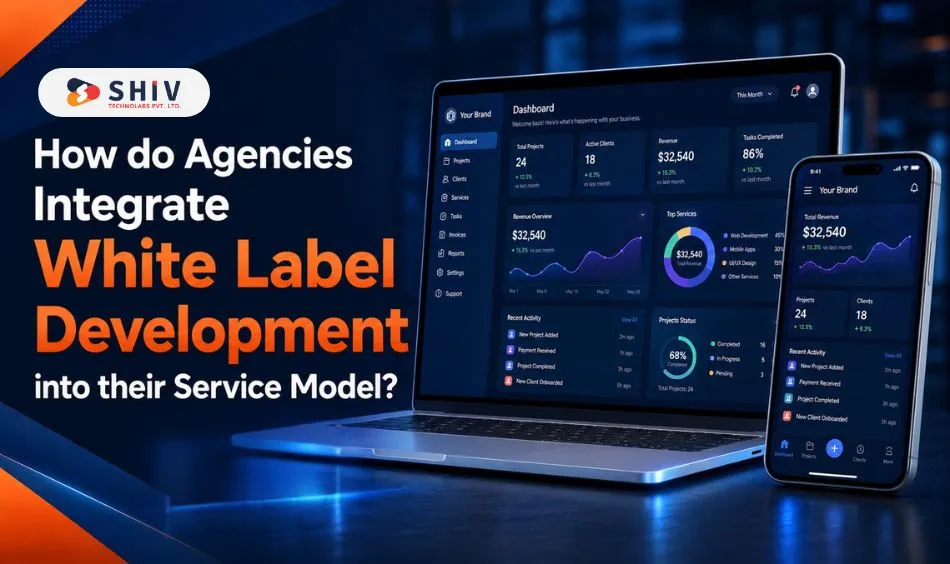
Adding white label app development to what your agency offers does not require restructuring your operations. Most agencies start small, learn the process with one or two overflow projects, and then decide how far to take it based on what they see.
1. Start With Projects Your Team Cannot Currently Take On
The lowest-risk entry point is using white label development for projects your agency would otherwise decline. When your team is at capacity, or when a client requests a tech stack you do not cover internally, route those projects to the partner. This lets you test the process, build trust with the partner, evaluate the communication workflow, and understand the margin before making it a core service line.
2. Build It Into Your Standard Service Offering
Once you have completed two or three projects with a white label development partner and confirmed the process works, you can position mobile app development as a standard service your agency offers. You set the pricing, manage the client, and structure the engagement the same way you would any other project type. The development cost becomes a production cost you build into your margins, the same way you would handle any specialist subcontractor.
3. Pricing the Work Correctly For Your Clients
Most agencies apply a 20% to 40% margin on top of what the white label partner charges. The exact markup depends on how much client-facing work your agency handles, how complex the communication and revision management is, and what the local market rate is for the type of app being built. Quote the client based on total value delivered, not on what the partner charges. Your agency’s project management, design direction, and quality control are part of what the client pays for, and those contributions justify the margin.
What Should Agencies Look For in a White Label Mobile App Partner?
Choosing the wrong partner can damage client relationships your agency spent years building. The evaluation criteria that matter most are not primarily about technology. They are about how the partner works with you when your reputation is on the line.
1. NDA and Full Brand Confidentiality
A white label partner must sign an NDA before the first project begins. All files, code, documentation, and communications should carry your agency’s branding, never the partner’s. Before committing, confirm they have a documented process for this and ask to review a sample deliverable from a previous white label engagement. If a partner hesitates on an NDA or cannot provide examples of branded deliverables, that is a clear signal to keep looking.
2. A Dedicated Project Manager and Consistent Communication
The biggest operational risk in a white label model is communication gaps. If your agency is waiting days for status updates from the development side, that delay passes directly to your client. A reliable partner assigns a dedicated project manager to each engagement and responds through tools you are already using. At Shiv Technolabs, agency partners work through Slack with a named project manager from the first day of the engagement.
3. Speed and Delivery Track Record With Other Agencies
Ask potential partners about their average delivery timeline for the project types you plan to bring them. Request references from other agencies they have worked with as a white label partner, not just from end clients. Agency references tell you something different: how the partner behaves when they are invisible, when your name is on the deliverable, and when the client pressure is on you to perform.
4. Tech Stack Coverage Across Platforms
Your partner should build across iOS, Android, and cross-platform frameworks like React Native and Flutter. They should also handle backend API development, third-party integrations, and app store submission. Gaps in any of these areas mean you will need to source additional vendors for certain project types, which adds coordination risk and complexity to projects that are supposed to be simple for your agency to manage.
Must Read: Top Mistakes to Avoid When Partnering with a White-Label Partner
Why Agency Partners Choose Shiv Technolabs for White Label Mobile App Development
Shiv Technolabs works with digital agencies across the US, UK, Canada, and Australia as a fully invisible development partner. Every engagement is NDA-backed, fully branded under the agency’s name, and managed through a dedicated project manager from kick-off through delivery.
1. What Agencies Get From Day One
From the first engagement, agency partners get a signed NDA, a dedicated project manager, and access to a development team covering iOS, Android, React Native, Flutter, and full backend development. Agencies can choose between fixed-scope project engagements and flexible retainer plans for ongoing volume. All code, documentation, and deliverables are handed over in the agency’s name with no Shiv Technolabs branding on any file.
2. Ready to take on your next app project?
If your agency is turning down app projects, waiting too long to quote them, or stretching your team past its limits to deliver them, a white label partnership changes that. Talk to the Shiv Technolabs team about how the model works, what it costs, and how quickly you can bring the first project through.
Conclusion
White label mobile app development gives agencies a practical way to accept more app projects without hiring a full in-house team. It helps them manage client demand, protect delivery timelines, and add mobile app development to their service list under their own brand.
The key is to choose the right development partner. Agencies should check the partner’s NDA process, communication style, project management support, technical skills, and delivery history before starting.
For agencies that already receive app project inquiries but cannot handle them internally, this model can turn missed opportunities into profitable client work.
Frequently Asked Questions
What is white label mobile app development for agencies?
White label mobile app development for agencies is a model where a development company builds mobile apps on behalf of an agency, with all deliverables branded under the agency’s name. The agency manages the client, and the development partner stays invisible throughout the project.
Can my clients find out that a third party built their app?
Not if your partner follows a proper NDA and white label process. All files, code, communications, and documentation are branded under your agency’s name. The development partner signs a confidentiality agreement and does not contact your client directly at any point.
How can agencies use white label partners for custom app builds?
Agencies scope the project with the client, then share the brief with the white label partner. The partner builds to those specs, sends updates through the agency’s dedicated project manager, and delivers all files under the agency’s branding. The agency reviews output, manages client feedback, and handles final delivery.
What types of mobile apps are best suited for white label development?
MVPs, eCommerce apps, on-demand service apps, booking platforms, healthcare appointment tools, and fitness apps all work well. These project types have well-defined requirements and established development patterns, which means a specialist partner can deliver faster and more reliably.
How do I integrate white label mobile app development into my agency’s offerings?
Start with projects your in-house team cannot take on due to capacity or tech stack gaps. Use those to build trust with the partner and understand the process. Once you see it working, add mobile app development to your standard service list and price it with your agency margin built in.
How long does a typical white label app project take?
A basic MVP with core features typically takes 6 to 10 weeks. A full-featured app with third-party integrations, payment gateways, and multi-platform delivery usually runs 12 to 20 weeks. A reliable partner provides a timeline estimate during the scoping phase before any work begins.
How should agencies price white label app development for their clients?
Most agencies apply a 20% to 40% margin on the partner’s cost, depending on how much client management the project requires. Quote the client on total project value, not the development cost, since your project management and quality control are part of what they are paying for.
What should I ask a white label mobile app company before partnering?
Ask whether they sign NDAs, how they handle branding of deliverables, who your dedicated contact will be, what their average delivery timeline is for similar projects, and whether they have references from other agencies they have worked with as a white label partner.