
Table of Contents
Starting an online platform is easier than ever nowadays, but getting one to work is much more difficult. According to research, 35% of startups fail due to a lack of actual market demand, and many fail due to an ineffective product strategy and competitive positioning. Most companies, including those that are heavily funded, fail because they focus on creating features rather than developing a powerful digital product strategy.
Regardless of whether it is the SaaS platform, a marketplace, a mobile application, or an enterprise system creation, success will be based on a clear roadmap that will help to align the business objectives, customer requirements, and technology implementation. At this point, a complete digital product strategy framework will be needed.

Without strategic planning, businesses often waste months of development time and tens of thousands of dollars ($50,000-$500,000+) building products that fail to gain traction.
An effective digital product strategy roadmap would ensure that product development decisions have a solid basis in actual market knowledge, user requirements, and technology scale planning.
What Is a Digital Product Strategy?
A digital product strategy is a framework that outlines how a business will create, develop, introduce, and expand a digital product in a competitive market. It bridges the gap between business goals and product capabilities, usability, and technical implementation.
A digital product strategy is aimed at long-term success rather than product development alone.
The overall product vision on the digital platforms is usually characterized by:
- Target Audience
- Product Vision
- Market Positioning
- Feature Prioritization
- Revenue Model ($)
- Product Growth Strategy
Firms with a defined digital product strategy have a much higher chance of attaining product-market fit and long-term growth.
Why Digital Products Fail After Launch

It is always worth knowing why digital products fail upon their introduction to the market before delving into the frameworks of strategies.
Most companies believe that a successful product is made after a good idea. In fact, most digital platforms fail because of strategic errors.
# Lack of Market Validation
Many online systems are developed without justifying actual customer demand. Businesses risk releasing products that address issues no one is interested in due to market validation.
# Poor Product-Market Fit
Although a product may address a real issue, it can still fail if the solution does not meet users’ expectations. Product-market fit is a situation in which users have a clear perception of the product’s value. In its absence, it is not well adopted by users.
# Feature Overload
The second error is usually creating excessive functions before core functionality is proven. Complex systems tend to disorient users and increase development costs.
# Weak Competitive Positioning
The current markets are very competitive. In the absence of distinction, digital platforms find it difficult to secure users. A good product strategy on digital platforms helps recognize unique value propositions.
Ineffective Product Launch Strategy
Launching a digital product will require more than development.
Companies must also plan:
- Marketing Strategy
- User Acquisition Channels
- Onboarding Experiences
- Growth Metrics
In the absence of these factors, even excellent products find it hard to perform after the launch.
Key Components of a Digital Product Strategy Framework
An organized digital product strategy model provides a platform for developing competitive digital products.
These are the following critical components.
# Product Vision and Business Goals
Every successful digital product begins with a clear vision. Product vision defines:
- What The Product Aims To Achieve
- Which Problems It Solves
- The Long-Term Business Objective
A clear vision ensures that all development efforts remain aligned with strategic goals.
# Define Target Audience
Understanding the target audience is critical when creating a digital product strategy. Businesses must identify:
- Customer Demographics
- Industry Segments
- User Behavior Patterns
- Customer Pain Points
A deep understanding of the target audience improves product design and adoption.


# Market and Competitor Analysis
Competitive research helps companies understand existing solutions and market gaps.
Market analysis typically includes:
- Industry Trends
- Competitor Product Features
- Pricing Strategies ($)
- Customer Feedback Insights
These insights guide product positioning.
# Value Proposition Design
The value proposition explains why customers should choose the product. Strong value propositions clearly communicate:
- The problem solved
- The benefit delivered
- How the product differs from competitors
This is a core element of any digital product strategy for startups or enterprises.
# Revenue and Business Model Planning
Digital products require sustainable revenue models. Common models include:
- Subscription Pricing ($)
- Transaction-Based Revenue
- Freemium Models
- Advertising Monetization
Revenue strategy must align with the product’s target audience.
How to Build a Digital Product Strategy
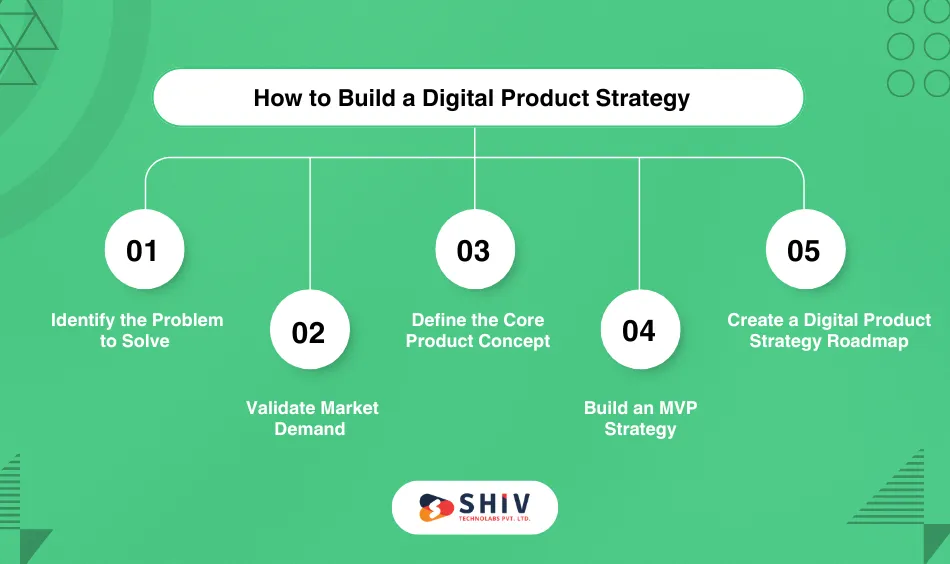
Companies frequently inquire about how to develop a digital product strategy to achieve long-term success. It takes organized planning and coordination between product, design, and the engineering teams.
The key steps are listed below:
# Step 1: Identify the Problem to Solve
Successful digital platforms solve meaningful problems. Businesses must clearly define:
- The User Problem
- Its Impact On Customers
- Existing Solutions In The Market
Strong problem definition drives product innovation.
Step 2: Validate Market Demand
Before development begins, companies must confirm demand. Market validation methods include:
- Customer Interviews
- Surveys And Feedback Sessions
- Competitor Research
- Landing Page Testing
Validation reduces development risk.
# Step 3: Define the Core Product Concept
After validation, businesses must define the core product concept.
This includes:
- Key Features
- Product Functionality
- User Experience Structure
- Platform Architecture
The goal is to design a product that efficiently solves the core problem.
# Step 4: Build an MVP Strategy
Companies do not always roll out a complete platform but begin with an MVP. MVP (Minimum Viable Product) includes only the features necessary to prove the product. Most firms use MVP development to speed up the process.
The launch of an MVP helps the business gather feedback and refine the product before expansion.
# Step 5: Create a Digital Product Strategy Roadmap
A digital product strategy roadmap is the plan that provides the timeline for development and feature releases. Roadmaps typically include:
- MVP launch timeline
- Feature Development Phases
- Product Scaling Milestones
- Growth Strategy Implementation
This roadmap helps development teams stay aligned with product objectives.
# Common Mistakes to Avoid When Planning a Digital Product Strategy
Strategic mistakes are made even by established companies. The following are common traps to avoid.
Ignoring Customer Feedback
Products created without the customer’s input often fall short of their expectations. Feedback loops need to be continuous.
Building Too Many Features
The problem with adding too many features is that it increases complexity and delays the launch schedule. First, define the core functionality.
Weak Product Positioning
Lack of differentiation means that products fail to compete in the markets.
Lack of Long-Term Product Roadmap
Products require long-term planning. In the absence of a proper roadmap, development is impulsive and not strategic.
Conclusion
To start an effective digital platform, it takes more than excellent development. It needs a well-defined digital product strategy that aligns with customer requirements, business goals, and technology implementation.
Those companies that invest in a robust digital product strategy framework can mitigate product development risks, enhance product-market fit, and create scalable digital platforms that compete in markets that must change at an extremely fast pace.
Shiv Technolabs offers professional digital product strategy, MVP development, and full-cycle product development services to help startups and businesses turn product concepts into scalable platforms.
Frequently Asked Questions (FAQs)
What is a digital product strategy?
A digital product strategy is a developed plan that outlines how an organization will design, develop, launch, and expand a digital product. It bridges the gap among business objectives, user needs, market opportunities, and technical development to ensure a successful product in the long run.
Why do digital products fail after launch?
The failure of digital products is due to improper market validation, low product-market fit, over-complexity of features, and a poor product launch strategy. In the absence of a powerful digital product strategy, businesses could develop products that are not in line with the actual customer requirements.
How do companies build a digital product strategy?
Creating a digital product strategy entails identifying the problem to address, validating market demand, conceptualizing the product, developing an MVP plan, and creating a digital product roadmap to guide its development and expansion.
What role does MVP development play in product strategy?
MVP development enables companies to release a barebones version of an online product with the critical features. This will assist in testing market demand, gathering user feedback, and making the product perfect before investing in large-scale development.
Why should businesses use digital product strategy services?
The digital product strategy services offer professional advice in market research, product planning, and development strategy. These services enable companies to mitigate risks, seek opportunities, and successfully introduce competitive digital platforms.