Table of Contents
Running a supply chain with manual steps, slow updates, and scattered data can create delays, extra spending, and poor planning. Many companies know AI powered supply chain implementation could help, but they still ask two key questions before starting.
- How much will it cost?
- How long will it take?
Those are fair questions.
AI can improve forecasting, inventory planning, warehouse workflows, supplier visibility, and route decisions. But pricing and timelines depend on project scope, business size, system readiness, and the speed of decision-making.
This guide explains realistic 2026 cost ranges, delivery timelines, and what companies should expect before starting an AI supply chain initiative.
How Much Does AI Powered Supply Chain Implementation Cost?
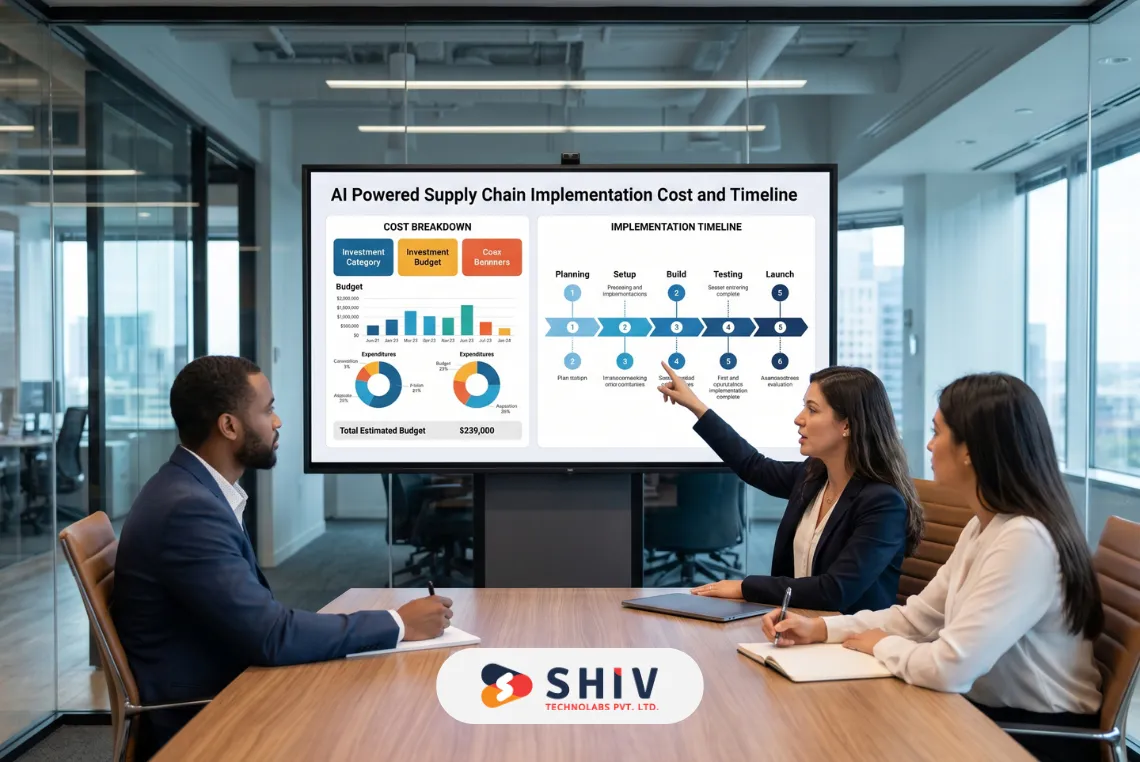
The cost of an AI powered supply chain project depends on the business size, number of use cases, system complexity, and custom requirements. In most cases, businesses spend $15,000 to $300,000+, depending on project scope. A focused pilot costs far less than a full enterprise rollout.
Many businesses begin with one area, such as demand forecasting or inventory planning. That keeps initial investment manageable and gives clear results.
1. Average Cost by Project Size
| Project Size | Estimated Cost | Best For |
|---|---|---|
| Small Pilot | $15,000 to $40,000 | Single process or location |
| Mid-Size Implementation | $40,000 to $100,000 | Forecasting, stock planning, dashboards |
| Large Multi-Site Program | $100,000 to $300,000+ | Warehouses, logistics, supplier network |
These ranges depend on features, integrations, and support scope. A detailed discovery phase gives a more accurate estimate.
What Is Included in This Cost?
- Business analysis and planning: The team reviews your current supply chain process, pain points, and goals. This helps define what AI should solve first.
- Data preparation: Raw business data often needs cleaning, mapping, and formatting. Good data leads to better AI results.
- AI model development: Developers build prediction engines, recommendation systems, or automation logic based on the selected use case.
- Dashboard and reporting: Users need clear reports and alerts. Dashboards help teams act faster.
- Integration work: AI tools must connect with ERP, CRM, WMS, or transport systems. This often takes a large share of the budget.
- Testing and launch support: Before go-live, teams test outputs and workflows. This lowers operational risk.
2. AI Supply Chain Cost by Project Scope
| Project Scope | Estimated Cost Range | Typical Timeline |
|---|---|---|
| AI Proof of Concept | $8,000 to $20,000 | 1 to 3 Weeks |
| Focused MVP Solution | $15,000 to $40,000 | 2 to 6 Weeks |
| Mid-Size Implementation | $35,000 to $75,000 | 4 to 8 Weeks |
| Enterprise Rollout | $75,000 to $200,000+ | 8+ Weeks |
These ranges reflect common custom AI development projects. Final pricing depends on the exact workflow and system environment.
3. AI Supply Chain Cost by Use Case
Many companies do not need a large rollout on day one. They start with one high-value use case. That approach lowers risk and gives faster results.
| AI Use Case | Estimated Cost Range | Fast Launch Timeline |
|---|---|---|
| Demand Forecasting | $15,000 to $45,000 | 2 to 4 Weeks |
| Inventory Planning | $20,000 to $55,000 | 3 to 5 Weeks |
| Warehouse Dashboard | $25,000 to $65,000 | 3 to 6 Weeks |
| Route Planning | $30,000 to $75,000 | 4 to 6 Weeks |
| Supplier Risk Alerts | $20,000 to $50,000 | 2 to 5 Weeks |
These ranges vary based on data sources and workflow complexity.
What Changes the Cost of an AI Powered Supply Chain Project?
The cost of an AI supply chain project can vary widely from one business to another. Some companies need a focused forecasting tool, while others require a connected system across warehouses, suppliers, and logistics partners.
That is why two businesses can ask for AI powered supply chain software and receive very different estimates.
A realistic budget depends on several core factors. Understanding them early helps avoid scope confusion, delays, and unexpected spending.
1. Project Scope and Business Goals
The first cost driver is the size of the problem you want to solve. If you only need demand forecasting for one product line, the project will cost far less than a full platform that handles forecasting, inventory planning, route decisions, supplier alerts, and reporting.
AI powered supply chain projects with narrow scope usually launch faster and cost less. Broader programs need more planning, more testing, and more resources.
Examples:
- Forecasting for one region
- Inventory planning for one warehouse
- Route planning across multiple cities
- Full supply chain visibility across business units
The clearer the goal, the easier it becomes to control cost.
2. Number of Use Cases Included
Many businesses try to solve too many problems in one phase. That often increases the cost quickly. Each use case requires data mapping, business logic, testing, and user workflows.
For example:
- Demand forecasting needs historical sales data
- Inventory planning needs stock movement data
- Route planning needs transport and traffic inputs
- Supplier risk alerts need vendor performance data
Adding multiple use cases at once increases project hours. Starting with one use case is often the smarter path.
3. Data Quality and Data Readiness
AI systems depend on data. If your data is clean, structured, and easy to access, development moves faster. If data sits in spreadsheets, old databases, emails, or disconnected tools, extra preparation is required.
This stage may include:
- Removing duplicate records
- Filling missing values
- Standardizing formats
- Mapping product codes
- Connecting different systems
Poor data quality is one of the biggest hidden cost factors in AI projects.
4. System Integrations
Most companies already use software such as ERP, WMS, CRM, TMS, procurement tools, or accounting systems. Your AI-powered solution usually needs to connect with these platforms. Integration work can become a large part of the total budget.
Common integrations include:
- SAP
- Oracle
- Microsoft Dynamics
- NetSuite
- Salesforce
- Custom internal systems
Modern systems with APIs are faster to connect. Legacy systems often need custom connectors or manual sync methods.
5. Customization Requirements
Some businesses need standard dashboards. Others need custom workflows built around their internal process.
Custom requests may include:
- Role-based dashboards
- Multi-language interfaces
- Approval workflows
- Exception alerts
- Unique KPIs
- Mobile access for field teams
More customization means more design, coding, testing, and revisions.
6. Business Size and Number of Locations
A company with one warehouse has simpler needs than a company with ten warehouses across countries. As the number of locations grows, so does complexity.
More locations often mean:
- Different stock rules
- Different suppliers
- Different tax or shipping rules
- More users
- More data volume
- More reporting needs
This directly affects both implementation cost and support cost.
7. Timeline Expectations
Fast delivery often needs a larger team working in parallel. If a company wants to launch in 3 weeks instead of 8 weeks, the project may need:
- More developers
- Faster testing cycles
- Dedicated project management
- Priority scheduling
Urgent delivery can increase cost, even if the total scope stays the same.
8. Internal Team Availability
Client-side delays also affect the budget. If approvals take too long or data access is delayed, project hours increase. Meetings, rework, and idle time can raise the final cost.
Projects move better when companies assign:
- One decision-maker
- One technical contact
- One operations owner
Strong internal ownership saves both time and money.
9. Security and Compliance Needs
Some industries require tighter controls for data handling, access logs, encryption, and audit trails. These needs may add extra work, such as:
- User permission systems
- Data encryption
- Audit reporting
- Secure hosting environments
- Compliance documentation
For healthcare, finance, or regulated industries, this can be a notable cost factor.
10. Post-Launch Support and Scaling Plans
The launch cost is only one part of the budget. After go-live, businesses may need:
- Monitoring
- Model updates
- New dashboards
- Workflow improvements
- Additional locations added later
Companies that plan scaling early often spend more wisely than those reacting later.


How Long Does AI Supply Chain Implementation Take?
AI supply chain implementation timelines are much shorter than many traditional software projects. With modern AI programming languages, pre-built cloud services, and faster integration methods, many companies can start seeing working deliverables in weeks.
Still, the final timeline depends on project scope, data readiness, system complexity, and internal response speed. A focused MVP may launch quickly, while a multi-location rollout may require phased delivery.
Typical AI Supply Chain Project Timeline
| Project Type | Estimated Timeline | Best For |
|---|---|---|
| AI Proof of Concept | 1 to 3 Weeks | Testing one business idea |
| Focused MVP Solution | 2 to 6 Weeks | One use case with live output |
| Mid-Size Implementation | 4 to 8 Weeks | Multiple workflows |
| Enterprise Rollout | 8 to 16+ Weeks | Multi-site transformation |
These ranges reflect modern delivery models where businesses prioritize speed and phased launches.
What Happens in Each Phase of the Timeline?
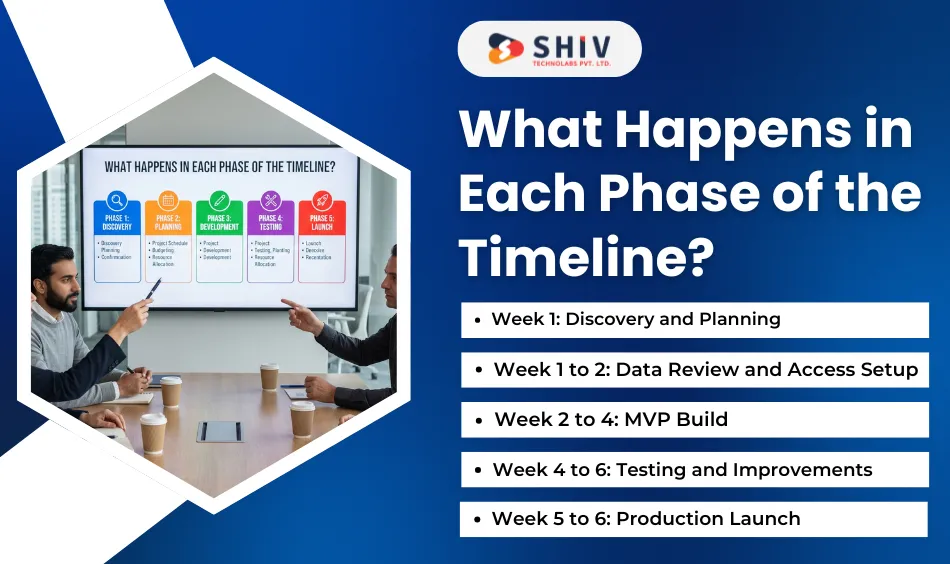
Most successful projects move through short, clear stages. Each phase adds value and keeps progress visible.
Week 0 to 1: Discovery and Planning
The team reviews current supply chain issues, business goals, available systems, and data sources. This stage often includes:
- Stakeholder meetings
- Process mapping
- Use case selection
- Success metric planning
- Timeline confirmation
A strong first week prevents confusion later.
Week 1 to 2: Data Review and Access Setup
AI projects need access to the right business data. Teams connect systems and review data quality early. This phase may include:
- ERP access setup
- Warehouse data review
- Product master data checks
- Historical sales exports
- Supplier data review
If the data is ready, this phase moves quickly.
Week 2 to 4: MVP Build
This is where teams create the first working solution. Examples include:
- Demand forecasting dashboard
- Inventory alerts
- Supplier delay alerts
- Route recommendations
- Operations reporting tools
By this stage, many companies have already started seeing usable outputs.
Week 4 to 6: Testing and Improvements
Users test predictions, workflows, dashboards, and reports. Feedback helps improve:
- Accuracy
- User experience
- Alert thresholds
- Dashboard layout
- Approval flows
This step is important because real users often spot issues quickly.
Week 5 to 6: Production Launch
Once approved, the solution moves into live operations. The launch may include:
- User onboarding
- Role permissions
- Final integrations
- Monitoring setup
- Support handover
Many focused projects can go live during this period.
What Hidden Costs Should You Plan For?
Many businesses focus only on building costs. But long-term success also needs post-launch spending. These items should be part of your budget discussion from day one.
Common Ongoing Costs
| Cost Area | Typical Monthly or Annual Impact |
|---|---|
| Cloud Hosting | Based on usage and storage |
| Data Pipelines | Ongoing sync and updates |
| Model Retraining | Quarterly or yearly reviews |
| Support Team | Hourly or monthly retainer |
| New Features | Based on the future roadmap |
Ignoring these items can create budget pressure later. A realistic plan helps avoid surprises.
Need a Realistic AI Powered Supply Chain Cost and Timeline Estimate?
Every supply chain operation has different systems, workflows, and business goals. That is why pricing and delivery timelines should be based on your actual needs, not generic estimates.
Shiv Technolabs helps businesses plan practical AI supply chain solutions with clear budgets, fast delivery models, and scalable roadmaps.
# What You Can Expect from Shiv Technolabs
- Discovery-based cost estimates tailored to your business
- Fast MVP development with launch-ready milestones
- Custom AI solutions for forecasting, inventory, and operations
- ERP, WMS, CRM, and third-party integrations
- Growth-ready roadmap for future expansion
- Ongoing support and performance improvements
If you are planning an AI initiative, starting with the right scope can save both time and cost.
Final Thoughts
AI powered supply chain implementation cost and timeline depend on project scope, data readiness, integrations, and business priorities. Many companies no longer need long and expensive programs to get started.
Focused AI solutions can often launch in 2 to 6 weeks with controlled budgets and measurable outcomes. Larger rollouts can follow in planned phases as business needs grow.
Companies that begin with one clear use case, track ROI, and expand step by step often see the best long-term value.
Frequently Asked Questions
1. What is the average AI powered supply chain implementation cost?
Most projects range from $15,000 to $75,000 for focused business implementations. Large enterprise programs can exceed $200,000.
2. Can AI supply chain projects launch in weeks?
Yes. A focused MVP with ready data can often launch in 2 to 6 weeks.
3. What is the cheapest way to start?
A proof of concept or one-use-case MVP is usually the most cost-effective option.
4. Which use case gives the fastest ROI?
Demand forecasting and inventory planning often deliver quick, measurable value.
5. Why do some projects cost more than others?
Higher costs usually come from complex integrations, multiple locations, custom dashboards, and poor data quality.
6. Is monthly maintenance required after launch?
Most companies choose some level of support for monitoring, updates, and performance tuning.
7. Should small businesses invest in AI supply chain tools?
Yes, if the business has repeatable planning or logistics challenges. A small pilot can be a practical starting point.
8. How do I know my timeline before starting?
A discovery session reviews systems, data, and goals. That creates a more accurate timeline.