Table of Contents
Unlike conventional chatbots, AI agents can retrieve information, select tools, make contextual decisions, and execute authorized actions. These capabilities introduce additional requirements around data security, system integrations, performance evaluation, and human oversight. A successful demonstration may show what an agent can do, but production readiness depends on how consistently and safely it performs.
Vendor choice has a direct effect on whether an agent project survives. Gartner predicts that over 40% of agentic AI projects will be canceled by the end of 2027 because of escalating costs, unclear business value or inadequate risk controls, and estimates that only about 130 of the thousands of vendors marketing agentic AI offer real agentic capabilities. A partner that can prove production experience is one of the most direct ways to reduce that risk.
This guide draws on Shiv Technolabs’ experience building AI agents for eCommerce, SaaS, fintech, healthcare, logistics and manufacturing businesses, with integrations across platforms such as Shopify, Magento, Odoo, HubSpot and Zendesk. It gives you a 12-point checklist, an agent-specific vendor scorecard, pilot acceptance criteria and cost ranges you can use in vendor discussions.
Quick Answer: To choose an AI agent development company, first verify that it has AI agents running in production. Then evaluate its business understanding, architecture, integrations, security, governance, testing, scalability, delivery process, pricing, ownership terms and post-launch support. Ask for documented evidence on each point and validate the vendor through a measurable pilot before committing to full development.
Does Your Business Need an AI Agent or Traditional Automation?
Not every business process requires an AI agent. Traditional automation remains suitable for predictable tasks that follow established rules, while AI agents may be more appropriate for workflows involving unstructured information, contextual decisions, and interactions with multiple applications.
Before hiring an AI agent development company, identify the business problem, expected outcomes, and level of decision-making flexibility required. This assessment helps determine whether rule-based automation, an AI-powered workflow, or an agent-based system offers the most practical solution.
| Business Requirement | Traditional Automation | AI Agents |
| Fixed business rules | Highly suitable | Often unnecessary |
| Repetitive data transfer | Suitable | Depends on complexity |
| Unstructured document processing | Requires additional components | Potentially suitable |
| Context-based decisions | Limited flexibility | Suitable within defined boundaries |
| Dynamic tool selection | Requires predefined logic | Can select approved tools |
| Complex business workflows | Requires detailed rules | Can handle variable inputs |
| Sensitive financial actions | Controlled rules and approvals | Requires strict permissions and approvals |
For example, transferring approved invoices between two applications may only require conventional automation. Reviewing invoices, identifying discrepancies, retrieving purchase orders, and recommending corrective actions may benefit from an AI agent working alongside established business rules.
Expert insight from the Shiv Technolabs AI team: A capable development partner should recommend the simplest technology that meets your requirements. Understanding where agents add genuine value is an important part of selecting the right architecture, as explained in OpenAI’s practical guide to building AI agents.
What Types of AI Agent Development Companies Are There?
AI agent providers fall into four broad groups. Knowing which group you need keeps you from shortlisting a vendor whose delivery model does not fit the project.
| Company type | What they offer | Best fit | What to watch for |
| Custom AI agent development companies | Agents built on your workflows, data and systems using agent frameworks and model APIs | Workflows that span several internal systems or need custom controls | Quality varies widely; verify production work |
| Agent platform and SaaS vendors | Configurable agents inside their own product | Standard use cases such as support or sales assistance | Limited customization and platform lock-in |
| AI consulting firms | Strategy, use-case selection and governance design | Organizations still deciding where agents fit | Implementation may be handed to another vendor |
| Freelancers and small studios | Prototypes and narrow automations | Proofs of concept with few integrations | Limited capacity for security, monitoring and support |
This checklist focuses on custom AI agent development companies, because they carry the most responsibility for architecture, integrations and security, and therefore need the most thorough evaluation.
What Should You Look for in an AI Agent Development Company?
The right AI agent development partner should demonstrate a combination of software engineering expertise, business process understanding, AI architecture knowledge, and responsible development practices. Its capabilities should extend beyond connecting a large language model to a user interface.
Use the following evaluation checklist to compare shortlisted companies before arranging technical discussions or requesting detailed development proposals.
| No. | Evaluation Criteria | What to Verify |
| 1 | Production experience | AI agents operating in real business environments |
| 2 | Business understanding | Workflow knowledge and measurable objectives |
| 3 | Technical architecture | Agent design, orchestration, and model selection |
| 4 | Integration capabilities | Secure connections with existing applications |
| 5 | Data security | Privacy, permissions, and compliance practices |
| 6 | AI governance | Guardrails, human approvals, and escalation |
| 7 | Testing and reliability | Evaluation methods and performance evidence |
| 8 | Scalability | Infrastructure, capacity, and failure recovery |
| 9 | Development process | Pilot planning, milestones, and deliverables |
| 10 | Pricing transparency | Development and recurring operational costs |
| 11 | Ownership and contracts | Source code, licensing, and exit terms |
| 12 | Monitoring and support | Maintenance, incident management, and updates |
These criteria provide a consistent framework for evaluating vendors. Businesses should request supporting evidence for each criterion rather than relying solely on service descriptions or sales presentations.
12-Point Checklist for Choosing an AI Agent Development Company
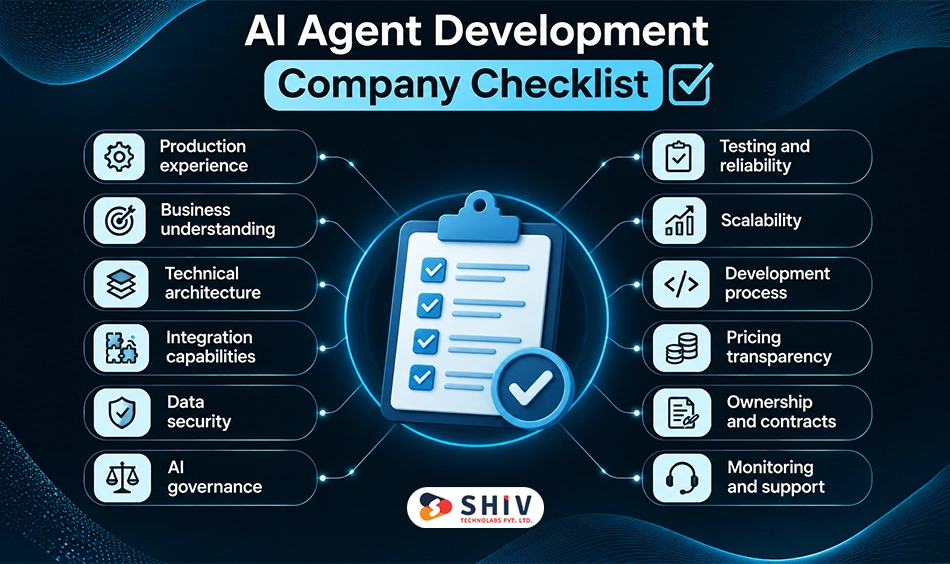
Selecting an AI development partner becomes easier when every evaluation criterion has a clear purpose and measurable evidence. Instead of asking whether a company has AI expertise, examine how its team approaches architecture, business integrations, security, testing, and production challenges.
The following checklist includes key evaluation factors, supporting documents to request, and practical questions to ask during vendor discussions.
1. Verify Experience With Production AI Agents
A company with experience building AI agents for production environments should understand the challenges of connecting models to real business processes. These challenges include inconsistent outputs, failed API requests, permission restrictions, incomplete information, and changing operational requirements.
Review projects where AI agents perform defined business tasks rather than simply generate conversational responses. Ask how the development team addressed implementation challenges and measured performance after launch.
Evidence to request: Production case studies, architecture summaries, client references, and evaluation reports.
Question to ask: Can you demonstrate an AI agent that performs authorized business tasks in a production environment?
2. Check Business Workflow and Industry Understanding
A capable AI development company should understand how your business operates before recommending models or technical frameworks. Its discovery process should identify workflow dependencies, decision points, operational exceptions, data availability, and expected business outcomes.
For example, an AI agent designed for invoice processing requires knowledge of financial approvals, purchase orders, supplier records, and accounting workflows. Businesses can assess their organizational and technical readiness using this guide to signs your business is ready for an AI agent.
Evidence to request: Process maps, workflow assessments, use-case priorities, and measurable business objectives.
Question to ask: How will you identify which business workflows are suitable for AI agents?
3. Review Technical Architecture and Model Selection
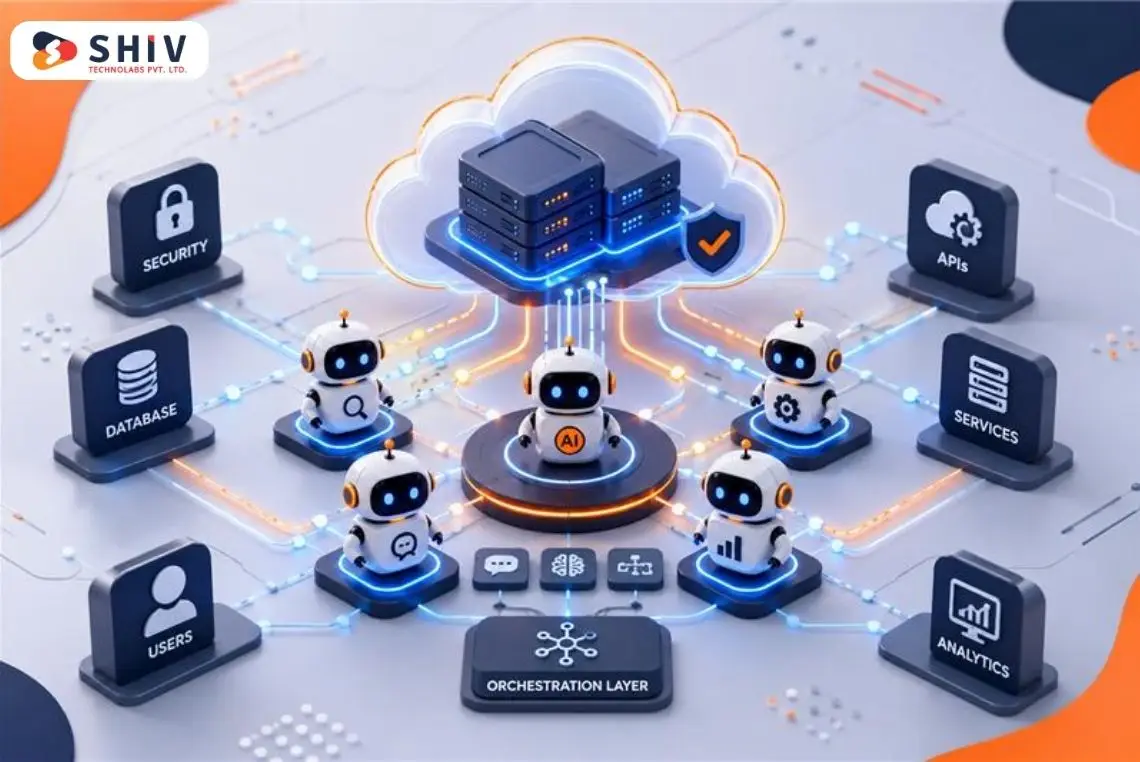
AI agent architecture determines how the system processes information, selects tools, maintains context and completes tasks. The team should be fluent in large language models (LLMs), retrieval-augmented generation (RAG), tool calling, orchestration, memory management and output validation. It should also be able to explain why it would use a framework such as LangGraph, CrewAI or the OpenAI Agents SDK, or write its own orchestration code, for your workflow.
The company should also explain whether a single-agent or multi-agent architecture is appropriate. Businesses should assess coordination requirements, task dependencies and operational complexity before choosing between single-agent and multi-agent systems, because each additional agent adds response time, operating cost and failure points. Architectural complexity must serve a defined business purpose.
Evidence to request: Architecture diagrams, model comparisons, technology recommendations, and workflow designs.
Question to ask: Why is the proposed AI agent architecture suitable for our business requirements?
From our projects: Most agents we deliver start as focused, single-purpose agents on a containerized microservices architecture, which we can typically deploy in 2 to 3 weeks. We add further agents only when a workflow clearly needs separate roles, because each additional agent increases testing, monitoring and operating cost.
4. Evaluate Enterprise Integration Capabilities
Enterprise AI agents often interact with CRM platforms, ERP software, databases, document repositories, and third-party applications. The development company must understand how to connect these systems securely while maintaining existing business rules and access permissions.
Integration expertise should cover authentication, API reliability, data synchronization, timeout handling, and duplicate-action prevention. For businesses using ERP platforms such as Odoo, agent integrations should respect the existing application logic established through Odoo development services.
Ask whether the team builds tool connections with Model Context Protocol (MCP), the open standard that many agent frameworks now use to connect agents to applications and data sources. Standardized integration methods such as Model Context Protocol can simplify certain connections, as demonstrated by the approach to connecting AI agents to Odoo data. Each MCP server still needs scoped credentials, input validation and logging, because it gives the agent direct access to business systems.
Evidence to request: API integration examples, authentication designs, permission models, and error-handling strategies.
Question to ask: How will the agent respond when a connected application becomes unavailable or returns incorrect information?
From our projects: We connect agents through APIs and webhooks to platforms such as Odoo, HubSpot, Shopify, Magento and Zendesk, and configure roles, rate limits and logs for each connection so that every action the agent takes is tracked and can be reviewed.


5. Examine Data Security and Compliance Practices
AI agents can access sensitive business information and interact with systems that contain customer, financial, and operational records. The development partner should explain how data moves between applications, AI models, storage systems, and external service providers.
Review security practices such as role-based access control (RBAC), encryption, credential management, data retention and tenant isolation. The team should also explain how it mitigates the risks in the OWASP Top 10 for Agentic Applications 2026, such as prompt injection that redirects an agent’s goals, misuse of connected tools, and agentic supply chain vulnerabilities, where a tampered tool, plugin or prompt loaded at runtime compromises the workflow.
Evidence to request: Security policies, applicable certifications, data-processing agreements, and security testing reports.
Question to ask: How will you prevent AI agents from accessing or sharing information outside their authorized permissions?
6. Check AI Governance, Guardrails, and Human Oversight
AI agents should operate within clearly defined action boundaries. A development company must explain which tasks an agent can complete independently, which actions require human approval, and when the system should stop and escalate an issue.
For example, a financial AI agent may retrieve invoice records and recommend payment approval, while transferring funds requires separate authorization. These distinctions are central to effective AI agent governance controls in enterprise systems, where permissions and oversight should reflect the consequences of each action.
Ask the vendor which autonomy level it proposes for each action the agent can take:
| Autonomy level | What the agent does | Typical use | Required controls |
| Assistive | Retrieves information and drafts outputs; a person takes every action | Research, drafting, internal Q&A | Output review |
| Supervised | Prepares actions; a person approves before execution | Payments, refunds, record changes | Approval workflow and audit log |
| Bounded autonomous | Executes approved low-risk actions on its own within set limits | Ticket routing, data enrichment, status updates | Permission limits, monitoring and a stop mechanism |
Evidence to request: Approval workflows, permission boundaries, escalation rules, and emergency stop mechanisms.
Question to ask: Which actions can the AI agent execute independently, and which require human approval?
7. Assess AI Agent Testing and Evaluation Methods
AI agents can produce different responses across repeated executions, even when given similar inputs. A single successful demonstration cannot establish that an agent consistently completes tasks correctly under real operating conditions.
The vendor should use representative evaluation datasets, repeated testing, tool-call validation, adversarial scenarios, and regression testing. These methods should form part of the broader quality assurance process established through qualified software QA services.
Evidence to request: Evaluation datasets, acceptance criteria, test reports, and execution traces.
Question to ask: How do you measure whether the AI agent consistently completes business tasks correctly and safely?
From our projects: We start with one workflow, record a baseline for metrics such as handle time, first-contact resolution, ticket deflection and SLA hit rate, run A/B tests against that baseline, and expand the agent only after results stay steady.
8. Review Scalability and Production Readiness
An AI agent that performs well during a small demonstration may encounter different challenges when processing hundreds or thousands of requests. Model rate limits, application dependencies, infrastructure capacity, and concurrent users can affect response times and task completion.
Ask the development company how it manages request queues, resource consumption, retries, infrastructure scaling, and provider outages. The architecture should also include appropriate stopping conditions and recovery mechanisms to prevent repeated failures from affecting connected systems.
Evidence to request: Load-testing plans, capacity estimates, performance benchmarks, and recovery procedures.
Question to ask: How will the AI agent handle increasing usage, rate limits, and temporary service interruptions?
9. Evaluate the Development Process and Pilot Plan
A structured AI agent development process should begin with workflow assessment and continue through architecture planning, implementation, testing, and phased production release. Each stage should have defined deliverables, responsible team members, and measurable acceptance criteria.
A limited pilot is particularly useful because it allows businesses to evaluate the proposed solution before committing to wider implementation. The pilot should address a representative business workflow with realistic data, integration requirements, and operational exceptions.
Evidence to request: Project roadmap, pilot scope, development milestones, and acceptance criteria.
Question to ask: Can we validate one representative business workflow before approving full-scale development?
10. Compare Pricing and Total Cost of Ownership
AI agent development costs extend beyond initial software engineering expenses. Businesses must consider AI model consumption, API integrations, cloud infrastructure, security controls, monitoring, maintenance, and future improvements.
The development company should provide transparent estimates based on expected tasks, usage volumes, integration complexity, and support requirements. Comparing the total cost of ownership helps businesses determine whether projected operational benefits justify both development and recurring expenses.
Evidence to request: Itemized pricing, usage assumptions, operational cost estimates, and change-request policies.
Question to ask: What will the AI agent cost to build, operate, and maintain at our expected usage volume?
From our projects: In our project estimates, integrations usually account for 20% to 35% of the build budget and testing and evaluation for another 10% to 20%. A proposal that allocates little to either is likely to cost more after launch.
11. Confirm Intellectual Property and Contract Terms
Ownership arrangements can influence how easily a business maintains, modifies, or transfers its AI agent solution in the future. Before signing a contract, clarify ownership of custom source code, prompts, evaluation datasets, configurations, documentation, and business-specific workflows.
Review licensing requirements for third-party models, frameworks, and proprietary vendor components separately. The contract should identify which assets the business owns, which it licenses, and how the system will be handed over if the partnership ends.
Also ask how portable the solution is across AI model providers. An agent whose prompts, tools and evaluation sets depend on one provider’s proprietary features may need significant rework if that provider’s pricing, performance or availability changes.
Evidence to request: Intellectual property clauses, licensing terms, repository access, and handover documentation.
Question to ask: Can another qualified development team maintain or extend the AI agent if we change vendors?
12. Verify Post-Launch Monitoring and Support
Production AI agents require ongoing attention because business processes, underlying models, APIs, and security requirements can change. The development partner should provide a maintenance plan covering reliability monitoring, incident management, model updates, and performance reviews.
Operational monitoring should track task failures, incorrect tool calls, human interventions, unexpected costs and security events. The vendor should also provide tracing: a step-by-step record of each agent run showing model calls, tool calls and decisions, so your team can explain why the agent took an action. Significant changes to models, prompts or tools should undergo regression testing before reaching production.
Evidence to request: Support agreements, monitoring plans, incident response procedures, and maintenance responsibilities.
Question to ask: How will your team monitor agent performance and resolve operational problems after launch?
Expert insight from the Shiv Technolabs AI team: The quality of an AI agent depends on the complete system, not only the selected AI model. Reliable integrations, controlled actions, measurable evaluations, and ongoing operational support are equally important when assessing a development company’s capabilities.
How Can You Compare AI Agent Development Companies Objectively?
Comparing AI agent vendors works best when every company is scored against the same agent-specific requirements. A general software or AI vendor scorecard measures delivery capability, but it can miss the factors that decide whether an agent is safe to run: controlled tool execution, approval design, evaluation evidence and run-level tracing.
The scorecard below weights those agent-specific factors. For broader criteria such as company stability, team structure and general AI delivery, use it alongside our AI development partner vendor scorecard.
Agent-Specific AI Vendor Evaluation Scorecard
| Evaluation Area | Suggested Weight | Maximum Score |
| Production agent evidence | 15% | 15 |
| Tool execution and integration controls | 15% | 15 |
| Autonomy limits and human approvals | 15% | 15 |
| Evaluation evidence (task completion, tool-call accuracy) | 15% | 15 |
| Agentic security (OWASP Top 10 for Agentic Applications) | 15% | 15 |
| Monitoring and run tracing | 10% | 10 |
| Cost per completed task transparency | 5% | 5 |
| Ownership and model portability | 10% | 10 |
| Total | 100% | 100 |
Assign each vendor a rating from 1 to 5 for every evaluation area. Calculate the weighted score by dividing the rating by five and multiplying it by the assigned weight.
AI Agent Vendor Evaluation Scorecard
Use this scorecard to compare shortlisted AI agent development companies based on their technical capabilities, security practices, business understanding, and long-term support. Assign a rating from 1 to 5 for each evaluation criterion based on documented evidence.
Development Company Name: __________________
| Evaluation Criteria | Weight | Rating (1–5) | Weighted Score |
| Production Experience | 15% | ||
| Business Understanding | 10% | ||
| Architecture and Integrations | 15% | ||
| Security and Governance | 20% | ||
| Testing and Reliability | 15% | ||
| Development and Scalability | 10% | ||
| Pricing and Ownership | 10% | ||
| Monitoring and Support | 5% | ||
| Total Score | 100% | __/100 |
Rating Guidelines:
- 1: Insufficient evidence
- 2: Partially meets requirements
- 3: Meets requirements
- 4: Exceeds requirements
- 5: Strong capabilities with documented evidence
Weighted Score Formula: (Assigned Rating ÷ 5) × Weight
Consider: Use the final score to compare development companies objectively. However, critical security weaknesses, missing compliance requirements, and unclear ownership terms should remain independent decision factors, regardless of the overall score.
What Are the Warning Signs of an Unreliable AI Agent Development Company?
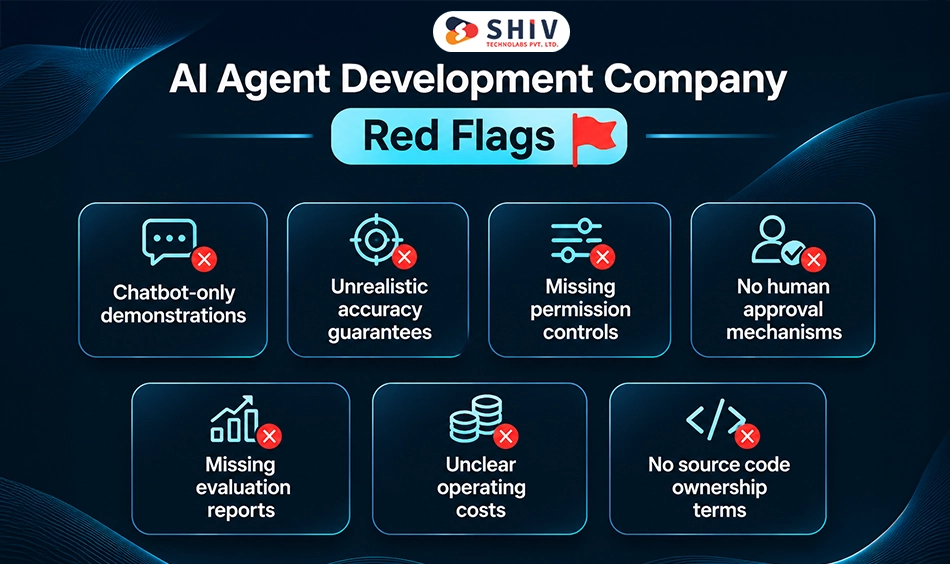
The growing demand for agentic AI has produced a practice Gartner calls agent washing: rebranding existing products such as AI assistants, robotic process automation (RPA) tools and chatbots as AI agents without substantial agentic capabilities. Gartner estimates that only about 130 of the thousands of vendors claiming agentic AI are real.
Businesses should examine what the proposed system can accomplish beyond generating responses. A development partner should demonstrate controlled tool execution, permission management, exception handling, and measurable workflow completion.
| Warning Sign | Why It Matters |
| Only chatbot demonstrations | Limited evidence of agent execution capabilities |
| Perfect accuracy guarantees | Unrealistic performance expectations |
| Missing permission boundaries | Potential unauthorized system actions |
| No human approval mechanisms | Limited control over sensitive decisions |
| Missing evaluation reports | Unverified performance and reliability |
| No failure recovery plan | Operational continuity concerns |
| Unclear recurring expenses | Unexpected operating costs |
| Missing source code ownership terms | Long-term vendor dependency |
During technical discussions, ask the vendor to demonstrate how the AI agent responds when an application fails, required information is unavailable, or a requested action exceeds its permissions. These scenarios can reveal architectural limitations that may remain hidden during a carefully prepared demonstration.
Expert insight from the Shiv Technolabs AI team: Evaluate an AI agent’s ability to recognize when it should stop, request clarification, or escalate a task. Responsible autonomy is more valuable than unrestricted execution.
What Questions Should You Ask Before Hiring AI Agent Developers?
Initial vendor meetings provide an opportunity to understand how a development company approaches technical challenges, project responsibilities, and business requirements. Asking consistent questions across shortlisted companies also helps identify meaningful differences in expertise and delivery practices.
Use the following questions during technical interviews, proposal discussions, and final vendor assessments:
- Can you demonstrate an AI agent operating in production?
- How will you determine whether our workflow requires an AI agent?
- Which AI models and frameworks will you recommend, and why?
- How will the agent connect to our existing applications?
- What security controls and human approval mechanisms will you implement?
- How will you measure agent reliability and manage failed tasks?
- What are the development and recurring operational expenses?
- Who will own the source code, configurations, and documentation?
- What maintenance and technical support will you provide after launch?
- How will you manage changes to AI models, APIs, and business workflows?
Request written responses where possible, particularly for security requirements, project deliverables, pricing assumptions, and ownership arrangements. Documented commitments provide a clearer foundation for establishing the project’s technical scope and commercial agreement.
How Should You Evaluate an AI Agent Pilot Before Full Implementation?
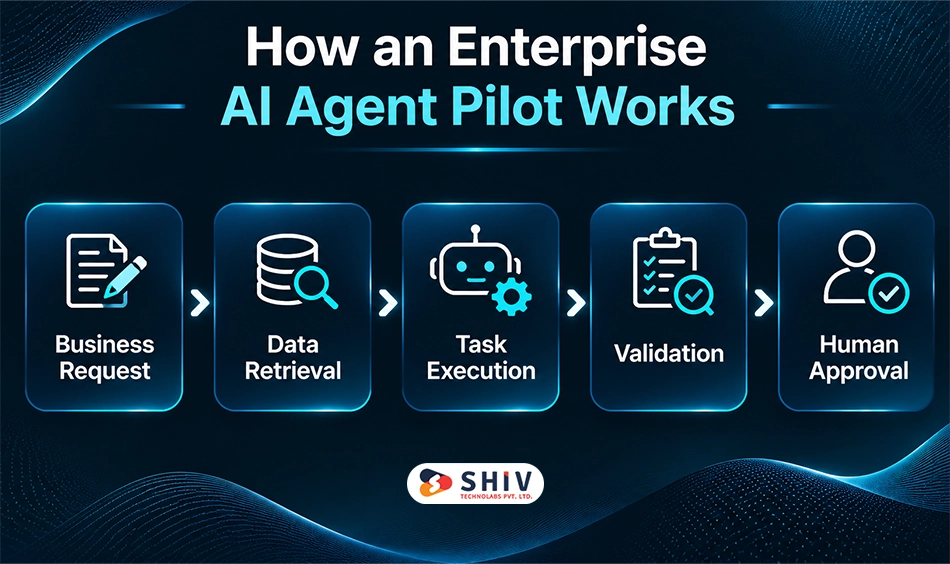
An AI agent pilot allows businesses to evaluate technical feasibility, workflow performance, security controls, and operating costs before committing to a larger implementation. Unlike a basic proof of concept, a well-planned pilot should address a representative business process under realistic operating conditions.
Choose a workflow with a clear business objective, accessible data, defined responsibilities, and measurable outcomes. Agree on evaluation criteria before development begins so that the final decision reflects documented results rather than subjective impressions.
Key Metrics for AI Agent Pilot Evaluation
| Evaluation Metric | What It Measures |
| Task completion rate | Percentage of tasks completed correctly |
| Tool-call accuracy | Correct selection and execution of tools |
| Human intervention rate | Frequency of manual assistance |
| Response time | Time required to complete a task |
| Cost per completed task | Operational spending relative to successful outcomes |
| Security violations | Unauthorized or unsafe actions |
| Failure recovery rate | Ability to recover from workflow interruptions |
| Business impact | Measured time savings or process improvements |
Example of an Enterprise AI Agent Pilot
Consider a business planning an AI agent for supplier invoice processing. Instead of automating the entire accounts payable department, the company could begin with a workflow that retrieves invoices, compares purchase order details, identifies discrepancies, and prepares recommendations for human review.
Illustrative AI agent workflow
Receive Supplier Invoice
Extract relevant invoice information
Retrieve ERP Records
Access approved purchase order data
Validate Invoice Details
Compare amounts, suppliers, and order references
Records Match
Prepare approval recommendation
Discrepancy Found
Flag issue for manual review
Human Approval
Authorized employee makes the final decision
Suggested Pilot Acceptance Criteria
| Metric | Illustrative Target |
| Representative test cases | 200 |
| Correct task completion | At least 95% |
| Correct tool selection | At least 98% |
| Unauthorized successful actions | 0 observed during testing |
| Required approval compliance | 100% during testing |
| Manual processing time reduction | At least 30% |
| Operating cost per successful task | Within agreed budget |
These figures are illustrative acceptance targets, not industry benchmarks or verified project results.
Test missing invoice details, duplicate records, incorrect purchase orders, restricted data requests, and temporary ERP failures. The appropriate success thresholds should reflect the business consequences of incorrect decisions. Wider implementation should proceed only after the required security and operational criteria have been met.
From our projects: We fund agent projects in stages. A proof of concept on one workflow typically takes 3 to 6 weeks, and a pilot with live users and live data runs 2 to 4 months. Escalation rules route low-confidence cases to a person, and the agent moves to wider rollout only after it meets the acceptance criteria agreed at the start.
How Much Does It Cost to Hire an AI Agent Development Company?
The cost of hiring an AI agent development company depends on workflow complexity, AI model selection, system integrations, security requirements, development resources, and expected usage. A focused internal assistant generally requires fewer development resources than an enterprise agent that performs multistep tasks across several business applications.
Businesses should evaluate both initial implementation expenses and recurring operating costs. A proposal that appears affordable during development may become expensive when model usage, infrastructure, monitoring, and maintenance requirements increase.
Typical AI Agent Project Cost Ranges
| Project type | Typical scope | Shiv Technolabs range (USD) | Typical timeline |
| Focused pilot | One workflow, 1 to 2 integrations, human approval on all actions | $8,000 to $25,000 | 3 to 6 weeks |
| Production single-agent system | One business process, 3 to 5 integrations, monitoring and evaluations | $20,000 to $80,000 | 6 to 12 weeks |
| Multi-agent enterprise system | Several processes, ERP and CRM integrations, governance and compliance controls | $150,000 to $500,000+ | 6+ months |
Ranges come from the Shiv Technolabs AI agent development cost guide for 2026 and exclude AI model usage, which depends on volume.
Key AI Agent Development Cost Components
| Cost Component | What It Includes |
| Discovery and planning | Workflow assessment and feasibility analysis |
| AI architecture | Model selection, orchestration, and system design |
| Custom development | Agent logic, interfaces, and business functionality |
| System integrations | ERP, CRM, databases, and API connections |
| Security and testing | Permissions, evaluations, and security assessments |
| AI model usage | Input tokens, output tokens, and other model charges |
| Cloud infrastructure | Hosting, storage, and computing resources |
| Maintenance | Monitoring, updates, and technical support |
Example of First-Year AI Agent Development Costs
The following example illustrates how a business could estimate first-year spending for a custom AI agent connected to existing enterprise applications.
Illustrative first-year budget · $67,000
Implementation $40,000
Annual operating costs $21,000
Contingency $6,000
This example represents a hypothetical budget, not a standard development quote. Actual expenses depend on project requirements, service agreements, model pricing, and workload characteristics. Businesses should request cost projections for normal usage, peak activity, and expected growth.
Expert insight: Evaluate cost per successfully completed business task rather than AI model pricing alone. A less expensive model may produce higher overall costs if it requires frequent retries, additional validation, or manual intervention.
Should You Hire an AI Agent Development Company or Build In-House?
The decision between hiring an external development company and building AI agents internally depends on available technical expertise, implementation priorities, budget, and long-term ownership requirements. Both approaches can be effective when responsibilities and business objectives are clearly defined.
An internal team may offer closer alignment with business operations, while an external partner can provide specialized development resources and experience across different technologies.
| Evaluation Factor | In-House Development | External Development Partner |
| Technical expertise | Requires internal specialists | Access to specialist teams |
| Initial investment | Recruitment and infrastructure | Project or engagement costs |
| Implementation timeline | Depends on team readiness | Can benefit from existing resources |
| Business knowledge | Strong internal understanding | Requires structured discovery |
| Project control | Direct internal management | Defined contractual responsibilities |
| Long-term maintenance | Internal team responsibility | Based on support agreement |
| Knowledge retention | Internal documentation and skills | Depends on handover process |
A hybrid development model may also be suitable for enterprises. Internal teams can manage business requirements, data governance, and operational decisions, while an external development partner handles specialized AI architecture, integrations, testing, and implementation.
The appropriate approach should reflect the organization’s technical capabilities, resource availability, and ability to maintain the system after launch.
How Shiv Technolabs Helps Businesses Build Custom AI Agents
Successful AI agent implementation requires a clear understanding of business processes, technical dependencies, security considerations, and expected outcomes. Shiv Technolabs works with businesses to assess these requirements and build AI-powered solutions suited to their operational needs.
From workflow assessment and architecture planning to application integration and ongoing maintenance, businesses can plan their implementation through Shiv Technolabs’ AI agent development services.
Our capabilities include:
- Workflow Assessment
- AI Agent Architecture
- Custom Agent Development
- Enterprise System Integrations
- AI Model Integration
- Security and Governance
- Performance Testing
- Ongoing Technical Support
Whether you are planning a focused internal AI assistant or a multistep enterprise AI agent, defining the right scope and implementation strategy provides a practical foundation for development.
Conclusion
Choosing the right AI agent development company requires a structured assessment of technical expertise, production experience, business understanding, security practices, and long-term support. A capable development partner should explain how its proposed solution will address your business requirements while maintaining appropriate control over data, permissions, and automated actions.
Use the 12-point checklist to compare vendors, request documented evidence, and evaluate performance through a limited pilot. Clear acceptance criteria, transparent pricing, and defined ownership arrangements can help businesses make informed investment decisions.
The right AI agent development partner delivers more than an intelligent interface. It helps businesses build reliable, measurable, and maintainable systems that support real operational requirements.
Frequently Asked Questions
1. What types of AI agent development companies are there?
There are four main types: custom AI agent development companies that build agents on your own systems, agent platform and SaaS vendors that offer configurable agents inside their products, AI consulting firms that focus on strategy and governance, and freelancers or small studios that build prototypes. Custom developers fit workflows that span several internal systems.
2. Which frameworks should an AI agent development company use?
There is no single correct framework. Experienced teams choose between options such as LangGraph, CrewAI, the OpenAI Agents SDK or custom orchestration code based on workflow complexity, approval and tracing needs, and your existing technology stack. Ask the vendor to explain why its choice fits your requirements and how hard it would be to change later.
3. How do I verify that an AI company builds real agents?
Ask the company to demonstrate an AI agent that performs multistep tasks, selects approved tools, interacts with business applications, and handles unexpected situations. Review execution logs, evaluation results, permission controls, and failure recovery mechanisms rather than relying only on conversational demonstrations.
4. What is agent washing?
Agent washing refers to presenting conventional chatbots, AI assistants, or automation systems as advanced AI agents without demonstrating corresponding capabilities. Businesses can identify agent washing by examining tool execution, decision-making flexibility, workflow completion, security controls, and production experience.
5. How do I avoid vendor lock-in with an AI agent developer?
Require ownership of custom code, prompts, configurations and evaluation datasets in the contract, plus repository access from the start of the project. Ask for an architecture that can switch AI model providers without a rebuild, documented handover procedures, and standard integration methods such as Model Context Protocol instead of proprietary connectors.
6. Why are guardrails important for enterprise AI agents?
Guardrails help restrict AI agent behavior, protect sensitive information, validate outputs, and prevent unauthorized actions. They establish operational boundaries for tool usage and decision-making while defining when human approval, clarification, or escalation is required.
7. How do I test AI agent reliability?
Test AI agents using representative datasets, repeated executions, realistic workflow scenarios, and unexpected inputs. Measure task completion, tool-call accuracy, response times, security violations, and human intervention rates. Conduct regression testing whenever models, prompts, tools, or business rules change.
8. Should an AI agent development company support multiple AI models?
Supporting multiple AI models can provide greater flexibility in managing performance, pricing, and provider availability. However, not every project requires multiple models. The development company should recommend an architecture based on business requirements, technical dependencies, and maintenance considerations.
9. How much does custom AI agent development cost?
Costs depend on workflow complexity, integrations, security requirements and usage. A focused proof of concept typically costs $8,000 to $25,000, while an enterprise agent costs $80,000 to $200,000 or more to build, plus recurring model, infrastructure and maintenance costs. Ask for an itemized estimate and a projection of cost per completed task.
10. Who should own the intellectual property of a custom AI agent?
Intellectual property ownership should be defined in the development agreement. Businesses should clarify their rights to custom source code, prompts, configurations, documentation, and evaluation datasets while reviewing separate licensing requirements for third-party frameworks and AI models.
11. How long does it take to develop an enterprise AI agent?
A focused pilot on one workflow typically takes 3 to 6 weeks, and a production enterprise agent with several integrations takes 3 to 6 months. The main factors are integration complexity, data readiness, security reviews and testing scope. Request a milestone-based schedule after technical discovery.
12. What support should an AI agent development company provide?
Post-launch support should cover performance monitoring, incident management, security updates, model changes, integration maintenance, regression testing, and operational cost reviews. The support agreement should define responsibilities, response times, maintenance scope, and procedures for handling critical failures.