Table of Contents
Think about the last few apps you used today. You likely interacted with an app that suggested products based on your past activity, recommended content that matched your interests, or simplified a task that once required multiple steps. These experiences feel natural, but they are the result of the latest trends in app development.
Users no longer compare apps within the same category. They compare every app to the best experience they have ever had. This means a finance app is compared to a shopping app, and a health app is compared to a social platform. That level of expectation is pushing businesses to rethink how they approach mobile app development.
At the same time, technologies like artificial intelligence, machine learning, IoT, cloud infrastructure, and advanced connectivity are enabling developers to build smarter and more responsive applications. Businesses that understand these changes early can create apps that stay relevant and competitive for a longer period.

What Is Driving the Trends in Mobile App Development in 2026?
Before looking at specific trends, it is important to understand the key forces influencing mobile app development. These drivers explain why certain technologies are gaining attention and how they are shaping development decisions.
1. Rising demand for personalization
Users expect apps to adapt to their preferences without requiring repeated input. They want relevant suggestions, customized interfaces, and experiences that feel tailored. This expectation has made personalization a central part of app design.
2. Growth in data and analytics
Every interaction within an app generates valuable data. Businesses are using this data to understand user behavior, improve engagement, and refine their offerings. This has increased the importance of analytics and data-driven systems.
3. Need for faster performance
Speed directly affects user retention. Even a small delay in loading or interaction can lead to drop-offs. This has made performance optimization a critical focus during development.
4. Increased focus on privacy
Users are more aware of how their data is used. Regulations are also becoming stricter. As a result, businesses must build apps that prioritize data protection and transparency.
5. Requirement for scalable systems
Apps must support growth without requiring major structural changes. This has increased the adoption of flexible and scalable architectures.
Top 10 Trends in App Development That Impact Cost, ROI, and Growth
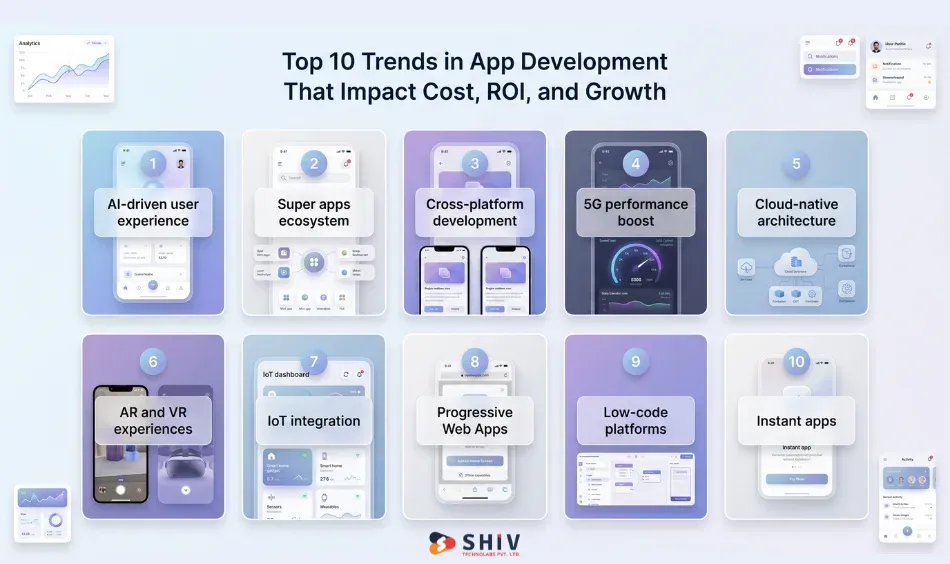
Trends in app development are not just about adding new features. It is about building systems that respond to user behavior, process data in real time, and adapt as user expectations change. Businesses are moving from feature-driven apps to experience-driven platforms, where performance, personalization, and scalability play a central role.
Each trend below reflects a shift in how apps are planned, built, and maintained. These are not short-term changes. They are shaping long-term development strategies across industries.
1. AI is Becoming the Core of User Experience
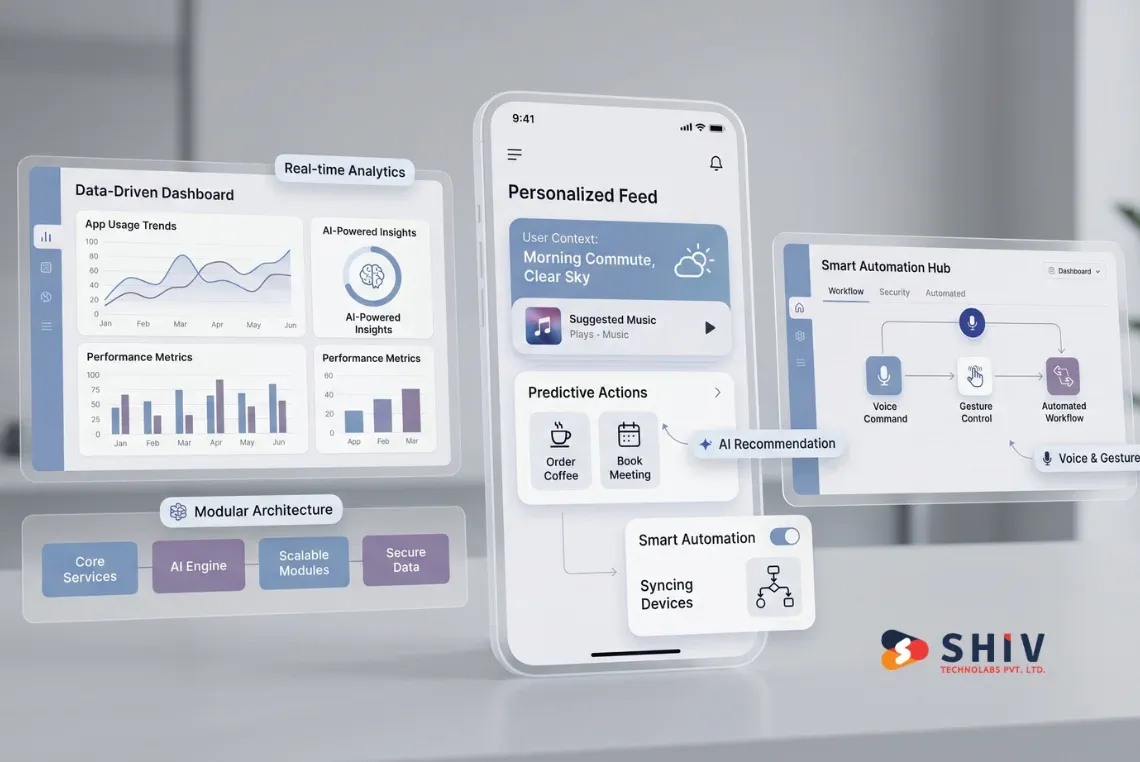
Artificial Intelligence is no longer optional. It is becoming the foundation of how mobile apps operate. Businesses are actively investing in AI development services to build apps that understand user behavior, predict actions, and deliver personalized experiences without manual input.
Instead of showing the same interface to every user, apps adjust content, layouts, and recommendations in real time. This creates more relevant interactions and increases engagement.
AI also plays a major role in backend development, where intelligent systems process large volumes of data, automate workflows, and support faster decision-making. A strong backend ensures that AI models run efficiently and scale as user demand grows.
Where AI is actively used in apps
- Personalized product recommendations in eCommerce
- Predictive insights in health and wellness apps
- Smart chat interfaces powered by NLP for customer support
- Fraud detection systems in financial applications
Advanced AI tools and technologies are used
- Machine Learning frameworks like TensorFlow and PyTorch
- Natural Language Processing tools such as OpenAI and Dialogflow
- Recommendation engines using collaborative filtering
- Computer vision models for image and video analysis
Supporting stats
- Apps using AI-based personalization can increase engagement by up to 40%
- Businesses report up to 30% faster decision-making with AI-driven analytics
- AI-powered recommendations can contribute to 20–35% revenue growth in eCommerce
What this means for businesses
Apps that use AI effectively can increase user retention and improve conversion rates through personalized experiences. They also reduce manual effort and improve operational efficiency across workflows.
2. Super Apps are Changing How Users Interact with Platforms
The concept of super apps is gaining attention because users prefer convenience over fragmentation. Instead of switching between multiple apps for different tasks, users want a single platform that handles everything.
Super apps combine services such as payments, messaging, shopping, and bookings into one interface. This approach simplifies the user journey and keeps users engaged within one ecosystem.
Core elements of a super app
- Integrated payment systems
- Messaging and communication tools
- Multi-service access within one platform
- Third-party integrations
Why businesses are considering this model
Super apps help increase user retention and open up new revenue streams. They also provide more opportunities to cross-sell services within the same platform.
3. Cross-Platform Development is Becoming a Practical Choice
Modern applications are no longer built for a single platform. Businesses are adopting cross-platform approaches to build applications that work seamlessly across devices and operating systems.
These solutions are no longer limited to simple use cases. They now support complex features and deliver near-native performance.
Tools like Flutter and React Native allow developers to build applications for multiple platforms using a single codebase. At the same time, backend systems and APIs play a critical role in enabling smooth communication across platforms, especially when handling cross-platform integration across different systems.
Why businesses are choosing cross-platform development
- Faster time to market
- Reduced development costs
- Easier updates and maintenance
Where it fits best
- MVP development
- Startups with limited resources
- Apps with standard functionality
Where native development still plays a role
Applications that require high performance, complex animations, or deep hardware integration still benefit from native development.
4. 5G is Enabling Real-time and High-performance Experiences
The expansion of 5G networks is changing how mobile apps handle data and interactions. With faster speeds and lower latency, apps can process information in real time and deliver smooth experiences.
This is particularly important for applications that depend on live interactions or high-quality media.
Key improvements enabled by 5G
- Faster loading and response times
- High-quality video streaming
- Improved real-time interactions
- Better performance for AR and gaming apps
Industries are seeing a strong impact
- Healthcare for remote consultations
- Gaming for real-time multiplayer experiences
- eCommerce for live shopping
- Collaboration tools for remote teams
5. Cloud-native Architecture Supports Scalable App Systems
Cloud-native development is becoming a standard approach for building modern mobile applications. Instead of relying heavily on device resources, apps use cloud infrastructure to manage data, processing, and storage.
This approach allows apps to scale based on demand and handle large volumes of users without performance issues.
How cloud-native apps improve performance
- Apps can scale without system redesign
- Updates can be released quickly
- Infrastructure management becomes more flexible
Why this matters for long-term growth
Cloud-native systems allow businesses to grow without worrying about technical limitations. They provide the flexibility needed to handle increasing users and data.
6. AR and VR are creating immersive app experiences
AR/VR technology is changing how users interact with digital content. These technologies allow users to experience products and environments more interactively.
Instead of viewing static images, users can engage with digital elements that feel more realistic.
Where AR and VR are used
- Virtual try-ons in retail
- Property walkthroughs in real estate
- Interactive simulations in training apps
Impact on user engagement
These technologies make apps more engaging and help users make decisions faster. They also create unique experiences that differentiate apps from competitors.
7. IoT Integration is Connecting Apps with Real-world Devices
Mobile apps are increasingly connecting with smart devices through IoT integration. This allows apps to collect and process data from multiple sources in real time.
The result is a connected ecosystem where apps and devices work together.
Examples of IoT-enabled applications
- Smart home control apps
- Health monitoring apps connected to wearables
- Industrial apps for equipment tracking
Business value of IoT integration
IoT expands app capabilities and creates new opportunities for services. It also improves efficiency by automating processes.
8. Progressive Web Apps (PWAs) are Changing How Apps Are Built
Progressive Web Apps combine the reach of the web with the experience of native apps. Businesses are using PWAs to build fast, reliable applications that work across devices without separate iOS and Android development.
Users can access PWAs directly through a browser, install them on their home screen, and use them even in low network conditions. This improves accessibility and reduces friction in user adoption.
Core capabilities of PWAs
- Offline access using service workers
- Fast loading with caching and background sync
- App-like experience with smooth navigation
- Push notifications for user engagement
- No app store dependency
What this means for businesses
PWAs help reduce development complexity while improving performance and reach. They are a practical choice for businesses that want scalable apps without high native development costs.
9. Low-code and No-code Platforms Are Speeding Up Development Cycles
Low-code and no-code platforms are making app development more accessible. Businesses can build high-performing and scalable applications without deep technical expertise.
This approach is useful for rapid prototyping and internal tools.
Benefits of low-code development
- Faster development and testing
- Reduced dependency on large teams
- Easier experimentation with ideas
Limitations to consider
- Limited flexibility for complex applications
- Dependency on platform capabilities
10. Instant Apps (Where Users Can Try the App Before Installing)
Instant Apps allow users to open and use part of an app without downloading it from the app store. Instead of installing the full app, users can click a link and instantly access key features.
Instant apps are usually used in retail apps for browsing products instantly, Event apps for checking schedules or booking tickets, Food delivery apps, as well as Travel apps for viewing hotels or bookings on the go.
In these kinds of apps, instead of being forced to install the app, it opens instantly and lets you browse the product, check details, and even take action.
This helps users try the app first, so they don’t hesitate to install it later. Instant Apps solve this by letting users experience the app first.
Why businesses are adopting Instant Apps
- Reduces friction in user onboarding
- Increases conversion rates from first-time users
- Lowers drop-offs during app installation
- Builds trust by showing value upfront
What this means for businesses
Instant Apps help users move from curiosity to action faster. When users can try an app instantly, they are more likely to engage and eventually install the full version.


How Shiv Technolabs is Ideal for Future-Ready Mobile App Development?
Shiv Technolabs approaches mobile app development with a focus on long-term value and adaptability. The team works closely with businesses to understand their goals, user expectations, and technical requirements before starting development.
With strong experience in healthcare app development, enterprise applications, and AI-driven systems, Shiv Technolabs builds solutions that align with real business needs. The focus is not only on building features but also on creating systems that can scale and evolve.
Core focus areas
- Scalable architecture for long-term growth
- Data-driven development strategies
- User-focused design principles
- Continuous improvement based on feedback
This approach helps businesses create apps that remain relevant even as technology and user expectations change.
Final Thoughts!
Top trends in app development are centered around artificial intelligence, connectivity, and adaptability. Businesses are moving beyond feature-based development and focusing on building systems that respond to user behavior and scale with growth.
These trends are shaping how apps are built and experienced. At the same time, privacy and user trust are becoming equally important. If you are planning a mobile app, focus on building a strong foundation. Choose technologies that support your long-term goals, prioritize user experience, and data security. Most importantly, build with flexibility, so your app can adapt as new trends emerge.
FAQs
1. What are the latest trends in app development?
AI-driven personalization, cross-platform development, cloud-native architecture, privacy-first design, IoT integration, AR/VR experiences, and real-time app performance are the key trends shaping mobile apps.
2. How is AI used in mobile apps today?
AI helps apps personalize content, improve search, automate support, predict user behavior, and analyze data. It also supports features like recommendations and smart assistants.
3. Is cross-platform development a good choice in 2026?
Yes. It reduces development time and cost by using a single codebase for Android and iOS. It works well for most apps except those requiring heavy performance.
4. How much does it cost to build a mobile app in 2026?
The cost to build a mobile app varies based on complexity, features, and region. Basic apps(MVP) cost around $20,000 – $50,000, a mid-level app might cost around $60,000 – $150,000, while advanced apps would cost somewhere around $150,000 – $300,000+ and require a much higher budget.
5. Why is app security important in 2026?
Users expect data protection, and regulations require it. Secure apps build trust and reduce risks related to data breaches.
6. What is the role of 5G in mobile apps?
5G improves speed and reduces delays, enabling real-time features, better streaming, and smoother user experiences.
7. What industries benefit most from mobile apps?
Industries like healthcare, eCommerce, fintech, logistics, and education benefit the most by using AI, real-time data, and automation to improve efficiency and user experience.
8. What is predictive analytics in mobile app development?
Predictive analytics uses past user data and behavior patterns to forecast actions, improve recommendations, and support smarter in-app decisions. It helps apps become more proactive and personalized.
9. Why are Progressive Web Apps still relevant?
Progressive Web Apps remain relevant because they combine web reach with app-like performance. They load quickly, work across devices, and reduce the need for separate native app builds.
10. Why should you choose Shiv Technolabs for futuristic mobile app development?
Shiv Technolabs builds mobile apps that become industry trend-setters with a focus on scalability, performance, and real user needs. Our team brings 10+ years of experience across building healthcare apps, enabling AI-driven features into powerful mobile apps, and helping businesses create apps that are ready for growth and long-term use.