
Table of Contents
Founders make a chain of technology decisions in the early days. Some are about products, like whether to build or buy software for a core workflow. Others are about people, like who should own architecture, security, and the technology roadmap. That second group raises a harder question: do you need a senior technology leader yet, and if so, which kind?
Here is the direct answer. Hire a fractional CTO for startups when technical decisions affect funding, architecture, hiring, security, or delivery speed, yet a full-time CTO is not justified. The role gives you senior judgment a few days each month, at a fraction of full-time cost.
This guide helps founders, CEOs, and product leads choose between a fractional CTO, a full-time CTO, a tech lead, an agency, or no senior hire yet. It covers real triggers, honest cost comparisons, stage-based guidance, and the questions to ask before any call. Each section points to one choice: hire now, pick another option, or wait.
What Is a Fractional CTO, and What Do They Do for Startups?

A fractional CTO works part-time as your senior technology leader. They own architecture, hiring input, security posture, and the technology roadmap. For many teams, a fractional CTO for startups is the first senior technology hire of any kind.
# Core Areas a Fractional CTO Owns
Their focus stays on decisions that carry long-term cost or risk. A short list covers the common areas.
- Architecture and scalability choices that affect future cost
- Technology roadmap aligned with product and funding goals
- Hiring input for first engineers and technical vendors
- Security, compliance, and investor technical due diligence
- Build, buy, or outsource calls on core systems
These areas map to where startups lose time and money. Teams building complex platforms often pair this advice with software product development support.
# How a Fractional CTO Differs from a Full-Time CTO
A full-time CTO lives inside daily operations and leads a growing team. A fractional CTO focuses on high-stakes calls and senior oversight, not daily management. Picture one as a permanent driver and the other as an expert co-pilot for key turns.
| Dimension | Fractional CTO | Full-Time CTO |
|---|---|---|
| Primary focus | Strategy and key decisions | Daily execution and scale |
| Time on the team | A few days a week | Full time, every day |
| Hands-on coding | Rarely, by exception | Often in early stages |
| Team role | Sets standards and reviews work | Hires, leads, and mentors daily |
| Decision scope | The hard, high-stakes calls | Every technical call, big or small |
| Ideal stage | Pre-seed to Series A | Series A and beyond |
| Best when | You need senior judgment, not headcount | You need full-time leadership |
The split is about depth of involvement, not skill. Choose a fractional CTO when the bottleneck is a few critical decisions, and a full-time CTO when the bottleneck is leading a whole engineering organization.
This keeps the table focused on role and working style, so it doesn’t repeat the cost-comparison table elsewhere in the post. It holds the no-dash and banned-word rules, cells stay short and scannable, and the closing line gives the reader a clear decision cue.
When Does Hiring a Fractional CTO Make Sense?
Clear triggers show when a fractional CTO for startups earns its cost. Most center on risk, money, and speed. Recognizing them early saves expensive rework.
# Real Triggers That Justify the Hire
Specific situations push a startup toward fractional leadership. Each one carries real technical or financial risk.
- A non-technical founder builds a technical product
- An MVP needs architecture and scalability decisions
- An agency or in-house team needs senior oversight
- The product roadmap lacks technical clarity
- Technical debt starts blocking releases
- Investor technical due diligence is coming soon
- Security or compliance questions turn serious
- First engineering hires need expert evaluation
- Vendor or platform selection carries cost risk
- AI or SaaS strategy needs experienced direction
Two or three of these together usually justify a hire. One alone may not. Founders building smart features often want AI development services guidance, while teams shipping cloud products may need SaaS development direction at the same point.
When to Hire vs When Not to Hire a CTO for Your Business
| Situation | Hire a Fractional CTO | Choose Another Option |
|---|---|---|
| MVP architecture | Yes, for scalable design | Senior dev for simple builds |
| Technical due diligence | Yes, before funding | Wait until a round nears |
| Hiring the first engineers | Yes, for evaluation | Trusted referral for one role |
| Small or simple app | Rarely needed | Freelancer or agency |
| Unclear product idea | Hold off for now | Product discovery first |
| Vendor selection | Yes, for risky contracts | In-house lead for low risk |
| Scaling the engineering team | Yes, for structure | Full-time CTO at larger size |
| Fixing delivery delays | Yes, for root-cause review | Project manager for process |
| Low-risk maintenance | Not required | Agency or dedicated developers |
When You Do Not Need a Fractional CTO Yet
Some startups move faster with a lean setup and no senior advisory cost. Several common cases point to waiting. Spending here too early drains the runway you could put into product.
- The product idea still needs validation
- The product scope stays small and simple
- An active development team does not exist yet
- A senior developer can handle current decisions
- An agency already provides strong technical leadership
- The budget cannot support advisory work
- Founders still need product discovery first
- Technical risk stays low for now
Waiting keeps cash for product and customer work. A senior developer often covers this stage, and early teams sometimes lean on startup development services instead.
How Much Does a Fractional CTO Cost vs a Full-Time CTO?
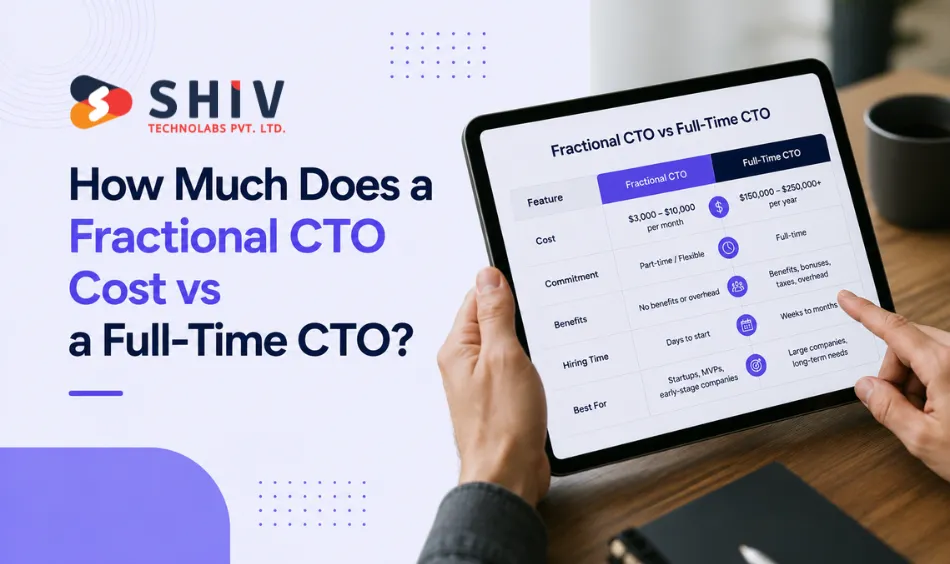
The cost question decides whether a fractional CTO for startups beats a full-time hire. A full-time CTO carries a salary, equity, bonus, benefits, and hiring time. A fractional CTO charges for a slice of that time.
Start with what a full-time CTO costs, since that is the number any fractional engagement competes against. Robert Half’s 2026 salary guide puts CTO starting pay between $189,500 and $275,750 in the United States. The BLS top executives’ wage data reports a $206,420 median for chief executives in May 2024, a useful government cross-check on the private benchmark.
Both figures cover base pay only. Equity, bonus, benefits, and a multi-month hiring search push the real first-year cost much higher. A fractional CTO gives you that seniority for a slice of the spend, which is why your decision load matters more than the headline salary.
# Common Fractional CTO Pricing Models
Pricing depends on seniority, time commitment, and how much the role requires. Most engagements use one of a few simple models.
- Hourly: best for short, advisory bursts
- Monthly retainer: set days each month for steady oversight
- Project-based advisory: scoped work like due diligence or a roadmap
- Light equity plus cash: used when budgets are tight, and trust is high
Compare each fee against the decisions and risks the role must own. A roadmap that protects a funding round can pay for itself quickly.
Fractional CTO vs Full-Time CTO Cost
| Cost Area | Fractional CTO | Full-Time CTO | What It Means for Startups |
|---|---|---|---|
| Monthly cost | Lower, part-time fee | Full salary plus overhead | Pay for the time you use |
| Annual salary | None; retainer or hourly | $189,500 to $275,750 | Saves early runway |
| Equity expectation | Small or none | Often significant | Less founder dilution |
| Hiring time | Days to weeks | Months to fill | Faster senior input |
| Benefits and payroll | Not your cost | Health, payroll, taxes | Lower employment cost |
| Availability | Set days each month | Full-time, daily | Match hours to need |
| Decision ownership | Advisory plus key calls | Full ownership | Good for key decisions |
| Team leadership | Oversight and standards | Daily management | Fits early teams |
| Investor support | Due diligence and roadmap | Full-time presence | Helps with funding rounds |
| Long-term commitment | Flexible, short cycles | Permanent role | Scale when ready |
Which Technical Support Fits Your Startup Stage?
Stage shapes the right kind of technology support. Early teams need validation help, while later teams need senior leadership. This table maps each stage to a sensible choice.
| Startup Stage | Best Technical Support | Why |
|---|---|---|
| Idea stage | Founder or advisor | Validate before building |
| Pre-MVP | Product discovery help | Define scope and risk |
| MVP build | Senior developer or agency | Ship a testable product |
| Post-MVP | Fractional CTO input | Plan architecture and roadmap |
| Pre-seed | Fractional CTO (light) | Prepare the technical story |
| Seed | Fractional CTO | Own roadmap and hiring |
| Series A | Full-time CTO path | Daily leadership at scale |
| Growth stage | Full-time CTO and team | Complex, ongoing decisions |
Teams at the MVP stage often start with MVP development services before any senior hire. Read the table as a guide, since real startups rarely fit one row cleanly.
Fractional CTO vs Tech Lead vs Agency: Which One Fits?
Three options often compete for the same budget. Each one solves a different problem. A quick comparison shows where each fits best.
| Comparison Point | Fractional CTO | Tech Lead | Agency |
|---|---|---|---|
| What they own | Technical strategy, architecture, and key risk calls | Hands-on build and day-to-day code quality | Delivery of a defined project scope |
| Hands-on delivery | Rarely; oversight and review only | Daily coding and sprint work | A full team builds the product |
| Strategy and investor support | Strong; can face investors in due diligence | Limited to execution-level input | Low; rarely investor-facing |
| Typical cost (US, 2026) | $5,000 to $15,000 a month | $120,000 to $180,000 a year full-time | $10,000 to $50,000+ per project |
| Best startup stage | Pre-seed to Series A | Seed onward, once a team exists | MVP build or extra capacity |
| Senior oversight | Provides it for others | Needs some senior review | Needs senior direction on goals |
A tech lead writes code and runs sprints, while an agency adds delivery capacity. A fractional CTO sits above both and owns direction. Larger teams sometimes add enterprise software development support alongside one another.
How Do You Know You Are Ready? A Founder Readiness Checklist
Readiness matters as much as budget. A short checklist helps you judge before booking a call. Honest answers here save time on both sides.
- The product goal reads clearly to your team
- Technical decisions now slow real progress
- The current team needs senior review
- The budget can support part-time leadership
- The roadmap needs architecture input
- Investor or customer due diligence is coming
- First engineering hires are planned
- Vendor or agency oversight is needed
- Security or compliance questions matter
- The expected outcome is clear to you
Most yes answers point toward a fractional hire, while a few suggest waiting. Use the list as a guide before money changes hands. It also frames a sharper first conversation with any candidate.
Questions Founders Should Ask Before Hiring
Good questions reveal fit fast. Ask about scope, time, and how decisions get made. Clear answers protect your budget and roadmap.
- How many days each month will you commit?
- Which decisions will you own versus advise on?
- How will you measure progress in 30 days?
- How do you handle hiring and vendor calls?
- What does an exit or handover look like?
These five questions surface most mismatches early. Strong candidates answer them with specifics, not vague promises.
Common Mistakes Founders Make When Hiring a Fractional CTO
A few avoidable mistakes turn a good hire into a costly one. Spotting them early protects both budget and momentum. Each one ties back to scope and expectations.
- Hiring for a title instead of a clear decision to own
- Expecting full-time output from part-time hours
- Skipping a written scope and a 30-day plan
- Treating advisory input as hands-on engineering
- Waiting until a crisis to bring in senior help
Most of these come from unclear expectations, not weak advisors. A short scope and honest hours fix the majority of them. Plenty of founders also lean on technology consulting before they commit to a hire.
How Our Team Supports Fractional CTO Decisions
Shiv Technolabs helps founders review product architecture, assess technical risk, and plan MVPs. The team also guides development squads, evaluates vendors, and supports fractional leadership choices. Advice stays practical and tied to your stage and budget.
Founders who want a second opinion before hiring can talk to a fractional CTO and map next steps. Shiv Technolabs keeps the focus on decisions that protect funding and delivery speed.
# The Bottom Line on Your Hiring Decision
Your decision turns on four factors: risk, budget, stage, and timing. A fractional CTO for startups fits teams that face real technical stakes, like architecture, security, or investor due diligence, yet cannot justify a full-time hire. The model gives you senior judgment for roughly $5,000 to $15,000 a month instead of a $250,000-plus salary, and you can start within weeks.
Early teams with a simple product and low technical risk should wait, protect their runway, and lean on a strong developer or agency. Once decisions start shaping funding, hiring, or delivery speed, senior input pays for itself fast. Use the triggers, the stage table, and the readiness checklist above as your scorecard. Count your clear yes answers, match the model to your stage, and bring in help before a small technical gap turns into an expensive rebuild. The right call is rarely about hype. It is about owning your next technical decision.
Frequently Asked Questions
Founders ask similar questions before hiring. These answers cover cost, timing, and fit in plain terms.
What does a fractional CTO do for startups?
A fractional CTO is a part-time senior technology leader. They set technical strategy, design architecture, choose the stack, interview and manage engineers, run vendor and build-versus-buy calls, and handle investor technical due diligence. They work a few days a week and make the decisions a full-time CTO would, but skip the daily hands-on coding and the full-time payroll.
When should a startup hire a fractional CTO?
Hire one of the moment technical decisions start affecting funding, architecture, security, hiring, or delivery speed. Common triggers: a non-technical founder shipping a technical product, an MVP that needs a scalable design, an agency that needs senior oversight, or an upcoming investor due diligence. If you only have routine maintenance or an unvalidated idea, wait and save the cash.
How much does a fractional CTO cost?
Expect $150 to $500 per hour, with most experienced operators charging $200 to $350. Monthly retainers run $5,000 to $15,000 for roughly 10 to 20 hours a week, with light advisory starting near $2,500 and embedded, near-full-time roles reaching $25,000. Fixed projects like a due diligence review or roadmap usually cost $10,000 to $50,000. AI, fintech, and healthtech sit at the top of each range.
How many days a month does a fractional CTO work?
Most work one to two days a week, so about 4 to 10 days a month, which maps to 10 to 20 hours weekly, with many startups starting around 10 hours. Light advisory can be 5 hours a week; embedded roles reach 2 to 4 days a week before a full-time hire makes sense. At about $200 an hour, ten hours a week runs near $8,000 a month.
Is a fractional CTO cheaper than a full-time CTO?
Yes, usually 60 to 80 percent cheaper. A fractional CTO at $10,000 a month costs about $120,000 a year, while a full-time CTO runs $250,000 to $450,000 or more once you add salary, equity, benefits, and recruiting. The full-time hire only wins when you genuinely use five days a week of CTO bandwidth, a board mandate requires it, or the fundraise narrative demands it.
When does a startup need a full-time CTO instead?
Bring in a full-time CTO once you truly use five days a week of leadership: a 15-plus person engineering team, complex or regulated systems, daily architecture decisions, or a board or fundraise that demands one. That usually lands around Series A or B. Below that, you pay $250,000 or more for bandwidth you will not fully use.
Can a fractional CTO manage an outsourced development team?
Yes, and it is one of the most common reasons to hire one. A fractional CTO sets coding standards, reviews the agency’s architecture, owns the roadmap, and holds vendors accountable on scope, quality, and timelines. You get senior technical control over an outsourced team without paying for a full in-house leadership layer.